
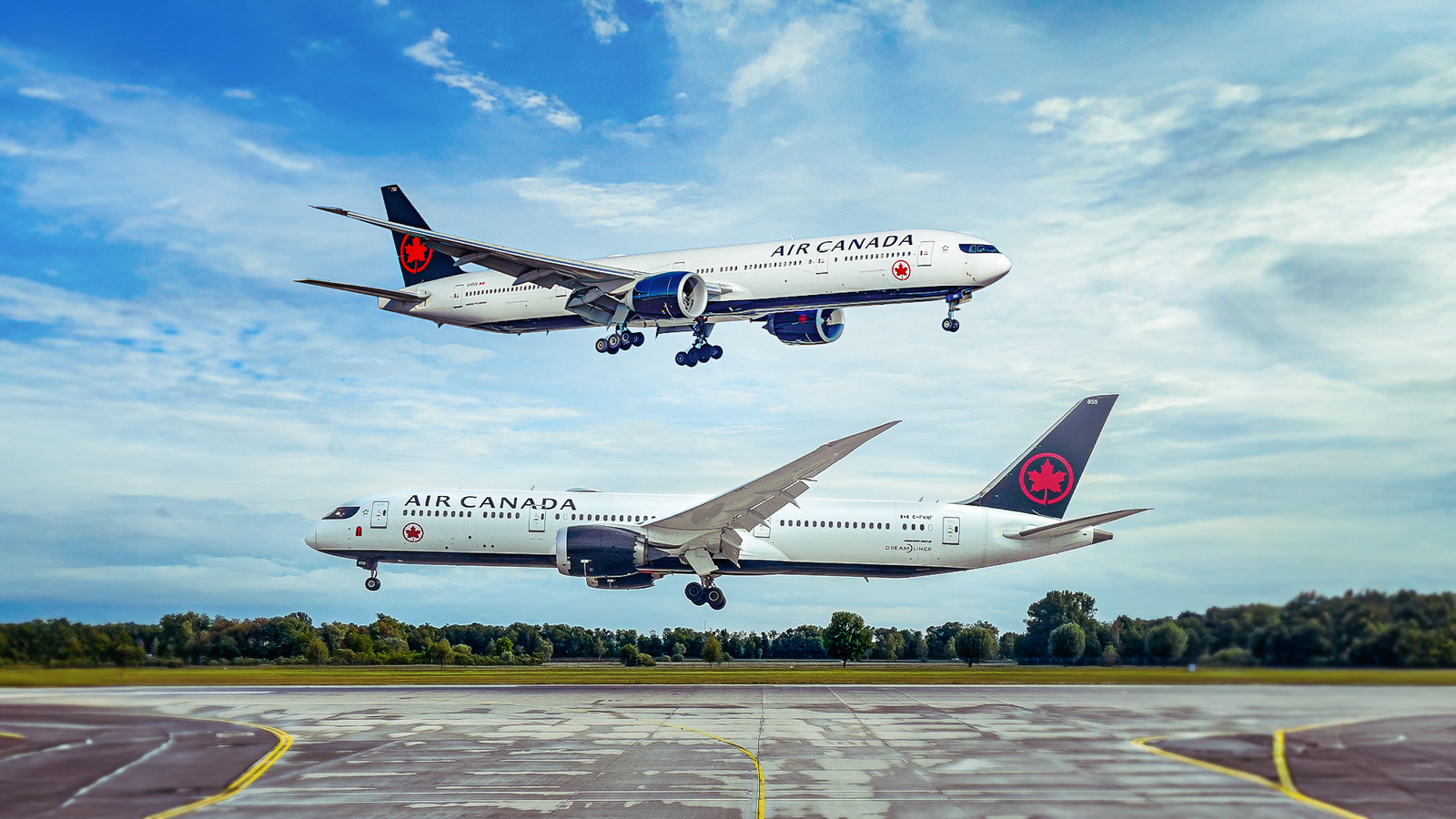
Published Oct 24, 2026, 11:00 AM EDT Airline and Airport Management Graduate, Student Commercial Pilot and Commercial Aviation Writer. Based in London & Nagoya Long-haul operations at Canada’s flag carrier are held tightly together by a fleet of 85 passenger widebody aircraft. Based on fleet data from ch-aviation, Air Canada's long-haul network consists of primarily Boeing twinjets, with 32 Boeing 787-9s, 20 Airbus A330-300s, 19 Boeing 777-300ERs, 8 Boeing 787-8s, and 6 Boeing 777-200LRs, supplemented by 6 dedicated Boeing 767-300ER freighters. With such a wide array of aircraft types, the airline's job is matching distinct widebody types to specific route profiles across transpacific, transatlantic, and South American corridors. As the airline prepares to introduce new aircraft types, how its existing Boeing twinjets support daily schedules explains how the carrier structures its global route network. Led By The Boeing 777 Air Canada’s heavy long-haul flying is led by its 25 777 airframes, split between 19 high-capacity 777-300ERs and 6 ultra-long-range 777-200LRs, as per Planespotters. Powered by General ElectricGE90 engines, these aircraft provide the payload capacity needed for high-demand international routes from major hubs in Toronto Pearson International Airport (YYZ), Montréal-Trudeau International Airport (YUL), and Vancouver International Airport (YVR). To optimize seating capacity on high-density leisure and visiting-friends-and-relatives (VFR) routes, Air Canada operates a sub-fleet of seven 777-300ERs configured with 440 seats. As detailed in Simple Flying fleet reports, this configuration was adjusted from a previous 450-seat layout by removing a row of economy seats to reduce overall weight and improve fuel efficiency. These 440-seat aircraft operate primarily on high-volume routes to destinations in Europe, Asia, and the Caribbean. Complementing the stretched -300ER, the six 777-200LR airframes carry 300 passengers in a three-class layout. Featuring a lower operating weight relative to their fuel capacity, the -200LRs handle long-haul point-to-point sectors, including nonstop routes to Australia and South America, where range and payload requirements preclude smaller twinjets. Keeping Efficiency At Its Peak The 777 handles heavy passenger loads, whereas Air Canada’s 40 787 aircraft serve as the backbone for international expansion. The fleet comprises 32 mid-sized 787-9s and 8 smaller 787-8s, offering lower trip costs and improved fuel efficiency compared to previous-generation widebodies. The 787 is designed to be an economical leader in the widebody market, making use of its composite airframe foundation to maximize fuel efficiency and yield on any type of route. The smaller 787-8, seating 255 passengers, allows network planners to open new secondary international routes, particularly into secondary European markets that can offer the airline exceptional revenue potential. Its lower seat count reduces commercial risk when testing unproven city pairs, allowing the airline to build route viability before upgrading to larger aircraft. The larger 787-9, configured with 298 seats, forms the core of the long-haul fleet. Operating high-frequency transpacific and transatlantic schedules, the 787-9 provides a balance of passenger capacity, cargo volume, and operating economics, replacing older widebody types across the main intercontinental routes. Shifting Over To Airbus With Boeing twinjets holding down the high-yielding international routes, Air Canada continues to deploy a secondary fleet of 20 A330-300 aircraft to absorb domestic demand and transatlantic volume. Powered by Rolls-Royce Trent 772B engines, these aircraft operate as a flexible option across the carrier's network, taking pressure off the lead Boeing widebody fleet. On the balance sheet, these owned, older airframes carry significantly lower capital overhead than newly delivered Dreamliners, allowing Air Canada to deploy them efficiently on medium-haul corridors where maximum fuel efficiency is less critical than asset cost control. In daily operations, the A330-300s handle high-capacity domestic transcontinental flights between YYZ and YVR, alongside seasonal transatlantic services to European destinations like Dublin Airport (DUB) and Manchester Airport (MAN). Refurbished with updated interiors matching the carrier's Signature Class standard, the A330s deliver a consistent onboard product while freeing up long-range 787-9s for wind-critical transpacific sectors to Tokyo Haneda Airport (HND) or Sydney Kingsford Smith Airport (SYD). Keeping older, higher-fuel-burn aircraft active alongside modern composite twinjets shows a clear operational divide. As fuel prices fluctuate and environmental mandates tighten across international airspace, there is only so long Air Canada can justify running a split widebody roster before maintenance complexity will end up leading to a total fleet consolidation. Adding The Final 787 Variant To The Fleet Credit: Air Canada Air Canada has committed to 14 787-10 Dreamliners, with initial deliveries expected to begin in late 2026, according to Air Canada press releases. The 787-10 is the largest member of the Dreamliner family, designed to carry significantly more passengers but retains commonality with the airline's existing 40 787-8s and 787-9s. Expanding the fuselage by 18 feet (5.5 meters) over the 787-9, Boeing created an airframe that optimizes seat-mile economics for dense, medium-to-long-haul routes. From an engineering and pilot scheduling perspective, integrating the 787-10 provides immediate operational depth. Flight crews share a single type rating across the entire 787 family, allowing dispatchers to swap aircraft variants based on real-time booking demand without incurring crew re-assignment penalties. On paper, the 787-10's lower operating empty weight per seat makes it an ideal replacement for both the aging A330-300s and standard-density 777-300ERs on high-volume transatlantic routes to London Heathrow Airport (LHR) and Paris Charles De Gaulle Airport (CDG). The 787-10 excels at seat-mile cost reductions; however, its increased weight and larger cabin limit its maximum operational range compared to the smaller 787-9. This range tradeoff means Air Canada needs to draw a firm boundary between high-density transatlantic flying and its longest transpacific routes, leaving the question of how to replace its heaviest flagship aircraft wide open for the decade ahead. Rejecting The 777X? Credit: guilhem gaubert I Shutterstock Solving the long-term flagship replacement puzzle led Air Canada to make a decisive break from its Boeing-dominated widebody purchasing history, contrary to what many analysts expected. In February 2026, the carrier finalized a landmark order for eight A350-1000 aircraft, with purchase rights for an additional eight airframes, marking Air Canada's first direct Airbus widebody order since the late 1990s. With deliveries slated to commence in the second half of 2030, this decision positions the A350-1000 as the ultimate successor to the 777-300ER fleet. Selecting the A350-1000 over Boeing’s rival Boeing 777X was a major decision, but one that ultimately came down to precise fuel burn metrics, aircraft weight profiles, and delivery timeline assurances, as explored in Simple Flying analysis. Powered by Rolls-Royce Trent XWB-97 engines, the carbon-composite A350-1000 offers a significant reduction in fuel consumption per seat while also providing the range-payload performance needed for ultra-long-haul sectors out of YVR and YYZ. Replacing GE90-powered 777-300ERs with Trent-powered A350s will fundamentally restructure Air Canada's heavy maintenance workflows, shifting the main widebody overhaul operations toward Airbus aircraft as the carrier enters the 2030s. By committing to a multi-decade split between 787s and A350s for its long-haul operations, Air Canada accepts the added cost of dual maintenance lines in exchange for optimal aircraft sizing. The reason is clear: Air Canada has operated a mixed fleet for many years and so understands what the risks are with such a strategy, as well as what the inherent benefits are. Now, with a far more efficient blend of aircraft, the airline can improve upon its operational performance, building upon its long-standing fleet strategy. Future-Focused Progression Air Canada's long-haul trajectory reflects a carefully calculated shift from a purely Boeing-centric strategy toward a tailored, multi-manufacturer widebody ecosystem. Now pairing high-density 777-300ERs with versatile 787 Dreamliners in the near term, the airline maximizes revenue generation across both heavy trunk markets and niche point-to-point destinations. The future is where the fleet strategy gets a lot more interesting, with a clear focus being placed on modernity and operational efficiency. As the first 787-10s arrive in late 2026 to begin replacing legacy A330 capacity, and as the A350-1000 prepares to take over flagship status in 2030, Air Canada is locking in the operational tools needed to secure its position as a global aviation powerhouse for decades to come, potentially outperforming its rivals in the US.
Air Canada's Widebody Fleet: How The Boeing 777 & 787 Dreamliner Power Its Global Network
Full Article
Original Source
Read the full article at Simpleflying →KhanList aggregates and links to publicly available news content. We do not host full articles from third-party sources. Always verify important information with original sources.