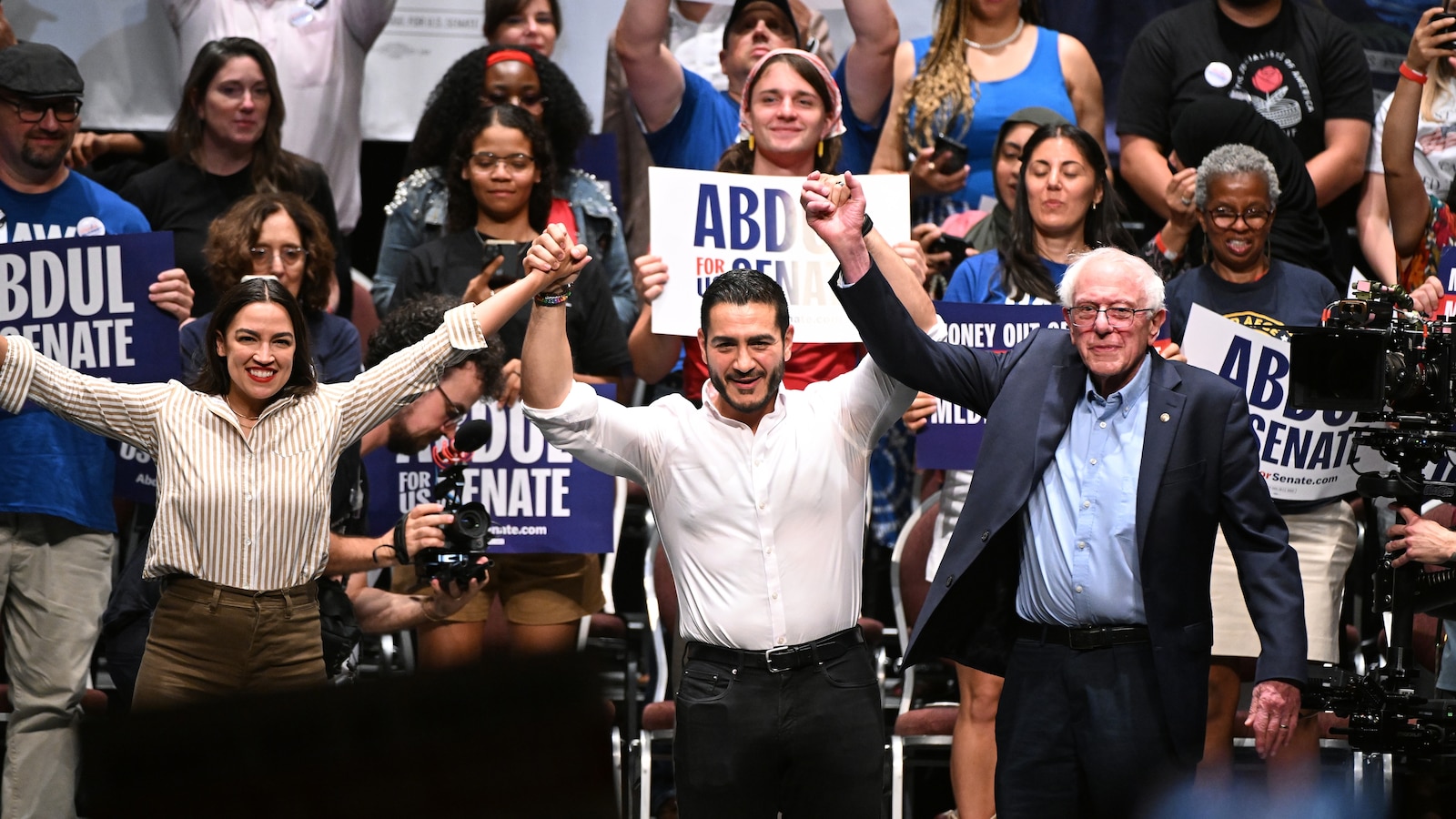
SOUTH HAVEN, Mich. -- Senate candidate Haley Stevens talks often about manufacturing, taking on President Donald Trump and why she’s the Democrat best positioned to win Michigan. The congresswoman has far less to say about the pro-Israel group that has spent millions trying to get her elected.The American Israel Public Affairs Committee, or AIPAC, and its affiliated groups have spent close to $30 million backing Stevens — their largest investment ever in a single race — as they seek to defeat progressive favorite Abdul El-Sayed in the Aug. 4 primary. Stevens has largely avoided discussing the organization directly, even as its spending has reshaped the race. Asked twice about AIPAC during a July campaign stop in West Michigan, she responded for more than 800 words without mentioning the group a single time. Israel came up only once, when she said she “wanted to see the U.S. and Israel working together to rebuild Gaza.”“Anyone who supported me is supporting me because of my dedication to the people of Michigan, and the things that I have done for Michiganders,” Stevens told The Associated Press when asked whether she welcomed AIPAC’s support.The exchange illustrates how politically fraught AIPAC has become in Democratic politics as the war in Gaza has divided the party over U.S. support for Israel. AIPAC works to elect lawmakers who support its mission of strengthening the U.S.-Israel relationship and advancing policies it says enhance the security of both countries.AIPAC did not respond to a request for comment. The organization’s super PAC, United Democracy Project, declined to comment. The issue carries particular weight in Michigan, home to the nation’s largest Arab American population. Beyond Michigan, El-Sayed’s progressive allies are framing the race as a broader test of whether grassroots organizing can overcome unprecedented outside spending.“One of the laws of nature in politics is whoever spends the most money wins,” said New York Rep. Alexandria Ocasio-Cortez, who has been campaigning for El-Sayed in Michigan this weekend. “It is an opportunity to show that things other than money can win in America.” The four-term congresswoman raised half of what El-Sayed did in the latest fundraising period until June 30. Her team said in a statement that the campaign “is raising the resources we need to win this race.”She spent only $12,000 of her own campaign funds on advertising through early July, before bumping it up to close to $1 million, according to AdImpact. Outside organizations, meanwhile, have poured close to $50 million into boosting her candidacy. One of them, A Stronger Michigan, has spent roughly $12 million without disclosing its donors.El-Sayed has made AIPAC and the tens of millions of dollars spent to support Stevens a centerpiece of his campaign. He and his allies have accused Stevens as being a mouthpiece for her large donors. “She is nothing more than an employee of these billionaires,” said Sen. Bernie Sanders, who is also campaigning with El-Sayed this weekend at rallies in Detroit, Lansing and Grand Rapids. Stevens has said she supports “comprehensive campaign finance reform.”Most voters are unlikely to realize many of the ads blanketing Michigan’s airwaves are funded by AIPAC. They never mention Israel, instead highlighting Stevens’ work on manufacturing and featuring former President Barack Obama. “AIPAC never runs on AIPAC. They never even talk about Israel and Palestine,” said former Rep. Andy Levin, whom Stevens defeated in a 2022 Democratic primary after redistricting. AIPAC spent millions opposing Levin, who is Jewish. “If you’re just a voter and you see a million ads, you don’t know who paid for it.”The surge of spending from AIPAC comes as the Democratic candidates have taken sharply different positions on Israel’s war in Gaza.Popular ReadsWhile Stevens is not Jewish, she has long been one of Congress’ most outspoken supporters of Israel. She has described herself as a “proud pro-Israel Democrat” and once said during a Hanukkah celebration that “Israel comes to me in my dreams.”Stevens has criticized Israeli Prime Minister Benjamin Netanyahu. During a recent debate, she said he “has not made us safer, has not brought us closer to peace, and he’s endangered Jews here in America and around the world.”El-Sayed has embraced the contrast. The son of Egyptian immigrants, he has called Israel’s military campaign in Gaza a “genocide,” described the Israeli government as “evil,” and repeatedly argued that AIPAC’s influence distorts Democratic politics.“The reason that we’ve seen this war fought is because of the impact of AIPAC in our politics,” El-Sayed said during a recent debate.The war in Gaza began after Hamas' Oct. 7, 2023 attacks in Israel that killed about 1,200 people and took 251 hostage. It has since waged on for over 1,000 days. Israel has killed more than 73,000 Palestinians in its retaliatory offensive, Gaza’s Health Ministry said. If elected, El-Sayed would become the first Muslim U.S. senator. He recently addressed questions about whether his faith would hurt his electability in the battleground state.“When they raise questions about my ‘electability,’ they are usually pointing to the most obvious thing about me that makes me ‘different’ — that’s my name and my Muslim faith,” he wrote in an email to supporters. “Faith, to me, isn’t just about an identity. It’s about the choices that I make every single day about how I live my life.”El-Sayed has spent about $3.2 million from his own campaign account on advertising, with around $1 million in outside spending. His campaign has instead emphasized grassroots organizing, saying it has recruited more than 10,000 volunteers statewide.Asked how many volunteers Stevens has, her campaign said it has “hundreds across Michigan.”“This election will come down to the many versus the money,” El-Sayed wrote.Once-firm support for Israel has eroded within parts of the Democratic Party in the fallout from the war in Gaza. As divisions over Israel have deepened, criticism of AIPAC has intensified.Earlier this week, 103 House Democrats voted unsuccessfully to block $3.3 billion in U.S. aid to Israel, the clearest sign yet of the party’s divide. Among them was New York Rep. Pat Ryan, who had previously voted to send aid to Israel and accepted support from AIPAC.“I expect groups like AIPAC will not support me in my future elections and frankly, I don’t want their support,” Ryan said on social media, later adding that he was returning the money.The tension also played out in 2024. In Michigan's Senate race, Democratic activists pressured now-Sen. Elissa Slotkin to take a harder line on Israel’s war in Gaza. Slotkin, who is Jewish, had already distanced herself from AIPAC years earlier. She ultimately defeated Republican Mike Rogers by fewer than 20,000 votes. Rogers is running for Senate again this year, and is unopposed in the GOP primary. While the issue still remains divisive for Democrats, some question whether it will ultimately shape how most primary voters cast their ballots, with concerns such as the economy carrying greater weight.“It’s not that Democratic primary voters love AIPAC. They obviously don’t,” said Michigan political strategist Adrian Hemond. “But this doesn’t even register as an issue that’s influencing voting behavior for the overwhelming majority of primary voters.”
AIPAC has spent a record amount on Michigan's Senate primary, the biggest test of its influence yet
Full Article
📰 Original Source
Read full article at Abcnews →KhanList aggregates and links to publicly available news content. We do not host full articles from third-party sources. Always verify important information with original sources.