
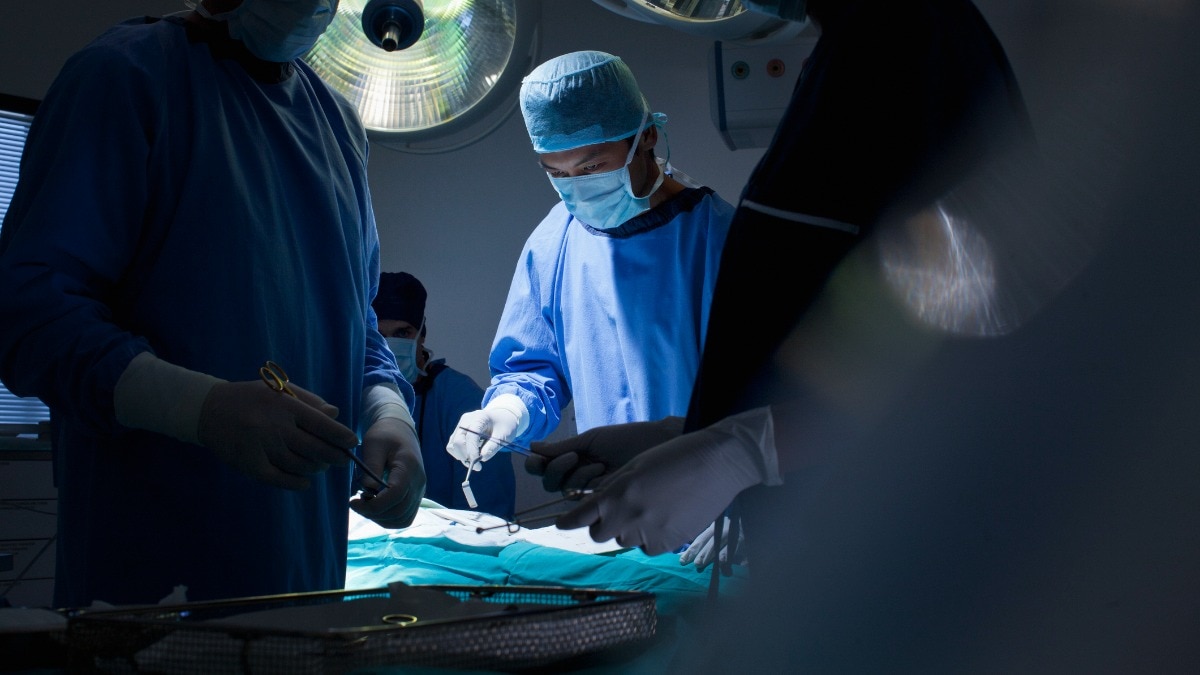
A 32-year-old man weighing 209 kg, who had to breathe through a tube in his throat after severe sleep apnea, has been discharged after AIIMS doctors carried out a meticulously planned bariatric surgery following 32 days of intensive preparation.He weighed 209 kg and breathed through a tube. How AIIMS doctors changed his life (Representational pic: Getty Images)Doctors at the All India Institute of Medical Sciences (AIIMS), Delhi, have given a new lease of life to a 32-year-old man who weighed 209 kg and was breathing with the help of a machine. The patient, Vivek, suffered from severe obesity and obstructive sleep apnea, a condition that caused repeated interruptions in breathing during sleep.Doctors first performed a tracheostomy, surgically inserting a breathing tube through a hole in his throat, before carrying out bariatric surgery to reduce his weight. The surgery was preceded by 32 days of extensive preparation. In just 14 days after the procedure, Vivek's weight dropped by approximately 49 kg, from 209 kg to 160 kg. His breathing problems have also been resolved, and he has now been discharged from AIIMS.Professor Dr Manjunath Maruti Pol, specialist in metabolic, bariatric and kidney transplant surgery at the Department of Surgery, AIIMS Delhi, shared details of the case with AajTak.in.AT 32, HIS WEIGHT HAD REACHED 209 KGDr Manjunath said the patient had a Body Mass Index (BMI) of 74 kg/m and suffered from several obesity-related health conditions, including high blood pressure, pre-diabetes, cholesterol problems, acid reflux, depression and knee pain. The most serious of these was obstructive sleep apnea (OSA), which caused his breathing to stop repeatedly during sleep, leading to dangerously low oxygen levels. He was admitted to AIIMS Delhi for treatment due to his critical condition.During his hospital stay, his weight increased further and his breathing rapidly deteriorated. The CPAP machine he depended on was no longer sufficient. Doctors first performed intubation and later an emergency tracheostomy. His abdomen was so large that it was impossible to safely lay him on a standard operating table. As a result, the tracheostomy had to be performed on his hospital bed. He remained on CPAP support through the tracheostomy for 32 consecutive days. During this period, he also developed a ventilator-associated infection that required antibiotic treatment.Dr Manjunath explained that excessive weight affects almost every part of the body. It puts pressure on the bones and joints, increases strain on the heart, impairs lung function, causes difficulty in walking and significantly raises the risk of respiratory arrest during sleep.HE HAD TO SLEEP EVERY NIGHT WITH THE HELP OF A MACHINEVivek suffered from severe obstructive sleep apnea, a condition in which the throat repeatedly closes during sleep, stopping breathing for a few seconds at a time. If left untreated, oxygen levels in the body fall and the heart can also be affected.To manage the condition, he had to use a CPAP machine every night. The machine keeps the airways open by delivering pressurised air. However, when his condition worsened, doctors had to perform a tracheostomy so that air could reach his lungs directly.32 DAYS OF PREPARATION BEFORE SURGERYBefore proceeding with surgery, doctors spent 32 days preparing the patient. A multidisciplinary team comprising surgeons, anaesthesiologists, physicians, dietitians, physiotherapists and other specialists was formed.The patient was placed on a very low-calorie diet (VLCD) for 32 days. Alongside this, doctors focused on breathing exercises, infection treatment, blood pressure control and constant monitoring.The preparation paid off. Doctors then decided to perform One Anastomosis Gastric Bypass (OAGB), a type of bariatric surgery.The surgery was performed on July 24. By the time Vivek was discharged on August 6, he had lost 49 kg, bringing his weight down from 209 kg to 160 kg in just 14 days.According to Dr Manjunath, the patient's abdominal circumference reduced from 198 cm at the time of surgery to 178 cm, and further dropped to 155 cm within 14 days of the operation. He has now been discharged and will continue to be monitored regularly.WHAT IS BARIATRIC SURGERY?Dr Manjunath said Vivek underwent One Anastomosis Gastric Bypass (OAGB), commonly known as bariatric surgery, which is performed to help patients lose weight.However, the aim of the surgery is not limited to weight loss. It also helps reduce the risk of serious diseases associated with obesity. Many patients see improvements in conditions such as diabetes, high blood pressure, fatty liver disease and sleep apnea after losing weight.A MULTIDISCIPLINARY TEAM EFFORTAccording to AIIMS, the patient's recovery was not possible through surgery alone. Doctors from multiple departments worked together throughout his treatment.The surgical team carried out the operation, while anaesthesiologists continuously monitored his breathing and heart function during the procedure. Among the medical specialists, Dr. Naval Vikram managed the patient's comorbidities and infection risk, while a dietitian supervised his nutrition before and after the surgery.This version mainly improves sequencing, paragraphing, transitions and readability while retaining all the facts, quotes and information from the original.(With inputs from Abhishek Panchal)- EndsPublished By: Princy ShuklaPublished On: Aug 7, 2026 10:40 IST
AIIMS doctors save 209-kg patient with a rare surgery, man loses 49 kg in 14 days
Full Article
Original Source
Read the full article at Indiatoday →KhanList aggregates and links to publicly available news content. We do not host full articles from third-party sources. Always verify important information with original sources.