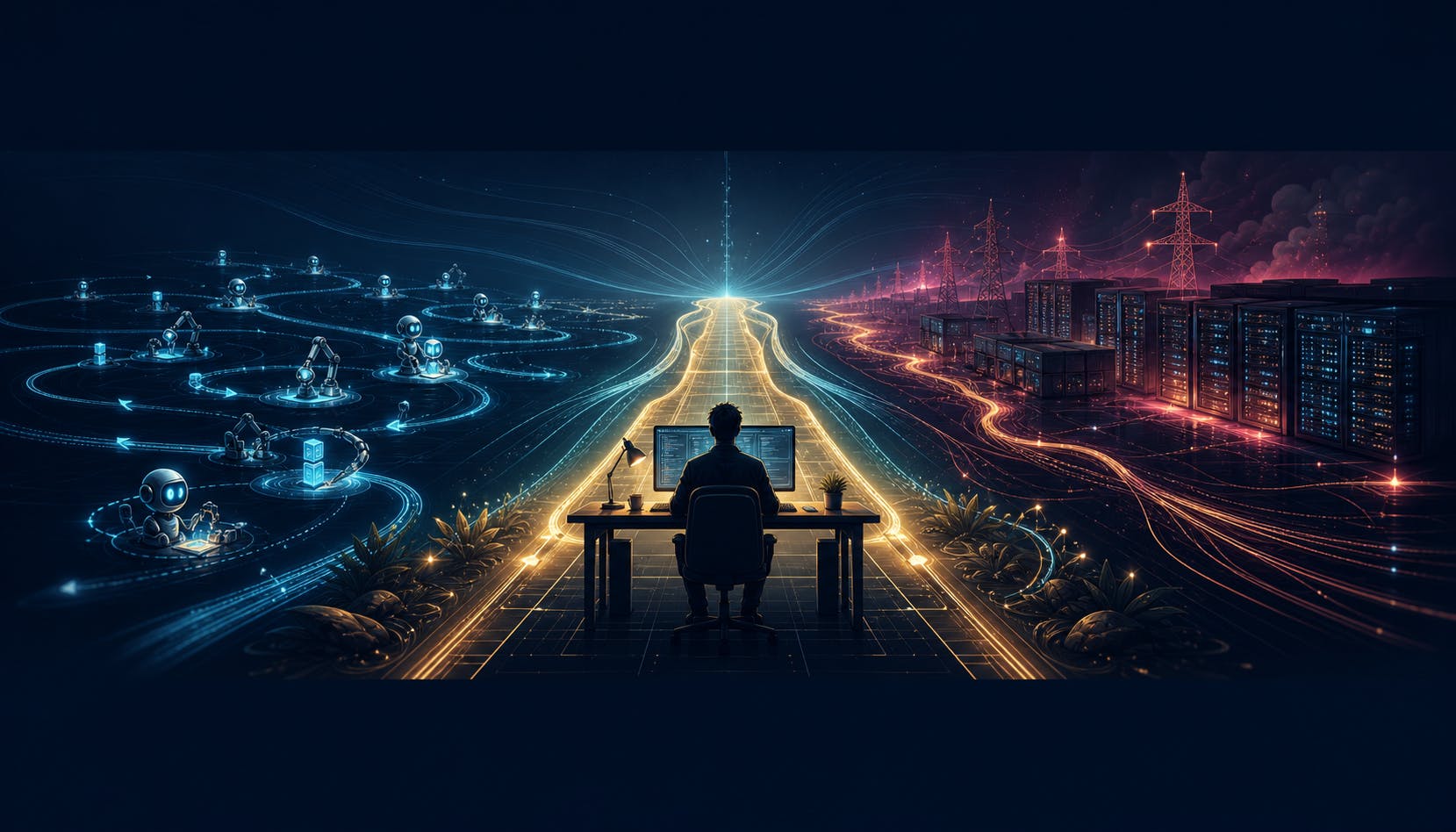
The strangest thing about modern AI tooling is not that it has limits. It should have limits. A system that can be automated all day, call tools, inspect code, browse, write, reason, and launch work across surfaces cannot pretend compute is free. The strange part is where the pressure lands.A solo developer can often optimize automation better than care. Lighter models can be routed. Jobs can be scheduled. Agents can be launched and left running. But the moment the human slows down to plan, ask better questions, review the output, switch from article to code to browser to workspace, and keep responsibility inside the loop, the work can start to feel more expensive, not less.That is backwards.If AI products want responsible builders, the interface should reward responsible building. It should be cheaper in attention and clearer in usage to plan before executing, to review before publishing, to choose a careful work mode, and to keep the human in the loop. The safest path should not feel like the most punishing path.The real distinction should be obvious: unattended automation is not the same thing as human-led creation. If somebody automates a system twenty-four hours a day, launches agents in parallel, burns compute continuously, and removes human review from the decision path, then yes, strong limits make sense. That kind of usage can become economically and technically unreasonable very fast. But that is not the same as a person brainstorming, testing, deciding, correcting, structuring, and using AI as a thinking partner under human judgment. Human-in-the-loop work should not feel like suspicious behavior. It should be the behavior the product encourages.One thing has to be said honestly: light automation is already very easy to love. With a lighter model, a modest reasoning setting, and narrow tasks, it can feel almost too easy to keep a workflow moving all day. I understand why that is exciting. I test these systems constantly, and part of me loves the engineering beauty of it. A small loop can draft, classify, summarize, rename, inspect, or prepare routine material while the human does something else. That is genuinely cool. It is also exactly why limits exist.But that is not the level where my real work happens. At the level of mathematical thinking, full-stack development, public visibility, book production, article production, source verification, and final responsibility, the hard part is not keeping a light loop alive. The hard part is deciding what deserves to exist. The hard part is building the architecture, testing the claim, choosing the right words, finding the weak assumption, preserving context, and knowing when the tool should stop. A cheap automated loop can run for hours and still produce nothing that matters. A careful human-led session can look heavier on the meter and yet produce the one decision that saves the whole project.There is a strange paradox here. With lighter models, scheduled workflows, coding agents, and careful task routing, it is technically possible to push a lot of automation through a month. That is exactly why limits are necessary. But when a human slows down, plans carefully, thinks through the architecture, refuses to let everything run unattended, and keeps responsibility in the loop, the experience can feel more mentally expensive and sometimes more usage-expensive. That feels backwards. The product should encourage care. It should reward the developer who stays present instead of pushing every decision into an automated pipeline.The reality is even more frustrating during real creative work. Human care is not just a noble principle; it is an active cost. It means asking better questions, answering clarifications, moving between ChatGPT, Codex, a coding workspace, a browser tab, a document, and sometimes another model just to keep the project coherent. On paper, that sounds like control. In the middle of creation, it can feel like friction. I do not always want to stop and route myself between tools while the idea is alive. I want the system to understand that this back-and-forth is part of responsible building, not wasted motion.The same logic applies to heavier work modes. If the mode designed for serious work feels too expensive to activate, a solo developer will avoid it, even when that mode would produce better structure, safer execution, and cleaner review. In my current experience, using a serious work surface can feel like it consumes the highest-capacity buckets too quickly, including the strongest reasoning and coding capacity. Whether that is exactly how the system is designed internally is not my claim. The product feeling is the problem: a builder can look at the work mode and think, if I use this properly, I may lose the rest of my productive week. If one eight-hour work session can feel like it consumes a whole week of serious capacity, the user cannot plan. The serious mode should not feel like a penalty. It should feel like the safest place to do serious work.In my view, work mode should save usage, not waste it. It should reduce repetitive context rebuilding. It should reduce model switching. It should help the system stay coherent across planning, coding, editing, and verification. If a user has to keep re-explaining the same project across surfaces, the product is leaking attention and compute at the same time. A well-designed work mode should compress that waste.This is the point I want to make as clearly as possible: a serious AI plan should separate automation pressure from creative pressure. Do not treat every long session as the same kind of load. Do not treat a builder who is writing, reviewing, choosing, and correcting like a silent bot farm. A user who keeps making the decisions, who structures the work, who validates the outputs, who refuses to let the tool decide alone, is not abusing the system. That user is practicing the responsible workflow everyone says they want.When Limits Become Infrastructure Developer AI usage is mainstream, but trust and debugging friction show why human review still matters. Source: Stack Overflow Developer Survey 2025. When a tool becomes infrastructure, the user needs predictability. If I see one place telling me I still have healthy usage and another place making me feel close to the wall, I cannot plan my week. If I have several days left in a billing cycle, I need to know whether I can continue building or whether I should slow down and preserve capacity. That uncertainty creates pressure before the work even begins, and for a solo builder that pressure is not theoretical. It changes what I dare to start.A company can distribute the cost. A funded team can treat AI as infrastructure and move on. A solo developer has to ask a more brutal question: can this subscription help me create enough value to justify itself before the next bill arrives? That is not entitlement. That is the economic reality of independent work. If the stronger model is the one that follows the repo, respects project instructions, keeps the reasoning coherent, writes carefully, and helps me finish, then losing access to that reliability can mean losing the ability to keep momentum. The tool has become part of the craft.This is where the plan ladder matters. A lower plan should help a new builder create the portfolio that justifies the next plan. A mid-level plan should help a serious solo developer build enough value to justify a professional plan. A higher plan should make sense when the work becomes a business, a team, or a client operation. The ladder should feel like a path upward, not like a wall that appears before the portfolio exists. If the product is truly a builder platform, it should help the builder climb.Reasoning Should Be a Control, Not a Guess As a user, I do not only want to choose a model. I want to choose the intensity of reasoning for the task in front of me. Sometimes I need a light pass. Sometimes I need careful planning. Sometimes I need deep reasoning over a complicated article, a messy repo, or an architecture decision where a bad shortcut will cost more later. That control should be explicit. If deeper reasoning consumes more visible usage, tell me. If it is handled differently, explain it. If automatic model switching is supposed to help, it needs to be reliable enough that a developer can trust it during serious work.Constantly switching models to manage quality, cost, quota, and instruction-following becomes its own cognitive tax. The tool is supposed to help me focus. I do not want to spend half the session guessing which model will respect the instructions, which one will hallucinate less, which one can handle the task, and which one will burn through my remaining capacity. Good developer tools reduce hidden state. AI products should do the same. The reasoning dial should be understandable in human terms: light, balanced, deep, and why.There is also a difference between chatting, brainstorming, and running agentic work. A human-led conversation should not be treated like a silent compute pipeline. Brainstorming is where the user is still deciding what the task even is. It is where structure appears. It is where the human says no, not that, smaller, verify this, stop there, rewrite that, now we know the real problem. If that phase becomes too expensive, too opaque, or too stressful, the product weakens the exact human judgment layer that should be protecting the work.This is why forcing constant tool switching can become more annoying than helpful. Codex may be the right surface for code. ChatGPT may be the right surface for thought. A project workspace may be the right surface for files. But the user should not be punished for needing all three during one serious act of creation. The boundary between planning, writing, testing, and coding is not clean in real work. A good AI system should help preserve that continuity.I understand the argument that I should brainstorm in ChatGPT and use Codex only when the work becomes implementation. On paper, that separation is clean. In reality, inspiration often appears while I am already working: reading an article, writing a paragraph, checking a file, reviewing a source, or trying to connect a technical idea to a public explanation. That moment is fragile. If I have to stop, decide which interface should receive the thought, switch tools, rebuild context, and explain the same project again, the idea can start to blur before I have captured it. For my level of work, I often need strong reasoning, not instant execution. I need the system to hold the thread long enough for the idea to become usable.The Creative Runway Problem When I am in a real brainstorming session, I do not want to calculate tokens. I do not want to pause the idea because I am mentally budgeting every paragraph, every file, every continuation, every attempt to clarify my own thought. I want to create. I want to follow the thread while it is alive. That is not laziness. That is how creation works. A builder often discovers the real structure of an idea only after pushing through the messy first layer.If the tool makes me count tokens in the middle of that moment, the system is no longer only managing infrastructure. It is interrupting thought. That does not mean usage should be invisible. It means the product should protect the creative runway. Give me calm signals. Tell me when a session is becoming heavy. Tell me when I should summarize. Tell me when I should split the work. Tell me when a lighter reasoning mode is enough. But do not force the builder to become an accountant in the middle of invention.For a solo developer, flow is not a luxury. It is the moment where the project finally moves. It is also the moment where the platform can either feel like a partner in the work or like a meter running in the background. I am not asking the system to ignore cost. I am asking it to distinguish between destructive, unattended automation and disciplined, human-led creation.The HITL Builder Should Be Encouraged There is a better product principle here: reward responsible control. If I keep the human in the loop, I should feel supported. If I make the decisions, review the claims, structure the prompts, reject weak outputs, and use the tool to build instead of letting it run wild, the system should recognize that pattern as healthy. It should not make me feel like the only safe workflow is to stop thinking deeply.Coding without parallel agents should also be encouraged. Not every coding session is an agent swarm. Sometimes a developer wants focused assistance: read this file, explain this function, refactor this small module, help me write a test, now stop. That kind of work should be predictable and sustainable. It is not the same as launching multiple autonomous jobs across repositories. The product should separate these modes clearly because they represent different risks, different costs, and different levels of human control.This matters because we are training the culture of AI development right now. If the best workflow feels punished, people will drift toward worse workflows. If careful human review feels too costly, people will rush. If model switching becomes the survival strategy, people will stop thinking about the work and start gaming the interface. That is not good for users, platforms, or the quality of what gets built.This is why the current incentive shape matters so much. If the careful path costs too much, the reckless path becomes attractive. If the structured work mode consumes the week, users will stay in fragmented modes. If human review feels more expensive than blind automation, we should not be surprised when people automate more and review less. That is exactly the opposite of what the AI ecosystem should want.What Better Clarity Could Look Like I would love to see a unified usage dashboard that explains ChatGPT and Codex usage in plain language. Not just a percentage, but what the percentage means, when it resets, what bucket it belongs to, and what kind of work is likely to consume it. I would love a plan that recognizes one serious builder who is trying to turn the tool into real output: not a casual user, not a team account, not a silent automation pipeline, but a human-led production workflow.I would love the plans to feel like a ladder. The entry paid tier should help someone build a starting portfolio. The next tier should help that portfolio become revenue. The professional tier should become obvious when clients, teammates, or larger production work arrive. That would make pricing feel like progression instead of pressure. It would also make the product feel like it believes in the builder.I would love graceful degradation instead of surprise failure. If I am approaching a limit, tell me what kind of work I can still do reliably. Let me choose slower execution, smaller context, lighter reasoning, or shorter tasks before quality drops under my feet. I would love project-aware usage planning. Before I start a heavy coding or research session, tell me: this may be expensive, this is fine, this should be broken into smaller tasks. I would also love cross-surface continuity: a way for planning, coding, writing, and browser-assisted work to feel like one responsible workflow instead of four competing meters. That would help me become a better user, not just a heavier user.AI limits are also infrastructure design: the IEA projects global data center electricity demand rising from 485 TWh in 2025 to 950 TWh in 2030, while AI-focused demand triples. The best work mode would not simply spend more. It would spend better. It would remember the project boundary, preserve the working plan, keep the model choice coherent, and prevent the user from paying again and again for the same orientation. That is the kind of infrastructure solo developers need.The most useful signal I see today is planning. A good planning mode can save work instead of spending it. It lets the user think, structure, refuse bad paths, and define the task before execution. That is not a small feature. It is a clue. Planning is where human judgment becomes reusable infrastructure.I would love to see that principle expanded into something like Builder Runway Mode: a reusable, human-led planning state that carries intent, constraints, decisions, files, and next actions across ChatGPT, Codex, browser work, and code editing. The point would not be to hide usage. The point would be to stop paying again and again for the same orientation, and to reward the user who keeps responsibility in the loop.This idea is not the same as simply compressing context. Context compression is a technical ingredient. Builder Runway Mode would be a product experience: a human-approved runway between thought and execution. It would let the builder preserve direction before launching heavier work, and it would make the careful path cheaper than the reckless path.Most of all, I would love creative-runway indicators. Not a scary meter. Not a vague percentage. A useful assistant-level signal: you are safe to keep exploring; you should summarize soon; this session is becoming expensive; this task should move to a smaller context; this part can use a lighter mode. The best version of this would not punish intensity. It would guide it.The Real Product Opportunity The real opportunity is not unlimited usage. The real opportunity is trust. A serious AI product should help the user understand the cost of work without breaking the work. It should separate chatting, brainstorming, coding help, deep reasoning, work mode, and unattended automation into clear modes. It should make the responsible path easier than the reckless path.For many solo developers, AI is becoming the tool that can help us earn the money to keep using the tool. That loop needs to be designed with care. If AI is becoming infrastructure, then usage design is not a billing detail anymore. It is part of the developer experience. It is part of whether an independent builder can keep building long enough to become sustainable.I am grateful for what these systems already make possible. I am not asking for magic. I am asking for clarity, predictability, and a plan shape that respects the reality of independent builders. I want to be encouraged for staying human-in-the-loop. I want to be encouraged for making the decisions. I want to be encouraged for structuring the work instead of automating blindly. That is the future I believe serious AI tools should make easier.The open question is simple:Should AI plans optimize first for raw quota, model quality, predictable resets, or a Builder Runway that protects human-led work from being confused with unattended automation?
AI Usage Limits Should Protect Human Flow, Not Punish It
Full Article
Original Source
Read the full article at Hackernoon →KhanList aggregates and links to publicly available news content. We do not host full articles from third-party sources. Always verify important information with original sources.