
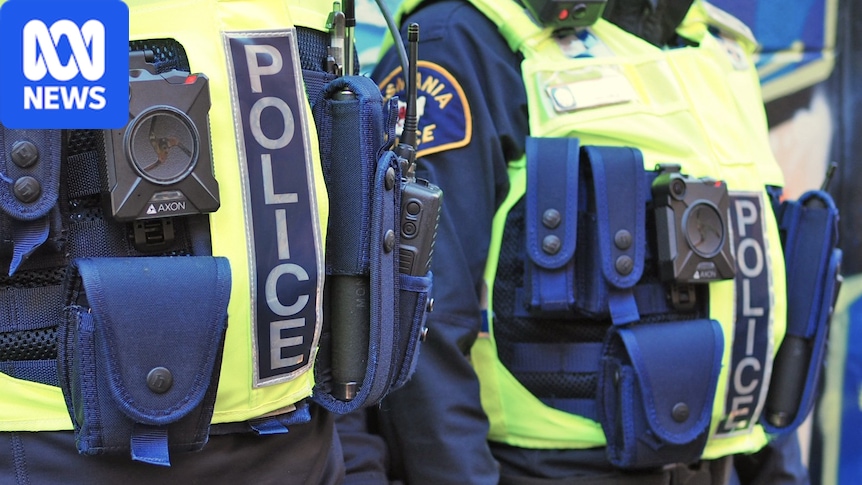
An AI tool that helps write reports on family violence incidents reduced police workloads but also introduced errors during a trial of the technology in Tasmania.Draft One, by US firm Axon, is an AI assistant that analyses audio from body-worn cameras and then generates narratives for officers to review, edit and approve.Documents released under Right to Information show Tasmania Police tested and evaluated the AI product last year to reduce administrative burden on officers.The company's website states Draft One does not add any "speculation or embellishments" and that AI-assisted reports "stick to the facts". (ABC News: Dane Meale)The first phase of the trial involved Draft One analysing almost 150 randomly selected body-worn camera recordings from historical family violence incidents.The second phase tested the AI tool in Launceston over several months in 2025, comparing human-written reports with ones assisted by the AI tool.The evaluation showed Draft One reports were written and validated in just 42 minutes, almost twice as fast as the traditional method.Over a year, this would save about 160 weeks of work time and $434,187 in wages, the evaluation found.It suggested millions of dollars could be saved if Draft One was also used for other purposes, including drafting offence reports, child safety reports and crash reports.It also noted the AI tool had been able to pick up some potential coercive behaviours that had been missed by officers."While Draft One is not a replacement for human judgement, its integration into workflows — supported by mandatory human verification and supervisor oversight — enhances accuracy, consistency, and quality assurance," the evaluation stated.A sample image showing an AI-assisted US police report of a traffic stop. (Supplied: Axon Draft One)Errors introduced during AI analysisThe evaluation also found Draft One occasionally confused names and roles, and, in a small percentage of cases, missed a threat, assault or risk factor.In one instance during the first phase of the trial, Draft One wrote that a woman had alleged a person who had a hidden firearm had "previously made threats against her life".When an officer reviewed the historical body-worn camera, they said the woman had actually said words similar to: "… no threats or anything like that".The officer suggested Draft One had misinterpreted what was stated because someone else was speaking at the same time.According to the evaluation, Draft One performed "exceptionally well" when summarising "straightforward" interactions between a single officer and an individual.However, it said its effectiveness decreased in complex scenarios, including when both partners, children, or other witnesses were present."In these cases, Draft One occasionally misidentifies roles, omits key details, or generates narratives that are overly verbose and lack clarity," the evaluation stated.An Axon simulation of Draft One AI-assisted US police report writing in a traffic stop scenario. (Supplied: Axon Draft One)Tom Sulston, from human rights group Digital Rights Watch, said it was "really worrying" that Draft One had not performed well in complex family violence situations."It's least functional when it would be most useful," Mr Sulston said.He also pointed to several instances overseas where the AI tool had allegedly made errors.In one instance, Forbes reported that Draft One had suggested "an officer had shape-shifted into a frog after misinterpreting background audio from [a] Disney film".Mr Sulston also questioned whether police officers would be able to rely on, or refresh their memory from, AI-assisted reports in Australian courts.Review to consider future rolloutAlina Thomas from Tasmanian family violence support service Engender Equality said AI assistance could be beneficial for police."I think whatever tools they can have with them to be able to assist, that is really helpful," she said.But Ms Thomas added that Draft One should not be a substitute for human experience."As long as we're always leading with a human and with a human face and a human's ability to communicate, that's really, really critical."Alina Thomas says it is critical "we're always leading with a human and with a human face and a human's ability to communicate". (ABC News: Jake Grant)Ms Thomas also suggested protocols should be developed to allow victim-survivors to have a say about whether AI tools are used to analyse incidents involving them.The evaluation recommended a phased rollout of Draft One once clear policies governing the ethical use of AI by Tasmania Police were established.It said there would be no need for legislative changes to use the AI tool.However, it added that funding would need to be secured to licence the tool from Axon, and for additional staff to run the program.A police spokesperson said the future use of Draft One was still under review."Prior to any potential rollout, funding models, further consultation with stakeholders, and additional trials would be undertaken," they said.Axon has been contacted for comment.The company's website states Draft One does not add any "speculation or embellishments" and that the AI-assisted reports "stick to the facts".It also says officers must review and add any missing information before approving the reports.
AI tool saves time but makes errors in police trial
Full Article
Original Source
Read the full article at Abc →KhanList aggregates and links to publicly available news content. We do not host full articles from third-party sources. Always verify important information with original sources.