
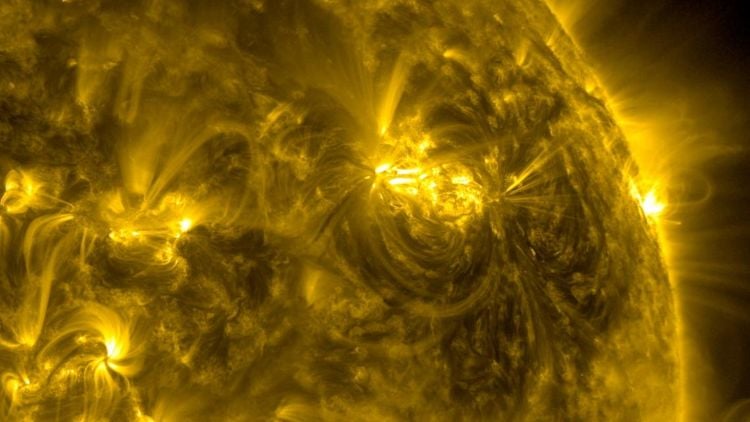
When we think of weather forecasts, we instinctively think of weather on Earth like rain or shine. However, we rarely consider weather forecasts from outside of the Earth, also called space weather. While space weather often results in the awe-inspiring aurora located at the northern and southern latitudes, we often forget the negative impacts of space weather on our everyday lives. This includes potential disruption of communication satellites or ground stations. The primary conundrum that has eluded researchers is being able to forecast incoming space weather so we can better prepare for its impact. Now, researchers might be one step closer to successfully forecasting space weather as a team of scientists discussed a new AI model named EarlyDetect in findings recently published in the Journal of Geophysical Research: Machine Learning and Computation that could potentially change how space weather is forecasted. As its name suggests, EarlyDetect primary objective will be to observe the Sun’s surface and magnetic field with the goal of detecting precursor signals on active regions, the latter of which is where space weather activity has been found to originate. "The main difficulty is that an active region begins developing beneath the Sun's visible surface, where we cannot directly observe the magnetic structure," said Dr. Alexander Kosovichev, who is a Distinguished Professor in Department of Physics at the New Jersey Institute of Technology (NJIT), a co-principal investigator of the project, and a co-author on the study. "Instead, we’re looking for very small changes in the magnetic field and in the pattern of acoustic waves continually traveling through the Sun. It's more like detecting a slight change in rhythm within a very noisy orchestra." To test EarlyDetect, the researchers incorporated data previously obtained by the Helioseismic and Magnetic Imager onboard NASA’s Solar Dynamics Observatory (SDO), also called SDO/HMI. While this method functions similar to large language models (LLMS) that require inputting information that the model can learn from, EarlyDetect is actually designed using an AI framework known as Transformer architecture, which is the same framework that powers LLMs like ChatGPT or Gemini. Like LLMs, EarlyDetect was trained on SDO/HMI data and then it was essentially set free to observe active regions it did not analyze during the training. In the end, the researchers found that EarlyDetect was able to detect precursor signals where active regions would eventually become visible with space weather activity at an average of 9.24 hours prior to such an event. "Machine learning hasn't been widely applied to solar activity forecasting yet," said Dr. Mengjia Xu, who is an assistant professor of data science at NJIT, the principal investigator of the project, and a co-author on the study. "Our work shows that advanced machine learning models can open new possibilities for future space weather prediction." Arguably one of the most famous space weather events in modern history is the Carrington Event, which occurred from September 1-2, 1859, resulting in auroras being visible worldwide and global telegraph networks failed from electric shocks to the teleoperators, telegraph machine continued operating even after their power had been disconnected, and telegraph paper even caught fire. The name of the event is derived from the discoverer of the solar flare that caused the mayhem, British astronomer Richard Carrington, which he discovered on the morning of September 1. The intensity of the flares he observed were later described being equivalent to 10 billion atomic bombs. The solar flares were so intense that they wreaked global havoc only hours later, with some speculating the apocalypse was happening. How will EarlyDetect help forecast space weather in the coming years and decades? Only time will tell, and this is why we science! As always, keep doing science & keep looking up!
AI Spots Hidden Solar Storm Signs 9 Hours Early
Full Article
Original Source
Read the full article at Universetoday →KhanList aggregates and links to publicly available news content. We do not host full articles from third-party sources. Always verify important information with original sources.