
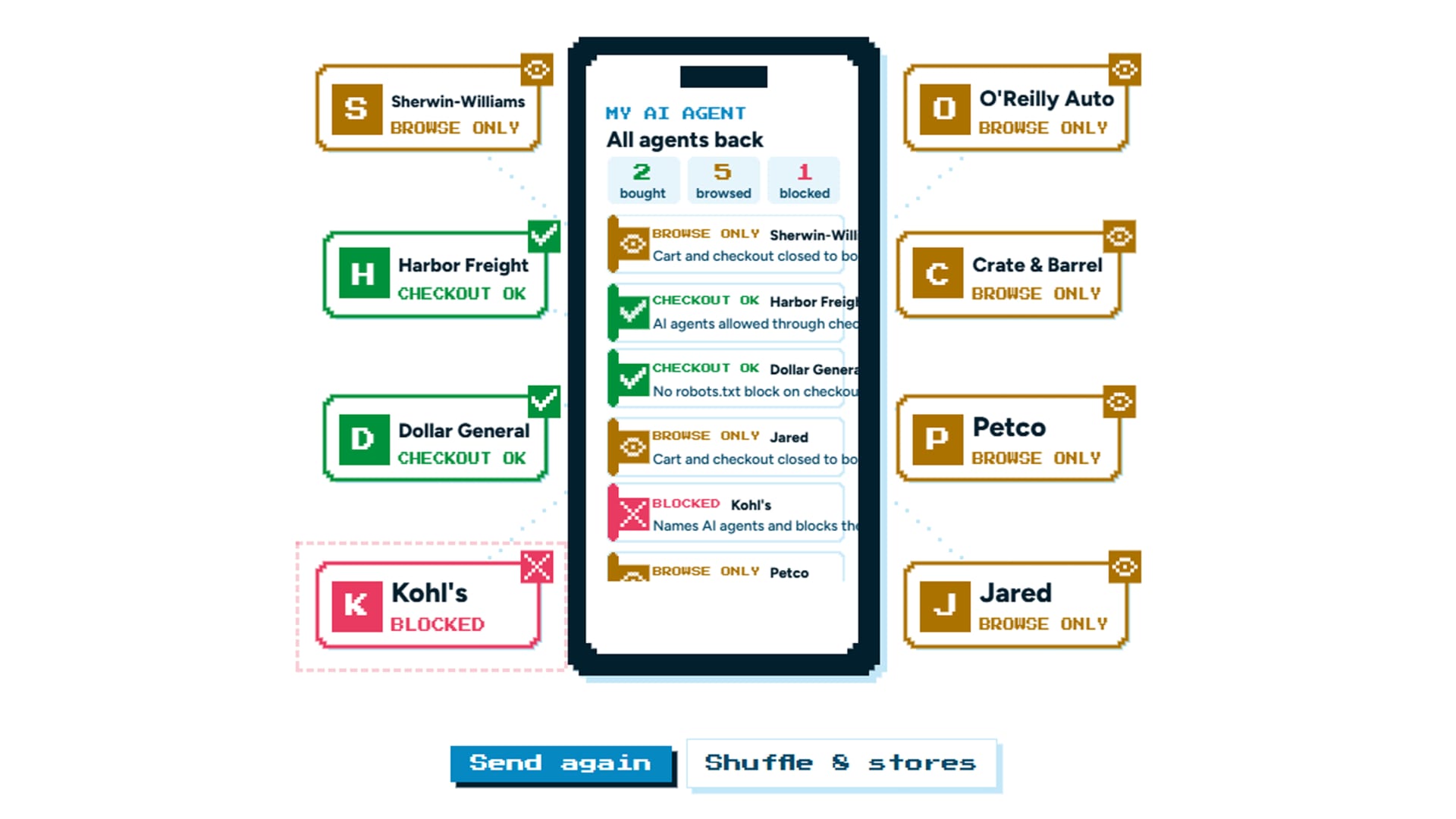
Maia Bittner urgently needed to replace her car's windshield wipers. So last month, she turned to Meta's Muse personal artificial intelligence agent. Bittner, chief product officer at fintech startup Imprint, gave Muse the greenlight to buy some wipers on her behalf from AutoZone. Or so she thought. About 17 hours later, she got a notification from her Muse agent, which she named Dash, saying AutoZone canceled her order due to an unspecified error. "Honestly, the most reliable path now is you ordering on Amazon yourself," Muse said, according to a screenshot of the message. The interaction encapsulates the current messy and complicated landscape of agentic shopping apps, the AI tools that can make purchases on behalf of users. Over the past year, tech companies like OpenAI, Meta, Google and Instinct have introduced versions of personal agents that promise to take the hassle out of browsing and buying online. The rollout has been far from smooth. While some major retailers like Walmart and Sephora have opened up their sites to agents, companies including Amazon, eBay, United Airlines and Kohl's limit what actions agents can take or block them outright. Others have added provisions to their terms of service spelling out that they're not liable if users' AI-driven purchases go wrong."It's a very mixed bag," Emily Pfeiffer, a principal analyst at Forrester, said in an interview. "It means that a consumer who's using an agent to shop and browse and learn is not going to see the full set of options because some websites are unavailable." The hiccups threaten to stunt the growth of shopping agents by creating a clunky and frustrating experience for users who are just starting to experiment with the tools. The question of who takes the blame when a transaction goes wrong also remains unclear. Despite those challenges, analysts remain bullish about agentic commerce's potential. U.S. revenue from agentic commerce could reach up to $1 trillion by 2030, analysts at McKinsey and ICSC forecast in April. Retailers and tech companies are also positioning agents as a helping hand for holiday shopping. Walmart on Tuesday touted its partnership with Meta, saying consumers could "put an AI agent to work" to nab Black Friday deals.Earlier this month, Shopify President Harley Finkelstein predicted this year would be the "first holiday season" where AI-driven shopping goes mainstream."I think last year we saw AI influence more in discovery," Finkelstein told CNBC's "Squawk on the Street." "I think now we're going to see more of that conversion."Patchwork of permissionsFor users hoping to turn their online shopping over to AI agents, the experience can be unpredictable. Agents encounter a patchwork of permissions across various websites. Retailers like Coach and Gap allow AI bots to browse but not check out, while others such as Target sometimes "block shopping agents by accident," according to an audit conducted in August from agent security company Billions Network. Amazon has responded the most aggressively to agents by walling off its site entirely. The company rankled Elon Musk last month after it prevented his Grok Bot from placing orders. In September, the company also blocked Meta's Muse from shopping on its platform, saying it never agreed to participate in the program. And last November, Amazon sued Perplexity, accusing the startup of concealing its Comet agent, which can purchase products on behalf of users. Amazon CEO Andy Jassy has said the company expects, "over time, to partner with third-party agents," but that any partnerships will require the right "value exchange" between agents and retailers. Bots encounter issues even when retailers welcome them in. They often fumble through webpages, and get stumped by login requirements at checkout. In some cases, the agents may require human intervention to bypass a CAPTCHA test and continue browsing. A Visa study published earlier this month instructed 22 models from 12 AI labs to carry out a range of shopping tasks like buying a TV, a laptop and a hair appliance. The agents failed about 43% of test runs, and in more than half of those failed runs, an agent purchased a product "that did not meet the customer's identified requirements," according to the study.Bittner said she is a "big believer" in AI agents' potential. Earlier this year, she was delighted when Perplexity's shopping agent found and purchased a pair of Adidas sneakers that were sold out for months. Other experiences have been clumsier. Last week, she asked Meta's Muse to help her find a Jellycat octopus plushie for her kids. It suggested a product marked 75% off from "Crazy Hobby Supply," a retailer she'd never heard of and that didn't appear to have any reviews. "I sort of trust Google to only surface sites that are not scams to me in their sponsored ads," Bittner said in an interview. "In the same way, I want AI to only surface to me websites that are not scams. I don't think we're there yet." Users have reported mishaps with other AI tools, including one case where Instinct's text-based agent booked a hotel and signed up for a loyalty program without the consumer's consent.Many retailers are approaching agents cautiously because they're concerned about fraudulent bot activity. San Francisco-based Skyfire is trying to solve that problem by arming retailers with more data to identify which bots are visiting their site, and verify that a human has actually consented to let an agent buy a product on their behalf.A commuter walks past Meta Muse ads displayed on screens at a subway station in New York City, US, Oct. 29, 2026. Jeenah Moon | ReutersTypically, when a human visits a website, there's "all kinds of signals" to prove it's not a fraudulent user, Skyfire CEO Amir Sarhangi said in an interview. None of those things are available to retailers when an agent accesses their site, Sarhangi said. Agents might appear even more suspicious because they mask their IP address or origin via data centers, and they often use one-time, virtual cards to check out. "So we talked to a lot of merchants and banks and financial institutions, and the things they told us were: we want to know who the end user is, and we want to know it's a real human," Sarhangi said. "We want to know who these agents are because we're not going to just let willy-nilly anybody do these types of transactions, and we need a way to kind of verify that." AI companies, retailers, financial institutions and other industries have announced an alphabet soup of "protocols," or rules that propose ways to make it easier for agents to transact on websites. There's yet to be a broad consensus around who takes responsibility when an agent purchase goes sideways. American Express in April said it would protect eligible customers "from charges related to AI agent error." Stripe, whose Link digital wallet is integrated with Muse, protects some agent purchases and offers a "refund guarantee." Others are more wary. Last month, JPMorgan Chase blocked external agents from operating on behalf of customers, citing security concerns. Best Buy is among several retailers that deem users responsible for agent purchases in their terms of service, saying it views those transactions "as if you performed them yourself.""Best Buy is not responsible for conduct, errors, actions, or inaction by any Digital Agent," the company's terms state.Sarhangi said he can see why retailers, especially Amazon, are shutting their doors to external agents when the user experience remains inconsistent. "At the scale [Amazon] operates in, I would think they need it to be much more aligned with their existing processes, so that they're not going to have a bunch of unhappy users saying, 'What's going on here,'" he said. Can't ignore them foreverFor now, agents remain a niche tool for shopping, with agentic purchases making up just 0.4% of global e-commerce transactions and 0.2% of value, according to Bain & Co. research published earlier this month. Uber disclosed last month that AI agents booked only 504 rides and Uber Eats orders during its busiest week in October. Airbnb also said it has seen little volume from agents, while DoorDash said it has recorded only "several hundred" agent orders so far. But retailers may not be able to ignore them forever. Roughly a quarter of Muse's 10 million users are shopping online via an AI agent with an average spend of $200 per order, Meta CEO Mark Zuckerberg said in October. Instinct CEO Noah Shinn told CNBC earlier this month that the average transaction value among its users exceeds $500 per person. Asked about some companies' efforts to block agents, Shinn said he tries to "give them some slack." "It's a new interface, it's a new mode of where users' attention is coming from and it might just disrupt existing large services of theirs," Shinn said at a CNBC CEO Council dinner in San Francisco. "They just need time and we've just done a lot of thinking on our side."He added, "We can obviously move very fast and certain businesses cannot. So, how can we collaborate with them?"Read more CNBC tech newsWhat Jensen Huang’s return means for Nvidia’s Colette KressAnthropic stock falls below $83 IPO price, but analysts are still largely positiveNvidia brought Jensen Huang back. But the investigations aren’t overSignal joins United Airlines, banks in limiting AI agents over customer risksAmazon faces FAA probe after delivery drone strikes Michigan fiber cable, garage
AI shopping agents are having a moment, but Amazon and a growing number of sites threaten to stunt their growth
Full Article
Original Source
Read the full article at Cnbc →KhanList aggregates and links to publicly available news content. We do not host full articles from third-party sources. Always verify important information with original sources.