
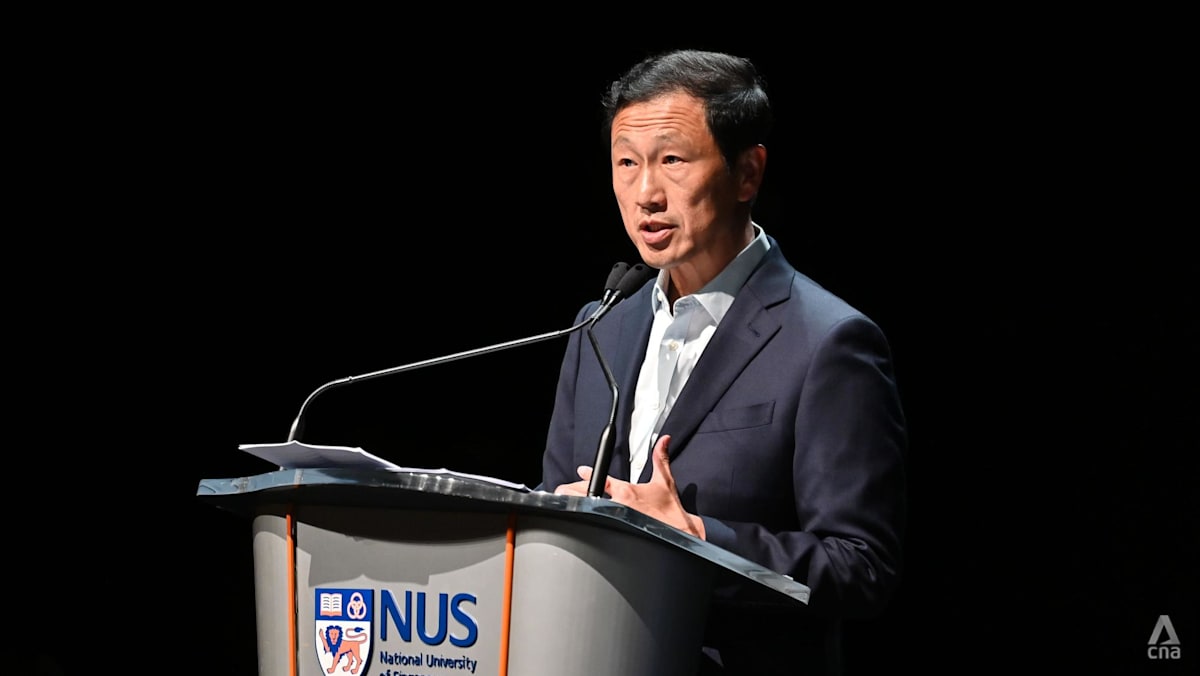
Singapore The health minister was speaking about the job market to students and academic staff members at the annual Kent Ridge Ministerial Forum. Minister for Health and Coordinating Minister for Social Policies Ong Ye Kung speaking at the Kent Ridge Ministerial Forum, held at the National University of Singapore (NUS) on Sep 7, 2026. (Photo: CNA/Alyssa Tan) New: You can now listen to articles. This audio is generated by an AI tool. SINGAPORE: While artificial intelligence is replacing certain tasks, it is not replacing entire jobs most of the time, Minister for Health Ong Ye Kung said on Monday (Sep 7).He added that AI is not resulting in mass job displacement, but it is used as a tool, which can lead to job redesign.“As AI replaces knowledge creation, and even human connection, the impact will be even more profound. Seizing its opportunities, installing guardrails, and pushing back against its adverse impacts are parallel efforts of equal importance that we must start work now,” said Mr Ong at the annual Kent Ridge Ministerial Forum.Held at the National University of Singapore’s (NUS) University Cultural Centre, the forum was attended by about 250 students from various tertiary institutions and members of academia. Speaking at the start of the forum, Mr Ong set out how he sees changes in the job market.He cited Graduate Employment Survey (GES) data, which showed that from 2023 to 2025, the proportion of graduates who secured employment six months after graduation declined from 92.9 per cent to 88.9 per cent.This reflects a “more competitive market”, he said.Mr Ong said employers are facing changes too, pointing to industries that have been undergoing “significant change” over the years.For example, automobiles are shifting towards electric vehicles, and ageing populations are reshaping healthcare. “And then, there is AI. In some organisations and industries, it is automating certain routine tasks. However, these tasks used to be handled by new hires ... so AI might have raised baseline expectations of what the new hires have to do,” he said.“In summary, more graduates entering the market, employers needing to differentiate job applicants and higher expectations of new hires, and these are three compounding factors resulting in a tighter graduate job market and greater job search anxiety that you are facing,” added Mr Ong, who is also coordinating minister for social policies. JOBS REMAIN RELEVANTMr Ong reassured students that Singapore is still competitive and creating jobs.“You are not entering a declining or stagnant economy. You are entering an economy that is growing, that is attracting investments, and that is still dynamic,” he added.Singapore remains relevant and competitive, and it has strengthened its position as a key node in global supply chains.The country also has an open economy, a strong network of free trade agreements, tripartite cooperation, as well as stable institutions and political climate, said Mr Ong.While some specific jobs such as programmers, editors and translators might be replaced by AI, “large swathes” of jobs remain relevant, he said.“I know for a fact, healthcare workers remain as busy as ever. In fact, they are hoping that AI can help reduce some of their routine work, some of their tedious work, such as automating record-taking during a consultation with a patient, planning their work rosters ... and providing with an extra pair of eyes when they do diagnostic scans,” he said.An interior designer told him that he uses AI to improve renderings for clients, but still coordinates contractors, applies for permits, liaises with clients and iterates ideas.Mr Ong said a young executive from the MICE industry who organises road shows for government agencies also told him that AI can help with some artwork. However, the executive still has to design the overall experience, curate the themes and narratives, and work with partners and media to bring everything together.“So the feedback by many of these conversations is quite consistent from people across many professions. Most of the time, AI is replacing certain tasks, but not entire jobs – at least not yet. So it is not resulting in mass job displacement, but it is used as a tool, which can result in some job redesign,” he said.The minister also urged graduates to tap the support available to them, such as free access to AI tools at some universities, career guidance and career fairs.Mr Ong added that the Singapore Business Federation and employers have a “very big part” to play.“Employers can help prevent hiring from becoming an ever-escalating arms race. If I put it frankly, the intensity of this arms race is ultimately shaped by how employers hire. “We are not asking employers to lower their hiring standards. But every additional signal that employers send – hiring candidates with more internships, more credentials, better grades – becomes something that students feel you must chase to curate your perfect CV,” he said.Mr Ong said that hiring a fresh graduate is always about spotting potential and taking a chance.Some students have spent years training and playing competitive sports, dedicated themselves to the arts, gone backpacking around the world, volunteered or taken on caregiving responsibilities at home.While these experiences may not “fit neatly” into a conventional CV, they reflect a candidate’s resilience, initiative, discipline, empathy, character, and work ethic, he said.“So I encourage, and hope, that employers will look at candidates more holistically, beyond GPAs and internships. Help assure applicants that this is how you hire, and cool down an arms race that is energy-sapping, and I think making the undergraduate experience less holistic for young people at a critical formative age,” he said. ACCEPTING OFFERSMr Ong told students that “the most important” aspect is to build mastery – or finding an area that they care about, going deep into the craft and working at it for the long haul.“A degree may open the door, but mastery of your craft will define you as a professional and become your biggest competitive edge.“In a world where AI takes over routine tasks and we are surrounded by AI-generated content ... mastery is what sets you apart and will be more valued than before,” he said.Mr Ong said students should “seriously consider” accepting offers when they receive them.“It will rarely be the perfect job; in fact, I don't think it will be the perfect job ... So if one of your shots hits the target, take the win. Every target you hit gives you confidence and brings you one step closer to mastery,” he said.Fresh graduates sometimes turn down an offer because the salary falls short of expectations, or because of a lack of work-life balance.While these things matter and it is understandable that graduates value them, Mr Ong said learning and laying a career foundation matter most at the start of their careers. “Your first job does not have to define your whole career. Your first job is a starting point, not a settling point. Seizing an opportunity, even an imperfect one, is giving yourself a platform to build towards your goals,” he said.Mr Ong acknowledged that AI is a “major source of uncertainty” as it is exponentially growing.Humanity could take steps to curb AI’s “unfettered growth”, and governments may reserve certain jobs to be done only by humans, as suggested by Bill Gates, he said.“Maybe consumers like you and me demand the human touch, in the same way that we will frustratingly navigate an automated hotline ... in order to reach a real human being. We may demand that doctors, teachers, educators, policemen, HR personnel, service staff, and financial advisers be human. “We want food prepared by human chefs, we want to watch live bands, we want songs written by the real Taylor Swift. We want to watch films featuring human actors and real-world imagery like Top Gun: Maverick,” he said.While it will be an uncertain process that is “understandably worrying”, it is not new to human history, he said, pointing to the Industrial Revolution and the rise of computers.“Further, from a personal standpoint, how does worrying help? How does getting anxious help? It doesn't change the situation. Life is not straightforward, that is a fact. Regretting the past and worrying about the future is a waste of energy, waste of mental power. It changes nothing. They are among our worst emotional enemies,” he said.“Instead, focus on the present. That means seizing the opportunities before us, investing in your own mastery, making the best use of opportunities.”
AI replacing certain tasks, but not entire jobs: Ong Ye Kung
Full Article
Original Source
Read the full article at Channelnewsasia →KhanList aggregates and links to publicly available news content. We do not host full articles from third-party sources. Always verify important information with original sources.