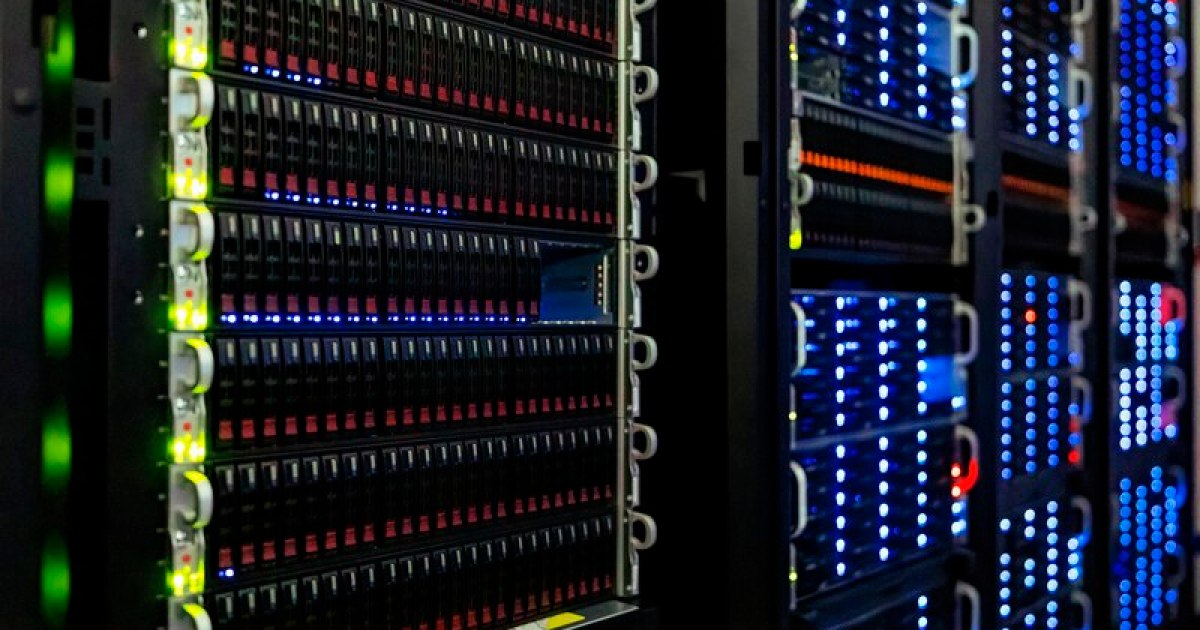
Storage drives and server hardware pack the racks in NOIRLab’s Computer Server Room, an example of the computing infrastructure that proponents of orbital data centers hope to launch into orbit. Credit: NOIRLab/NSF/AURA/T. Slovinsky AI’s appetite for power and water is growing as fast as its role in daily life. In 2024, artificial intelligence data centers accounted for roughly 4% of the U.S.’s electricity consumption. This figure is expected to more than double by 2030. To meet those increasing demands, several of Silicon Valley’s biggest names have turned their eyes to the stars. The rise of data centers Data centers are secure facilities packed with hardware that processes everything we do online. At their core are central processing units (CPUs) — computer chips containing billions of transistors that serve as the brain of modern computers. As the internet grew, data centers did too, from single rooms into warehouses filled with CPU-powered servers. AI has driven another leap in scale. Meta’s planned Hyperion data center in Louisiana, for example, will span nine buildings and over 90 acres. These massive data centers are built around advanced computer chips known as graphics processing units (GPUs), which process thousands of calculations simultaneously, allowing them to train and run complex AI models. GPUs require more electricity and more water for cooling than CPUs. A facility like Hyperion can consume up to 5 million gallons of water per day — roughly equivalent to the water needed to supply a town of 50,000 people. The argument for moving all of this off-planet is simple and seductive. If you launch data centers into orbit, power them with sunlight, and cool them in the vacuum of space, you can reduce electricity costs, water demands, and CO2 emissions. Plus, you can escape the community opposition and regulatory scrutiny increasingly stalling Earth-based data centers. But is it possible? And compared to building data centers on Earth, is it better? An aerial view of a data center’s rooftop reveals row upon row of cooling equipment — a visual reminder of how much energy and water earthbound facilities consume just to manage waste heat, the same problem that would bedevil any orbital equivalent. Credit: Rsparks3, CC0 1.0, Via Wikimedia Commons Looking to orbit In January 2026, SpaceX filed with the Federal Communications Commission (FCC) for approval to launch up to 1 million data center satellites. According to the European Space Agency, there are currently around 15,000 satellites in orbit; this proposal alone would increase that number nearly 70-fold. If the plan gets off the ground, the swarm of individual satellites, connected via laser communications, will be the largest constellation ever by a factor of almost 100. While SpaceX CEO Elon Musk has yet to release a timeline for the project, he’s hopeful that orbital data centers are right around the corner. In a February 2026 podcast appearance, Musk projected, “[I]n 36 months, but probably closer to 30 months, the most economically compelling place to put AI will be space.” SpaceX is hardly alone in its vision. Jeff Bezos has predicted “giant gigawatt data centers in space” within 20 years. Former Google CEO Eric Schmidt acquired rocket manufacturer Relativity Space in a move he confirmed was at least partly a play for orbital computing. And in November 2025, Google unveiled Project Suncatcher, a program exploring constellations of solar-powered satellites equipped with Google’s Tensor Processing Units (TPUs) — chips designed to accelerate machine learning. Google plans to launch two prototype satellites in 2027. Some tech giants, however, are trying to put the brakes on the hype train. OpenAI CEO Sam Altman has mused that data centers in space might be a long-term solution for AI computing. But recently, he has been pushing back on Musk’s optimistic outlook, calling the near-term prospect “ridiculous” given launch costs and the difficulty of servicing hardware in orbit. “Orbital data centers are not something that is going to matter at scale this decade,” he said at a February press conference in New Delhi. Engineering challenges The physics of building a data center in space are daunting. Skeptics point to a series of engineering challenges that space-based data centers must overcome before AI computing can move off-planet. The first is radiation. High-energy particles in space damage and destroy electronics, which is why most spacecraft use components that are hardened against radiation. This process is not exotic — NASA has been doing it for decades — but NASA builds one-off hardware for individual missions. Producing radiation-hardened chips at the scale of a million satellites is a different problem — one that would require a dedicated, high-volume fabrication operation. Musk’s answer is Terafab, a planned microchip fabrication facility announced in March 2026 as a joint venture between three companies he oversees: Tesla, SpaceX, and xAI. The plant’s pilot facility could cost $20 billion to $25 billion, with the full project running as high as $5 trillion by some estimates. It would produce custom AI satellite chips, though it has no production timeline, and none of Musk’s ventures has ever fabricated a microchip. Then there’s the issue of heat. There’s a common misconception that space is always cold, so cooling orbital data centers should be easy. In reality, temperatures in space fluctuate from extreme highs to extreme lows depending on the environment. But the bigger issue is that heat can only be transferred via radiation in the vacuum of space. There is nothing in space to conduct heat, or carry it away via convection. Because of this, spacecraft rely on radiators to dissipate waste heat from their electronics. Dealing with excess heat is the biggest engineering bottleneck for orbital data centers, says Igor Bargatin, a mechanical engineer at the University of Pennsylvania. In order to justify launch costs, radiators will need to be far lighter. “The currently known designs are very heavy,” he says. “We need something that is an order of magnitude lighter than what we currently have.” The largest radiators in orbit, for example, are those that make up the International Space Station’s External Active Thermal Control System (EATCS), which uses 48 panels across six ORUs (Orbital Replaceable Units). The EATCS has a total of 5,134 square feet (476.9 square meters) of radiating surface and expels up to 70 kilowatts of waste heat. A several-hundred-megawatt (MW) or multi-gigawatt (GW) data center would generate thousands of times more waste heat, requiring a radiator thousands of times larger. While the technology exists, a structure of that scale has never been built or assembled in orbit. Credit: Astronomy: Roen Kelly. ISS: NASA Proof of concept Despite these obstacles, early missions are proving that on-orbit computing does work — even if not yet at scale. In May 2025, China launched the first dozen satellites of its planned 2,800 satellite constellation known as the Three-Body Computing Constellation. Once completed, the laser-linked constellation will form a supercomputer 600 times more powerful than El Capitan — one of the world’s fastest — at Lawrence Livermore National Laboratory in California. Still, it won’t come close to the combined processing capabilities of a hyperscale AI data center, which can contain tens of thousands, if not hundreds of thousands, of GPUs. And, last November, the startup Starcloud, backed by U.S. chipmaker Nvidia, launched Starcloud-1, a fridge-sized satellite carrying a powerful NVIDIA H100 GPU. From orbit, Starcloud-1 was able to train and run small language models like NanoGPT and Google’s Gemma. In March, the company filed plans for a constellation of up to 88,000 satellites. These missions prove orbital computing is possible in principle. Whether it’s possible at scale is ultimately a question of economics. The bottom line Even if the engineering challenges are solved, there is no guarantee the economics will follow. “If you run the numbers honestly, the physics doesn’t immediately kill it, but the economics are savage,” Andrew McCalip, an engineer at Varda Space Industries — a private California-based aerospace firm that processes pharmaceuticals in orbit — wrote on his website. McCalip has estimated that a 1 GW orbital data center would run roughly $51 billion over five years — more than three times its earthbound equivalent. The figure comes from a calculator McCalip built using public data, which prices out a fleet of roughly 39,000 Starlink-class satellites against a natural-gas-powered terrestrial data center. The calculator assumes satellites will need to be deorbited and replaced at the same rate as Starlink hardware — a cost that could shrink if on-orbit servicing technology matures. Satellite hardware alone accounts for $23.6 billion of McCalip’s $51 billion estimate. Data center satellites in a swarm arrangement like Musk envisions would be larger and more numerous than the Starlink-scale satellites McCalip’s model is based on, meaning the real manufacturing bill could be considerably higher. Then there are the launch costs — a Falcon 9 flight runs about $2,700 per kilogram to low Earth orbit. McCalip’s $51 billion estimate assumes launch costs of around $500 per kilogram — cheaper than even SpaceX’s Starship rocket has promised to deliver. Even if launch costs dip to unprecedented lows, the math isn’t favorable. And if you get the hardware into orbit, you have to keep it running. McCalip’s model accounts for a 9% annual GPU failure rate — drawn from Meta training data — and prices in the cost of replacing failed hardware, but not what it would cost to launch and install hardware. Replacing GPUs in orbit would involve technology that doesn’t exist, although it could be on the way soon. A study published in Nature in April argues that on-orbit servicing could experience a boom around 2030, potentially making satellite maintenance more routine. In the meantime, however, “GPUs are pretty darn happy living on the ground,” McCalip wrote. “They like cheap electrons, mature supply chains, and technicians who can swap a dead server in five minutes. Orbit doesn’t get points for being cool. Orbit has to win on cost.” Orbital trade-offs Suppose the engineering gets solved and the costs come down. Would space-based data centers actually be better? Moving AI infrastructure into orbit doesn’t eliminate problems so much as transform them, and in some respects, amplify them. First, there are carbon emissions. While a data center in orbit won’t emit CO2, getting it into orbit still requires a rocket, and rockets do emit CO2. They also deposit black carbon — a warming agent up to 1,500 times more potent than CO2 — directly into the stratosphere, where it lingers far longer than emissions released at ground level. And because megaconstellation satellites are designed to deorbit every five years — in order to prevent defunct satellites from accumulating in space — keeping a large constellation running requires a continuous stream of replacement launches. A split view contrasts today’s roughly 15,000 satellites in low-Earth orbit (left) with an imagined scenario (right) showing how crowded the region could become by 2036 if all currently proposed constellations are launched. A 2025 study in Nature led by Alejandro Borlaff suggests the total could reach 560,000 by the end of the 2030s — a prospect that researchers warn would threaten astronomy. Credit: Astronomy: Roen Kelly Bargatin’s team modeled the CO2 cost of launching orbital data centers against the emissions of running equivalent hardware on Earth, and found that a sufficiently lightweight satellite design could come out ahead. But the tech for such a design doesn’t yet exist. “If you repeat the calculation with current masses,” Bargatin says, “you’re going to emit more launching it than it consumes on Earth.” And that’s before accounting for other warming agents like black carbon deposited into the upper atmosphere during launch. A new generation of lighter radiators could tilt the scales in favor of orbital compute. But at the same time, expanding renewable energy on the ground could clean up terrestrial data centers faster than orbital ones can be made economical. Which technological changes will arrive first, and in what combination, is hard to predict. Then there’s the added question of what happens on the way back down. Reentering satellites deposit aluminum and other materials at altitudes where particles don’t quickly wash out of the atmosphere. Scientists are still working to understand the long-term environmental effects of deorbiting satellites, and more megaconstellations would exacerbate those issues. “The space industry right now is basically an uncontrolled and untested geoengineering experiment,” Connor Barker, an atmospheric researcher at University College London, tells Astronomy. Not to mention the implications for science. Because data center satellites require continuous solar power, they would be oriented toward the Sun nearly constantly — making them far more reflective than satellites like Starlink, exacerbating impacts to astronomy. Alejandro Borlaff, a NASA researcher who has studied the impact of megaconstellations on observatories, estimates that data center satellites would run six to seven times the size of a Starlink unit, making science much more difficult for both ground- and space-based astronomy. Satellite trails slash across a long-exposure image of the Orion Nebula, a striking example of how existing constellations already compromise both professional and amateur astronomy. A future swarm of data center satellites would dramatically amplify the effect. Credit: A. H. Abolfath/NOIRLab/NSF/AURA Regulations and red tape Back on Earth, terrestrial data centers — which were once courted by states competing to offer tax breaks and incentives — are increasingly facing a wall of community and regulatory resistance. Between May 2024 and March 2025, local opposition blocked or delayed more than $64 billion in proposed U.S. data center projects — $18 billion of which was canceled outright — according to Data Center Watch, a research group that tracks local opposition to data centers. In addition to the protests, regulation is catching up. According to the consulting firm MultiState, 27 states are currently advancing legislation requiring data centers to cover their own energy costs. And bills that would impose statewide moratoriums on data centers have been introduced in 11 states. In orbit, the regulatory picture is totally different. The FCC, which approves satellite launches, has relied on the same categorical exclusion from environmental review since 1986 to effectively bypass any formal environmental assessment. Andrew Von Ah, a director at the Government Accountability Office who has studied the FCC’s oversight of large satellite constellations, says the agency has never clearly defined what circumstances would require it to revisit that exclusion. In 2022, the GAO recommended the FCC revisit the exclusion; as of last year, it had not done so. Von Ah sees few signs it will. All of the FCC’s recent actions, he says, have made it easier to put satellites into space, not harder — and Congress has signaled it may go further still. If this trend continues, it may become a motivator for moving data centers off-planet, assuming the engineering and economics catch up. AI isn’t going anywhere, and for now, neither is the stress on ground-based infrastructure it has created. But moving those problems to orbit doesn’t solve them. For AI to be sustainable, whatever comes next will require a better way to power and cool the computers the world is increasingly running on. Brooks Mendenhall is a staff writer for Astronomy magazine and is based in Chattanooga, Tennessee.
AI outgrows Earth
Full Article
Original Source
Read the full article at Astronomy →KhanList aggregates and links to publicly available news content. We do not host full articles from third-party sources. Always verify important information with original sources.