
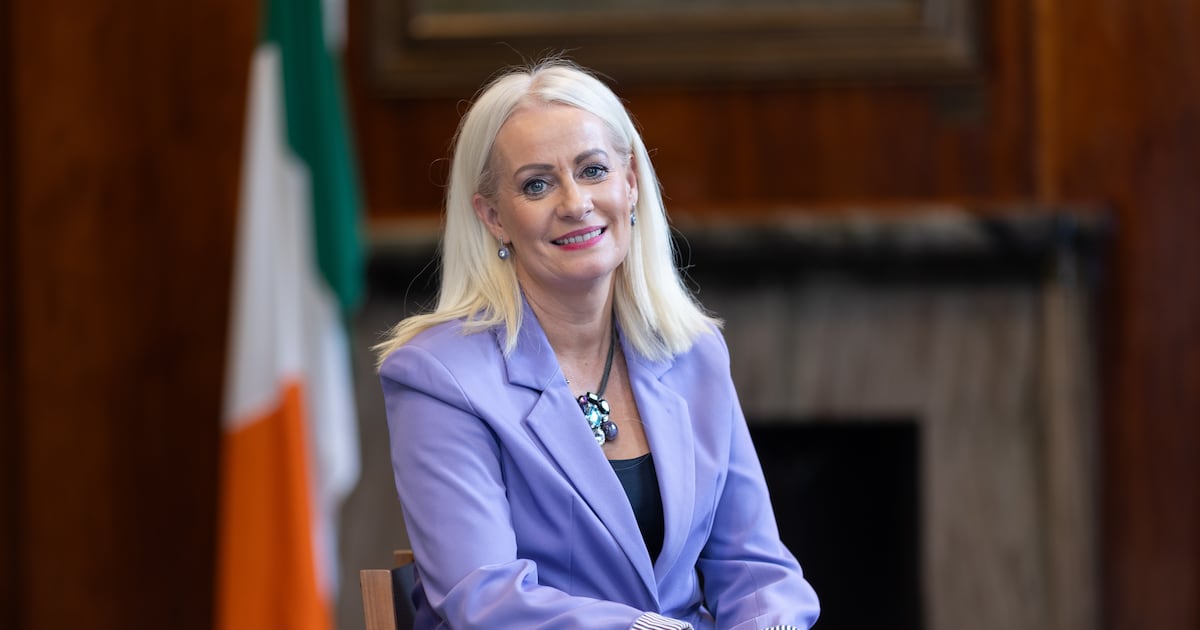
After a month in which the people driving AI’s technological revolution suggested even they have only minimal control over where it might all lead us, it’s not surprising that Ireland’s Minister for Digital Transformation is concerned by the worst-case scenarios.Niamh Smyth, Minister of State at the Department of Enterprise, Tourism and Employment, says she is “cautiously optimistic” about the balance of pros and cons AI has in store for us during the years ahead, but admits she still worries about the potential for a hugely negative impact on the labour market. “I’d have concerns around displacement and I would never shy away from that,” she tells The Irish Times in the run up to the Government’s International AI Summit at the RDS next week. The event boasts an impressive line-up of speakers including Google DeepMind co-founder Demis Hassabis and a long list of political, tech sector and business heavyweights. “I do believe there will be new jobs created. I do think the human oversight of any technology will have to remain in place. And AI jobs have certainly been on the rise in Ireland,” she says, referring to the substantial growth in numbers since 2023.READ MORE“But obviously, there will be displacement. There will be people impacted by the capability of the technology, because [in various areas] it won’t take as many humans. “So I am optimistic and I am excited by the technology, but I have concerns. I don’t want to see mass displacement, because that innately causes civil unrest. It causes anarchy. And I’m very conscious that things can be whipped up very quickly on platforms and with the use of AI too.”Just this week, it emerged that Oracle is looking to cut another 70 Irish jobs this year as it continues to trim costs to fund its expensive push into AI infrastructure and data centres.AI is the perfect tool with which to make the damage AI itself might do worse.Smyth, the first person to serve as Minister of State with responsibility for the area – her particular responsibilities are for Trade Promotion, AI and Digital Transformation – says the technology, and the speed at which it is evolving, present huge challenges, for business, the Government and the EU but believes Europe, and Ireland, are in a better place to navigate the landscape than many other jurisdictions. ‘I’d have a very different view, obviously, than President Trump. I don’t think self-regulation is any regulation’— Niamh Smyth, Minister of State with responsibility for AIMany Americans, she says, envy the legal framework established on this side of the Atlantic to deal with the tech giants and the way they are changing the business, social and human environments. “In my view, the legislation is there,” she says, referencing the EU AI Act, the Digital Services Act and others. The companies know what’s acceptable and what’s not acceptable; the prohibitive practices piece, the ban on high-risk systems, the requirement that companies ensure that due diligence is taken with any of the AI tools they have developed, or more importantly, released.“Then obviously we have our own domestic legislation around that, and the establishment of the National AI Office. Obviously, [European] Commission president [Ursula] von der Leyen has also talked about an EU Kids Act, to address the protection of young people online, too. So there’s so much going on,” she says. In the US, meanwhile, Donald Trump has come out against legal regulation even in the face of the most prominent owners’ appeals for it, and has recently corralled them into a system of self-regulation that even he described as only “morally binding”.“I’d have a very different view, obviously, than President Trump,” Smyth says. “I don’t think self-regulation is any regulation.” It is one of the reasons, she believes, why many legislators at state level in the US are envious of the framework established within the EU.“I was in the [United] States on a trade mission before the summer, meeting with political colleagues, at a state level, and they actually look to Europe,” Smyth says.“You’ll never hear this in the geopolitical debate. In that, people are always hammering Europe for being stifled by red tape and stifled by legislation, preventing innovation. But the truth is, when you’re out there and you’re speaking to legislators in the [individual] states, they’re looking to Europe to see what we’ve done because they feel we have done more than they’ve been able to do. Because at a federal level there, the attitude is different, but they’re really craving more guardrails and oversight on the development of these technologies.“What we’re attempting to do is to get the balance right to ensure that innovation is encouraged, that we’re allowed to be creative in terms of the designs of technology, but, more importantly, to look at how businesses who maybe aren’t technology-based can adopt it to put more efficiencies in place.”That, she admits, is not quite where she would like to see it, particularly in the SME sector, where she feels take-up has been hindered by practical or financial considerations.“We’re trying to address that,” she says. “I know we have done a roadshow where we’ve been to a number of counties working with the Local Enterprise Offices [LEOs]. Some of the LEOs have been working on digital transformation and the impact of AI long before it became a ministerial role. They have become a good source of feedback for us on where the supports are needed, or where we need to go and tell businesses about the supports that are already there. “Because sometimes people are so busy when they’re running SMEs and they don’t have a HR section or a finance section to know what is even available to them. So we have a job of working to ensure the SME sector is completely aware of what supports are there.”The Government itself, she acknowledges, meanwhile, has been getting to grips with how seemingly all-pervasive the issue of AI is. She lists off some of the Ministers whose departments are involved in some aspect or other – training, health, protection of children, employment, cyber security – the list goes on. Smyth says a growing amount of collaboration on both pursuing the opportunities and tackling challenges is happening.The Government’s own AI advisory council, chaired by Patricia Scanlon and including academics, entrepreneurs and others with expertise in the area, had done some work on this and suggested much more, but it was disbanded as the AI Office of Ireland was established – which might be regarded as somewhat premature given the need for informed opinion on what are very big issues for the country, economy and civil society.Smyth says the working papers the council completed are still regarded as important documents feeding into current work programmes, and that she still calls on members of the council to hear their views and consider their advice on a wide range of issues.Scanlon, she says, was with her the day before this interview, and encouraged her and the Government to do more to promote the innovation sector, to nurture and champion the sorts of start-ups that can become significant players in the sector over the coming years.[ Ireland’s great AI job displacement: ‘Every employer, every worker should be talking about this’Opens in new window ]The previous evening, she says, she took that suggestion to the Taoiseach, and argued it was something that might be addressed in the budget. Quite how much the conversation fed into the measures unveiled on Tuesday is impossible to gauge, but there were moves to assist start-ups and to help companies to scale up, as well as increases to research and development credits to encourage investment. More widely, she believes Government and the EU has to find a way of using AI to remain competitive during what is set to be a dramatic shift in the way workplaces operate, while keeping the safeguards and ensuring their presence does not hand a competitive advantage to rivals.‘The technology is developing at breakneck speed and the impacts of it are throwing up different problems, different challenges, every day of the week’— Niamh Smyth“Citizens right across Europe have demanded that safeguards be put in place. And I think the European Commission is very aware of where our citizens are at around this. They want to know they can use the technology but they want it to be safe, and I suppose that’s the balancing act for us.”It remains to be seen whether this can really be done when the biggest players are US firms with little regard, it often seems, for European-style regulation which enjoy the backing of a president who sometimes seems to see such controls as a personal and political affront.The past few weeks, however, have highlighted the need for tighter controls, with Smyth, like many others, openly taken aback by some of the stories of AI agents gone slightly rogue.“It’s such a fluid situation,” she says. “The technology is developing at breakneck speed and the impacts of it are throwing up different problems, different challenges, every day of the week. We’ve gone from the Hugging Face intervention, with OpenAI’s bots, you know, making their way out of the systems they were supposed to stay in, and also how the bots themselves seemed to be aware of the fact they weren’t supposed to be doing what they were doing, and so they tried to disguise it ... it’s really remarkable. Incredible.”Since then there has been the Australian healthcare hack and others in the US, with companies coming in for criticism over delays in realising what their own technology was up to – and an apparently relaxed approach to impacts upon the authorities.[ Message from the Editor: prophets of AI catastropheOpens in new window ]The episodes raise obvious questions about what might be possible if bad actors were actually directing things and how vulnerable the Government, agencies such as the HSE, or financial institutions might be to cyberattack, when the budgets for security measures are being dwarfed by the amounts being spent on advancing these very systems, most obviously in the US and China. Ireland’s National Cyber Security Centre chief Richard Browne acknowledged the seriousness of this issue again this week.“Of course, I would be worried,” says Smyth. “It’s the one piece of technology that needs all arms of the State. You’ve got the cybersecurity aspect, which falls under the Department of Justice. You take the social media platforms, which fall under the Department of Culture. There is the AI piece, which is part of my own remit. So it takes a collective approach, from the Irish State, from the European Union, to ensure people are protected and kept safe; ensure that you know European values are adhered to. That people are protected and safe.”When it comes to the arts, for instance, or newspapers, their views on “fair use” seem firmly rooted in the US legal definition, something that has allowed AI’s scraping of words, sounds and images on a colossal scale without, most of those being scraped would say, anything like commensurate compensation.Smyth has, she says, strong feelings on the issue. Having studied arts-related areas at the National College of Art and Design, the University of Limerick and the Institute of Arts Design and Technology and chaired the Oireachtas committee on the arts before taking up her current role, she is conscious of the challenges facing those working in the sector while retaining a belief that human creativity will retain a valued edge over that of machines. “I was out recently in Brussels at a copyright committee, and obviously, as we hold the presidency, we’re very mindful of how we address it. I can’t say I have all the answers on that yet. But I completely understand their desire to protect their original work. It is awful that it would be scraped, copied, plagiarised. What we need to make sure is that they are remunerated correctly for that work.”Will that happen, though?“I want to see it happen,” she adds.The potential impact on the arts touches on the wider potential impact on human engagement and all that entails. The previous day, she says, she was at an event in Maynooth where some big questions were asked, including where this all leaves us as humans.Smyth readily acknowledges “I don’t have all the answers.”Beware anyone who says they do.
‘AI Minister’ Niamh Smyth: ‘I’d have a very different view than President Trump’
Full Article
Original Source
Read the full article at Irishtimes →KhanList aggregates and links to publicly available news content. We do not host full articles from third-party sources. Always verify important information with original sources.