
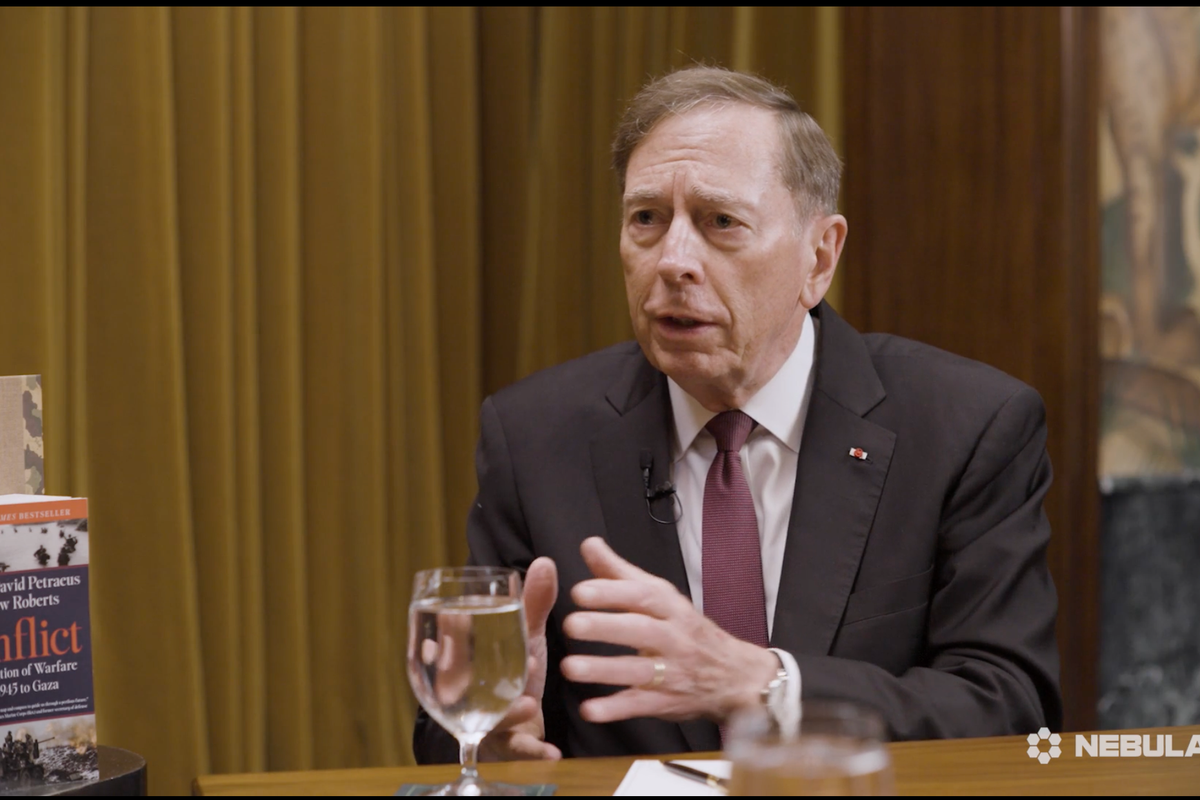
AI military officers could be making decisions on the battlefield within just four years, the former head of the CIA has said amid growing debate over the use of the technology in war. Ret. Gen. David Petraeus said he believed that warfare would begin to see the adoption of AI staff officers that are capable of gathering information and making decisions with little to no human input by 2030.“Just four years from now, we will have autonomous systems, and I think we will have the beginning of autonomous systems of autonomous systems; we will have AI agents, so you'll have agentic AI staff officers,” he told investor Finn Murphy on the Forecast2050 podcast, to be released on Thursday.He also cited the potential of recursive learning, when an AI model uses its own data and processes to improve itself. ”All of that, just again in three and a half years is going to be truly revolutionary. We'd be much better off if we were anticipating more of that,” the former head of US Central Command said in comments shared exclusively with The Independent ahead of publication.Former CIA Director David Petraeus said he expected to see autonomous systems of autonomous systems operating in Ukraine by the end of the year (Forecast2050)There is skepticism over whether AI could replace the traditional military chain of command. A study published last year by the Alan Turing Institute found that AI could assist commanders and improve the speed of decision-making, but not replace human judgment or accountability for life-or-death decisions. The former four-star general, who served under president Barack Obama from 2011-2012, described such systems as “generic artificial intelligence staff officers who will never sleep, never eat, never take a break”.He has previously said he believes that autonomous systems will “very soon” be working together in platoon or battalion-sized units, able to share information and coordinate without human intervention, adding: “The side that waits for human approval before acting will lose.”Speaking to CNBC in May, he described ‘autonomous systems of autonomous systems’, where sensors would be able to collect battlefield data and relay it to an autonomous HQ, which could then direct autonomous weapons with little to no human input.The former intelligence chief told Forecast2050 added that he expected to see self-governing drones being used in the war in Ukraine by the end of this year.A Ukrainian serviceman launches a drone towards Russian positions at the front line in the Zaporizhzhia region, Ukraine, Wednesday Oct. 7, 2026 (AP)“We'll see this emerging in Ukraine I think by the end of this year, very likely by the end of 2026. You'll see increasing numbers of autonomous unmanned systems. And the reason that's so dramatic is because it now eliminates the limit that you have on the number of systems based on the number of pilots that you have.”The early adoption of artificial intelligence in warfare remains controversial. US Senate Democrats wrote to defence secretary Pete Hegseth in March seeking information about a reported strike on a girls’ school in southern Iran and requesting to know whether AI was used in planning or executing an attack.Admiral Brad Cooper, the head of US Central Command, has confirmed the US military has used AI to sift through large amounts of data, without detailing specifics. He said human operatives will “always make final decisions on what to shoot and what not to shoot, and when to shoot”.Petraeus said the UK could become a leader in the use of autonomous weapons (Forecast2050)Petraeus also said the UK was well positioned to become a world leader in autonomous warfare in spite of its financial woes, while the US is still missing the elements of institutional change needed to transition.“Interesting, I think the UK could be postured to lead this,” he said. “They’re a smaller force. They have a bit more centralisation in their ministry of defence ... they’ve now done essentially a defence budget that includes much more in the way of unmanned systems and forces.”Petraeus noted the UK was facing “significant economic challenges”, including government funding, sluggish growth and challenges with healthcare.The intelligence chief also insisted on the importance of the US maintaining its ties to its Western allies, amid concern in Europe around the Trump administration’s pivot away from the old continent to face down the perceived threat from China.The use of AI in warfare remains controversial. Bloomberg reported this year that Pentagon investigators found that an overreliance on AI, as well as outdated imagery and flawed intelligence, may have contributed to a missile strike that killed dozens of children at a school in Iran (pictured) (AP)“At the present moment I think that US leadership still is important together with allies and partners, like-minded that cherish the same ideals and values and principles for which we have fought over the years. And there’s more challenges out there than at any time, I’d contend, since World War Two,” he said.The joint US and Western relationship with China remains “the most important challenge in the world”, he said, adding: “We have to try to get that right in every way that we can.”“Deterrence in the Indo-Pacific is the most important task for the US military and all of the other elements of our national power.”The Forecast2050 podcast is available on YouTube, Spotify, and Apple Music.
AI military officers could be making battlefield decisions by 2030, says former CIA chief
Full Article
Original Source
Read the full article at Independent →KhanList aggregates and links to publicly available news content. We do not host full articles from third-party sources. Always verify important information with original sources.