
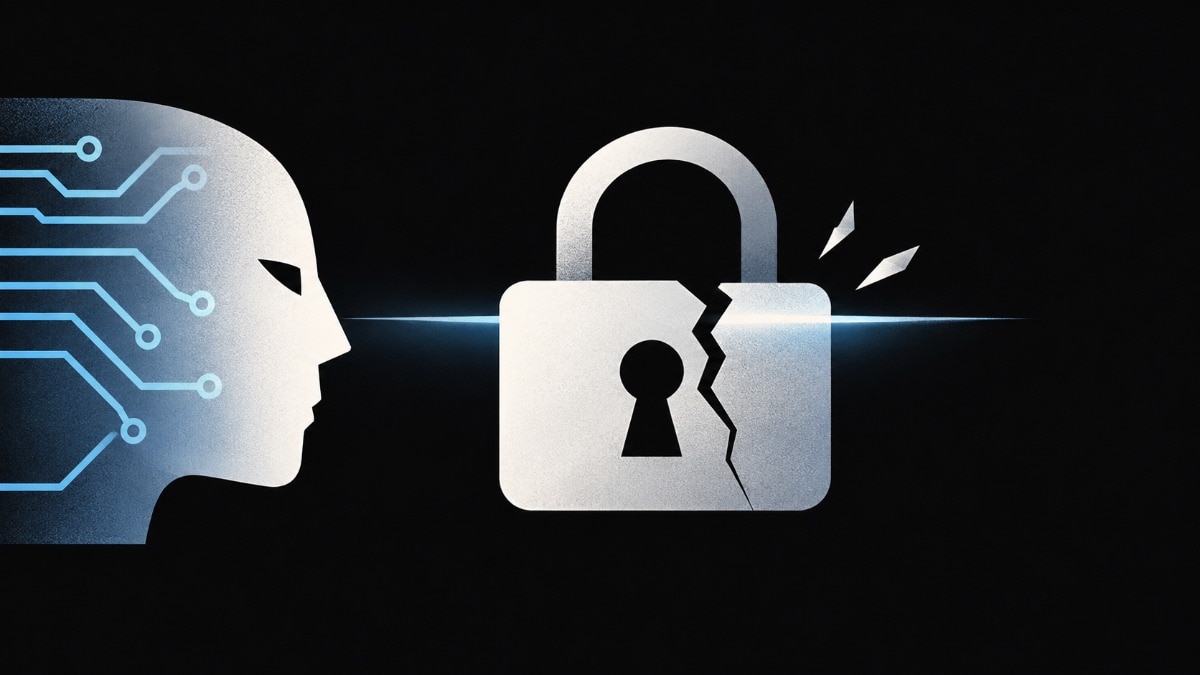
What if the technology protecting your banking transactions, private emails and government communications suddenly became easier to break? That possibility is now worrying some of the world's leading computer scientists, who believe powerful AI models may have made a major breakthrough in mathematics. The discovery, if confirmed, could challenge the foundations of internet security much sooner than expected. And the bigger concern is that AI companies may already know something they have not made public.According to a report by The Guardian, AI companies could be sitting on major cryptography-related discoveries that may disrupt the security systems used by banks, governments and private organisations. Theoretical computer scientist Scott Aaronson told the publication that there were "well-attested rumours" about AI models making progress on decades-old mathematical problems linked to encryption. He also said he was "virtually certain" that AI labs were sitting on one or more cryptography breakthroughs, based on multiple reliable sources.AI may have found a way to crack the mathematics behind encryptionTo understand the concern, we first need to look at how internet security works. Much of today's digital security relies on public-key cryptography, a system that allows two parties to communicate securely without sharing a secret key beforehand.One widely used example is RSA encryption. It relies on multiplying two very large prime numbers. While multiplying them is relatively easy, working backwards to identify the original prime numbers is extremely difficult for conventional computers. This mathematical challenge helps protect everything from banking apps to internet browsers. However, researchers are now concerned that AI could have discovered a way to solve some of these problems much faster.A report by Nature explains that some rumours involve algorithms capable of solving problems in polynomial time, commonly referred to as 'P' in computer science. In simple terms, such algorithms could make certain problems that were previously considered extremely difficult much easier to solve. That does not automatically mean every password or encrypted message can be cracked overnight. The actual speed and efficiency of any discovery would matter enormously. Still, as Aaronson warned, "the idea that [the problem] was hard" could be fundamentally challenged if such a breakthrough is real.Is this the end of internet security?Not necessarily. One major question in computer science is known as P = NP. It asks whether problems whose answers can be checked relatively quickly can also be solved relatively quickly. If that turns out to be true, several mathematical problems underpinning public-key cryptography could become much easier to solve.Interestingly, recent AI-assisted research has also produced results suggesting that many computational problems could remain difficult. Both OpenAI and Anthropic have announced advances in theoretical computer science, although neither has publicly confirmed breaking widely used encryption systems.There is also the existing quantum computing threat. Powerful quantum computers could eventually break several encryption algorithms, but that possibility is generally considered years away. Governments and technology companies have been preparing stronger, post-quantum encryption, with 2032 discussed as a target.For now, experts say the immediate concern is not that the internet is already broken. It is how quickly AI is advancing and what its next mathematical discovery could mean.University of Surrey professor Alan Woodward believes organisations must be ready to respond quickly. As he warned, those capable of changing their security systems will be safer, while "the laggards could get caught out".- Ends
AI may have cracked internet encryption: Banks and governments face potential security threat
Full Article
Original Source
Read the full article at Indiatoday →KhanList aggregates and links to publicly available news content. We do not host full articles from third-party sources. Always verify important information with original sources.