
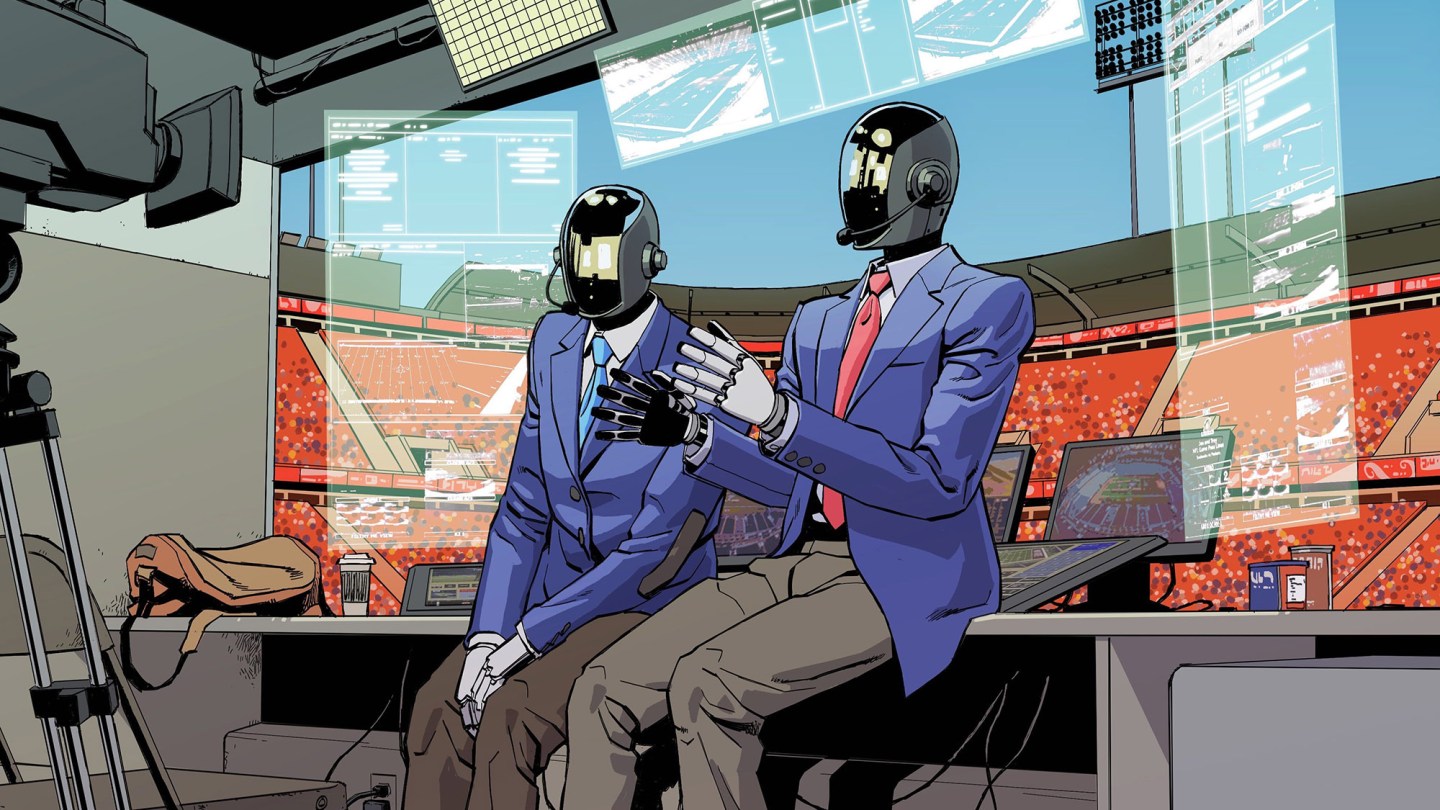
Jim Nantz learned about the power of generative AI from Jim Nantz — or, rather, from a computer-generated version of him in a clip someone sent to him about three years ago. “I still have it in my phone,” says Nantz, CBS’ top voice for the NFL and the Masters. “I was so blown away by it; it sounds exactly like me.” Nantz is now considering lending his voice to an AI-related project. He’s mum on the details, except to say that it would go beyond a lifetime tie-up. “It’s a from-the-grave kind of a deal,” he says. “Who knows where this AI is going, but it has the chance to call certain things for as long as somebody wanted to use it … It’s just extraordinary to think about the possibilities.” Still, Nantz says he’ll only go through with that kind of thing if it’s done right. Artificial intelligence has already made its way through most top sports TV productions, with companies sharing few specifics on how much they’re spending on the tech, in part because it would be overwhelming to tally up all the ways it’s been integrated into broadcasts. This summer, Telemundo sent its World Cup analysts flying through New York City, onto private beaches, and into the center of Dallas Stadium during AI-generated segments in the first major live broadcast partnership for AI startup HeyGen, with support from CAA. On other top telecasts, AI is called in to sharpen slo-mo shots, speed up graphic creation or even help direct viewers’ attention in real time. Executives have extolled AI’s ability to enhance game coverage and create elements more efficiently. Done right, it can bring fans closer to their favorite stars and help commentators reach wider audiences. On the other hand, some announcers reasonably harbor concerns about being replaced by robots. And even if the tech works perfectly, the human element of sports — which supposedly will protect the media industry from algorithmic shake-ups engulfing other sectors — could be endangered if fans’ connections with their favorite teams become mediated by some form of Bot Costas. “We, from the very beginning, had this vision that two things would be true as the space developed,” says CAA head of strategic development Alex Shannon. “Number one, that the need for protections and guardrails would only grow in importance, and number two, that over time the commercial opportunity would be astronomical.” While Amazon Prime Video relies on Al Michaels and Kirk Herbstreit to call Thursday Night Football games, producers have used AI for several of the show’s signature features. Football and computer science experts collaborated to build algorithms that spotlight defenders likeliest to blitz pre-snap, in one example. “We had this idea, and we didn’t really know how we’d get it done,” Prime Video senior coordinating producer Alex Strand says. “And then somebody much smarter than us hopped in and said, ‘Let’s try something crazy.’” For the past year, ESPN has used AI-generated voices tuned to sound like the network’s real-life anchors in a personalized SportsCenter for You show. At 7 a.m. each morning, a user can now get a compilation of clips recapping games from their favorite baseball team and local school’s football squad, with narration reminiscent of Hannah Storm or Christine Williamson, who wouldn’t have the time to chronicle bits of the 100-plus contests played each day. “It really is helping us be able to reach fans and serve them at scale,” says Kaitee Daley, ESPN senior vp for digital, social and streaming content. SC for You’s AI underpinnings also free up ESPN’s social content producers to focus on other endeavors, such as clipping moments from the network’s TV shows — still a fully human process. Concerns over “AI slop” may be growing across media, but ESPN has been happy enough with the computer’s work over the past year that executives plan to expand SportsCenter for You into an always-on — and constantly updating — experience. NBC has gone one step further, restoring narrator Jim Fagan’s tones for elements of its NBA coverage, in partnership with his family. Fagan, whose voice was a recognizable part of NBC’s hoops broadcasts in the 1990s, died in 2017 after dealing with the effects of Parkinson’s disease. “Knowing that his voice will once again be part of the game he loved — and that a new generation of fans will get to experience it — is incredibly special for our family,” Fagan’s daughters Jana Silvia Joyce and Risa Silvia-Koonin said last year. The Amazon Thursday Night Football broadcast set with Charissa Thompson, Tony Gonzalez, Ryan Fitzpatrick, Andrew Whitworth and Richard Sherman during an NFL football game between the New York Jets and the New England Patriots at Gillette Stadium on Nov. 13, 2025, in Foxborough, Massachusetts. Cooper Neill/Getty Images Today’s AI can also be used to create entirely new personalities. This spring, the NBA introduced Alley, Oop and Buzzer, three cartoon characters whose YouTube show connects young viewers with NBA stars like Nikola Jokic and Victor Wembanyama. The league otherwise wouldn’t have the bandwidth to produce content geared toward such a narrow audience, NBA senior vp for digital and social content Bob Carney says. After trying multiple methods, the league and tech partners at WSC decided to use human voice actors to create a baseline. AI then assists the experts producing each episode, speeding up the scripting, narration and animation processes. “Humans still build the show, but the generative AI engine is now doing all this heavy lifting at every step,” Carney says. “What would normally have taken weeks or months can now be done in a day or two.” NBA execs have already discussed IP extensions for its AI-powered characters. Fans today increasingly have the ability to perform similar feats of engineering at home. AI audio company ElevenLabs, valued at more than $10 billion, offers users a collection of more than 10,000 voices in its online library. Among them are fabricated sportscasters trained to say things like: “Folks, in my 30 years calling this game, I have never seen a ball hit that hard. This is why we love sports!” Another voice option drops a John Madden-esque “Boom!” in its audition tape. It’s reasonable to be both wowed by the tech and a little worried by what it might mean. These narrators can take backyard highlights or group chat smack talk to the next level. But there are risks. After CBS NFL commentator Tony Romo was arrested on suspicion of driving under the influence, for instance, AI-created clips mimicking police bodycam footage rocketed around the internet. Other startups have jumped to letting users make content with Bob Costas’ recognizable voice — regardless of copyright concerns. AI investors like Los Angeles Lakers buyer Josh Kushner and new Seattle Seahawks owner Vinod Khosla are increasingly putting money into sports teams, recognizing that a group of talented athletes won’t be disrupted in the same way SaaS (Software as a Service) platforms have been. But too much lifeless content surrounding games could weaken the connection fans feel. And the worst forms of AI content come off as downright creepy. Year-over-year, even minute-by-minute, organizations are fine-tuning how they want to deploy Silicon Valley’s newest capabilities. Working with two of sports’ most tradition-rich events, IBM added AI voiceover to Masters and Wimbledon highlights packages in 2023, providing audio coverage of shots otherwise unremarked upon by TV’s top commentators. This year, however, the company has pivoted to other AI uses for those franchises, making 50 years of historical Masters clips searchable and adding in-game analytics to Wimbledon’s app coverage. For the U.S. Open, IBM rolled a new “serve quality” metric powered by computer vision that will track more than 1 billion data points over the course of the tournament. NASCAR enlisted AI for live Spanish-language coverage of its 2025 Mexico City race. The tech worked as expected. Still, NASCAR chief brand officer Tim Clark says that if he had a do-over, he would have done something different, even as NASCAR continues to leverage algorithms away from the cameras. “One of the few things that brings everyone together is sports,” Clark says. “It’s a really personal experience, and for us to automate that to a disconnected voice, I just don’t think is the right thing for our fans.” Some teams have won plaudits by declaring their social content AI-free. Bill Simmons, meanwhile, has taken heat for integrating ChatGPT’s “opinions” into his show since adding OpenAI as a sponsor. A June poll of 20,000 sports fans across 12 countries from IBM found that AI use among respondents grew from 52 percent to 69 percent over the past year, though the proportion of people who said they trusted AI-generated sports content dropped from 63 percent to 59 percent. Plus, 71 percent of U.S. adults think AI will lead to job loss over the next 20 years, according to a recent Pew poll. It could be hard for people to ignore related concerns while listening to computer-generated commentary, even if AI is rarely replacing existing announcers. “There are ways that people think AI is scary,” says IBM vp for sports and entertainment partnerships Kameryn Stanhouse. “But being able to show the real-world value of how we can actually help people scale their productivity is what’s so meaningful in these partnerships.” She points to the U.S. Open, where AI helps an editorial staff of five people employed by the nonprofit USTA to produce written recaps for all 254 matches, with up to 17 matches happening simultaneously. Combined with advanced computer vision technology, it’s no longer far-fetched to imagine a local Little League game called by a robot impersonating Joe Buck — or even Vin Scully. Maybe Jim Nantz could become the voice of your softball team, whether or not he’s around to hear it. But this much is clear: CBS has no intention of handing Nantz’s headset to his virtual impostor on Sunday afternoons anytime soon. This story appears in The Hollywood Reporter’s August 2026 Sports issue. Click here to read more. THR Newsletters Sign up for THR news straight to your inbox every day Subscribe Sign Up
AI Is Bringing Broadcasters Back From the Dead — and Creating New Ones
Full Article
Original Source
Read the full article at Hollywoodreporter →KhanList aggregates and links to publicly available news content. We do not host full articles from third-party sources. Always verify important information with original sources.