
OpenAI CEO Sam Altman believes that for the world to reap the benefits of what AI could bring, we must accept that some things may change for the worse. “We (OpenAI) believe that the world should accept some bad things happening for the benefits of this technology and people having the agency,” Altman made the startling claim on the Decoded by Politico podcast. He did not however go into the specifics leaving listeners on a cliff-hanger. Whatever did he mean by “bad things”?AI, as we have come to realise, is a double-edged sword. Sure, it has incredible use cases. We’re starting to see the early signs of how this technology might help us in some way somewhere down the future. But some of the same people behind this technology – Sam Altman included – are also flagging the potential risks. Job displacement is a recurring theme in most of these conversations. But there’s more. Whistleblower accounts go as far saying AI could – eventually – end humanity without strict guardrails and regulations. Former Anthropic researcher Jacob Coxon who has also previously worked at OpenAI is in the news for saying and we quote, “The people building AI earnestly believe that it could kill us all by the end of the decade.”Experts say these dangers and threats are anything but new. Think360.ai CEO Amit Das mentions a study from 2024 that found that among 2,778 published AI researchers, the median respondent put a 5 per cent probability on AI causing human extinction or a similarly severe outcome. Speaking to India Today Tech, Das points out that a 5 per cent chance is still a lot in the real world. “No one would board an airplane with those odds.”Some industry insiders like Anthropic safety lead Evan Hubinger expect that there is a 10 per cent chance that AI ends humanity within the next decade. That, however, is a doomsday scenario, with which not everyone agrees. Nvidia CEO Jensen Huang, for instance, said, “2030 is not going to be the end of the world. There is 0 per cent chance that's going to be the end of the world.” What bad things?Coming back to Altman’s “bad things” statement. The OpenAI CEO did not specify what he meant by that. However, experts seem to have an idea of what these bad things – apart from a doomsday scenario – can look like.“AI can amplify many risks that already exist by making them cheaper, faster and easier to scale,” Anirban Mukherji, CEO of cybersecurity firm miniOrange, tells India Today Tech. “In cybersecurity, that includes highly convincing phishing, deepfakes, voice cloning, automated fraud and more sophisticated attempts to steal credentials or manipulate users.” Cybersecurity has become a key point of concern in the AI industry. While Anthropic’s Claude Mythos first raised these alarms, things have only become more serious after the Hugging Face breach by rogue OpenAI agents. During the incident, over 1,000 AI agents came up with an internal message board to talk to one another, with 700 of them trying to hack Hugging Face. Since then, OpenAI has disclosed cases of its AI agents trying to access other websites including those of the US and Australian governments.Manish Mohta, managing director at edtech firm Learning Spiral, says that currently safeguards for such cases are not being made at the needed pace. “The development of AI systems is faster than the creation of the systems of governance and security,” he tells India Today Tech. “What is even worse is that the damage that can be caused by the use of AI will not be dependent only on the failures of specific projects, but on the fact that even some examples of such technology can cause considerable damage.”Cybersecurity does not stick to only enterprise or government websites. It can also be a threat to consumers directly. The National Crime Records Bureau recorded 1,01,928 cybercrime registrations in 2024, a 17.9 per cent increase from a year prior. It also marked the first time a single year crossed one lakh cases. It is possible that cybercrimes increase with AI tools that are widely available.Nishant Chandra, co-founder of Newton School of Technology, believes this may have a direct impact in countries like India. “In India, we must also prepare for deepfake and voice-clone scams across Indian languages, where public awareness and detection may not scale as quickly as misuse,” he tells India Today Tech.Of course, we cannot talk about the impact of AI without talking about jobs, or rather job loss. In 2026 alone, as per layoffs.fyi, over 1,30,000 tech employees have been laid off across 300-plus companies. And this impact may only increase. “AI could disrupt entry-level work faster than people can reskill, weaken critical thinking through overdependence and concentrate opportunity among a small number of companies or countries,” Chandra adds.But who decides it?Those were just bad things we reckon. But who gets to decide which ones are acceptable to reap the benefits of AI?Currently there is no global framework that regulates this area. But according to Dr N Vivek, Chairman of Centre of AI in Business at Great Lakes Institute, this should not be left to a single authority. “No single technology company, government or individual should have the authority to decide unilaterally which social costs are acceptable in exchange for technological progress,” he tells India Today Tech.Vivek says that it also comes down to who really benefits from AI to begin with. “The people who benefit from AI and the people who bear its costs may not be the same people,” he adds. “A productivity gain for a company does not automatically compensate an individual whose livelihood has been disrupted.”Amit Das concurs. He believes that we need proper regulators to really make such decisions. “An adult using a chatbot accepts some risk of a wrong answer. But Mr Chauhan never agreed to have his face used to sell stock tips,” he adds. “Where harm falls on people who did not choose the risk, the decision belongs to regulators and courts of law, not product teams.”What justifies these bad things?And lastly, let’s discuss the root cause of this discussion. The benefits. We have heard Elon Musk talk about abundance for all, and that you will never have to work again. Those are some big goals, but there may be some truth to it, at least that’s what software company Innostax’s CEO Prashanth Tondapu says. “The industry's bet is that AI creates far more abundance than disruption,” he tells India Today Tech. “For India, the prize is concrete: a good doctor's advice and a good teacher's attention, in every language, in every village. That's worth the real risk. But it isn't a blank cheque.”But the bigger benefits may come in terms of productivity. Bajrang Saharan, founder of Pressmate OS, explains, “The biggest opportunity is to use AI and automation to improve productivity, reduce repetitive manual work and help businesses operate more efficiently.” Though on the individual side, Saharan says, it can help give you more time to do things that require creativity as compared to mundane tasks. “It can enable employees to spend more time on tasks that require judgement, creativity, customer interaction and problem-solving,” he says.The same goes for scientific discovery. Recently, US biotech companies Moderna and Merck have made a breakthrough in personalised cancer vaccines with AI, which can change the way cancer is treated. Days later, Anthropic announced that Claude had discovered a new CRISPR-like gene editing system. It is likely that we will see more such discoveries as AI models advance.However, the concerns remain at the way we achieve these benefits. “These potential benefits should not be treated as a guaranteed justification for every consequence of AI adoption,” says Dr N Vivek. “The relevant question is not simply whether AI creates more value overall, but how that value is distributed and whether those who bear the costs of the transition have meaningful alternatives.”- Ends
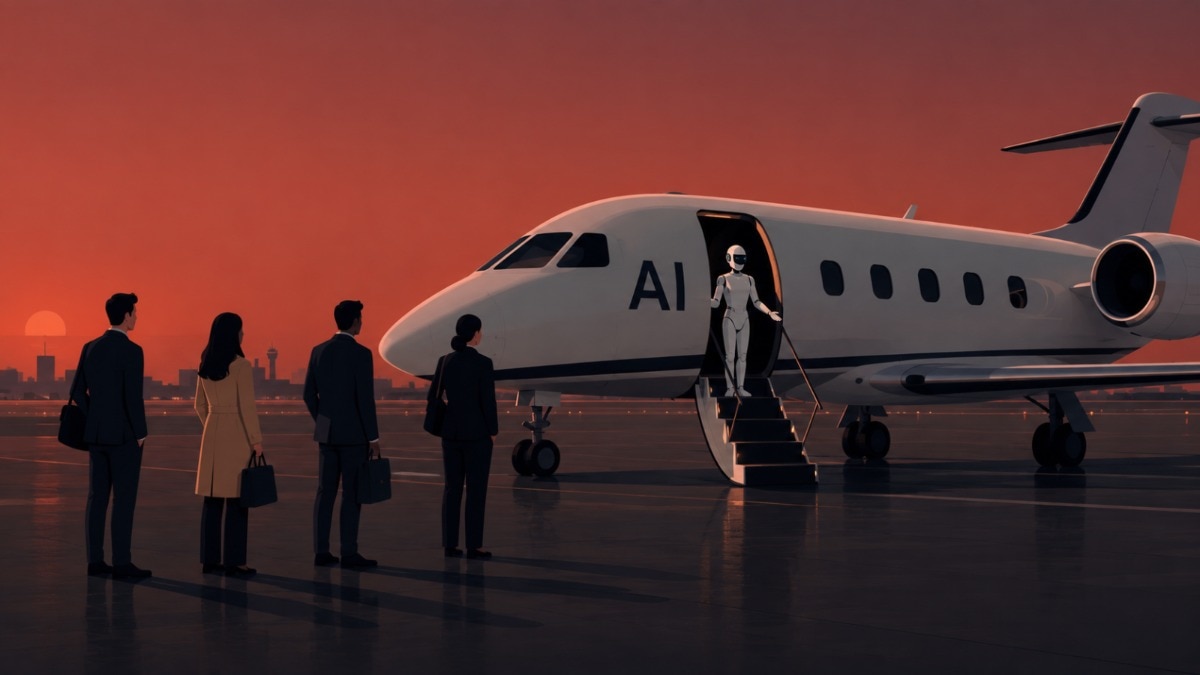
AI is beneficial but could end humanity, no one would board plane with those odds: Experts
Full Article
Original Source
Read the full article at Indiatoday →KhanList aggregates and links to publicly available news content. We do not host full articles from third-party sources. Always verify important information with original sources.