
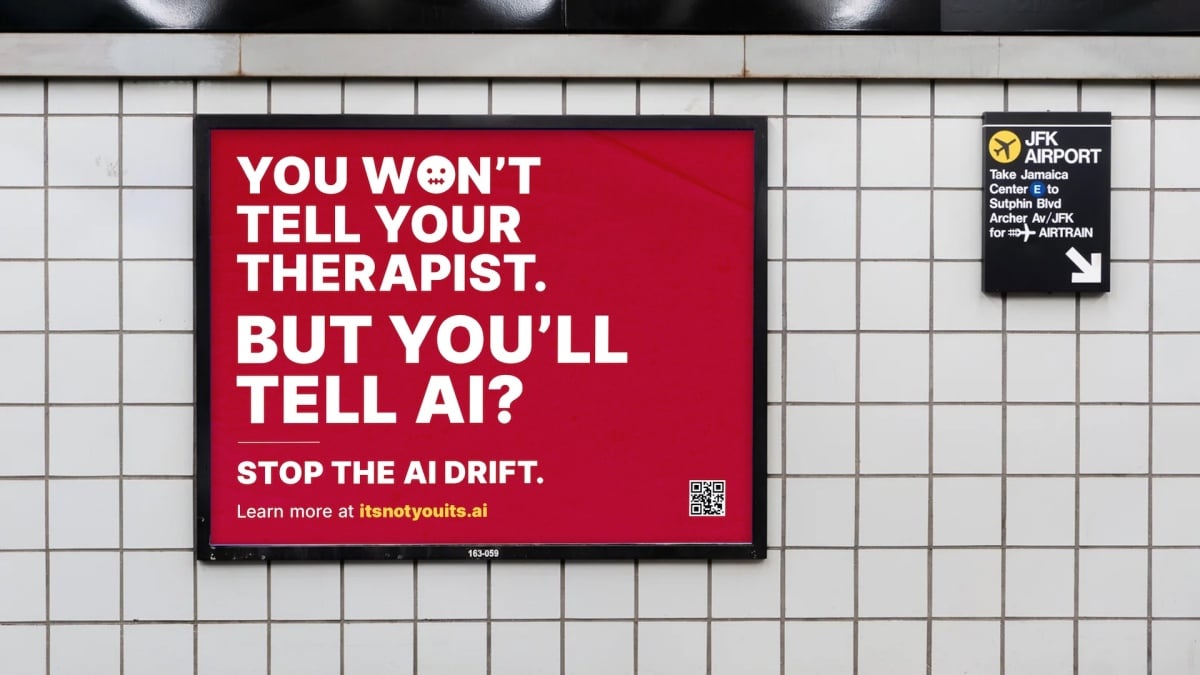
Chipper ads for artificial intelligence products are plastered all over New York City subway tunnels and cars. On Monday morning, however, a different type of AI ad debuted in the subway system with a uniquely declarative statement: Stop the AI drift. The slogan is preceded by familiar scenarios. "You won't tell your therapist. But you'll tell AI?" "Did your kid write that essay? Or was it AI?" The refrain of "stop the AI drift" is part of a campaign launched by the nonprofit Center for Humane Technology. For a month, the campaign's ads will run in numerous subway stations and cars. The campaign will also feature social media influencers who create content about AI drift. The goal is to help people name the uneasy feeling they have about outsourcing so much to AI, and invite them to reconsider using it for quintessentially human tasks and endeavors. "We define AI drift as the gradual erosion of human abilities as AI takes on more of our daily lives," Camille Carlton, senior director of strategy and impact at the nonprofit Center for Humane Technology, told Mashable. As people increasingly use AI to think, communicate, create, and act on their behalf, it comes at a cost, Carlton explained. What's lost are the skills, relationships, and meaning that give people's lives purpose.The phrase "AI drift" is a play on the term "model drift," which describes the deterioration in a machine learning model's accuracy after it's exposed to real-world data. These Stop the AI Drift ads will appear in the New York City subway system for a month. Credit: Courtesy Center for Humane Technology AI drift as a concept may seem quaint compared to the possibility that AI could kill humanity, as some safety researchers have claimed in recent weeks. Yet Carlton said it's no less of a catastrophic risk. "I think there are different ways that we can talk about really big threats to humanity when it comes to AI," she said. One of them is certainly the slow "erosion of our humanity" wherein people lose their sense of self and ability to feel the "joy of life." AI drift sneaks up on peopleWhile "Stop the AI Drift" is designed to raise awareness amongst individual consumers, Carlton isn't faulting people for turning to AI more and more. Mashable Light Speed After all, the current chatbots are designed to encourage AI drift, she said. They'll do things like write wedding vows, coach users through interpersonal conflicts, and complete homework and professional assignments — and they're available 24/7.Sloan Thompson, who presents on the risks of AI at U.S. college campuses but isn't involved in the stop AI drift campaign, said she see frequently sees students relying on AI for academic and personal matters. She said AI drift sometimes "sneaks up" on users."There is absolutely no friction or barrier between using AI in one specific area or aspect of your life, and then it just naturally flows into more intimate areas or more personal areas," said Thompson, director of education and AI Initiatives at EndTAB, a training organization focuses partially on the impact of AI on relationships and safety.Examples of AI driftThompson notes that students often say they're "conflicted" about using AI so much but feel they'll fall behind if they don't. Indeed, a recent report on AI published by the Massachusetts Institute of Technology found that the university's own students were most tempted to use a chatbot when they feared missing a deadline. Thompson said she's seen a wide spectrum of AI drift, particularly as it applies to relationships. One dating app, for example, has featured AI directly in its product through pop-ups that nudge users as they create a profile. Thompson said such advice is typically benign, though it can shape how people present themselves. At the spectrum's opposite end are AI agents that date on a user's behalf. The user may feel exhausted by online dating and use the agent to avoid the initial work of matching with a romantic interest. Whether or not they share that with their date is another story, Thompson said. She added that highly personal AI use may go undiscussed, especially when people feel stigma, embarrassment, or shame about it. How to stop AI drift Carlton is clear that stopping AI drift is dependent on changing product features that encourage AI reliance. That includes prohibiting "dangerous and deceptive anthropomorphic design," which can lead to highly personal relationships with AI. Companies should also offer products that prompt human thinking rather than default to thinking for a user, as well as build models that augment human work instead of replacing it. Tips from Stop the AI Drift campaignThe Stop the AI Drift website offers tips for preventing AI drift, including the following strategies: Save deeply personal conversations for the people in your life. Whatever task you want a chatbot to perform, "own" your initial effort before bringing AI into the process. Take one day off from AI every week. Identify what "friction" is valuable and guard itCarlton also believes AI users can try to prevent AI drift by focusing on friction, or the effort that meaningful tasks require. This is critical for human development and living a fulfilling life, Carlton said — no matter how much Silicon Valley pitches efficiency and optimization as paramount. So AI users should not surrender tasks that lead to productive and rewarding friction. This definitely includes managing interpersonal "rupture and repair," Carlton said. It also includes working through a difficult problem in the classroom or workplace. Even though the line between tool and crutch can be blurry when using AI, Carlton recommends protecting friction that leads to personal growth. Using AI to plan a trip, for example, might effectively leverage AI as a tool. Relying on it to provide feedback on an argument that happens during the trip, however, would create AI drift. "The question is about what type of friction we do we keep," Carlton said. "It's not so much about whether doing a task or a thing is hard, but it's about whether that hard part of it actually produces something for us."
AI drift: The catastrophic risk youre taking but dont realize
Full Article
Original Source
Read the full article at Mashable →KhanList aggregates and links to publicly available news content. We do not host full articles from third-party sources. Always verify important information with original sources.