
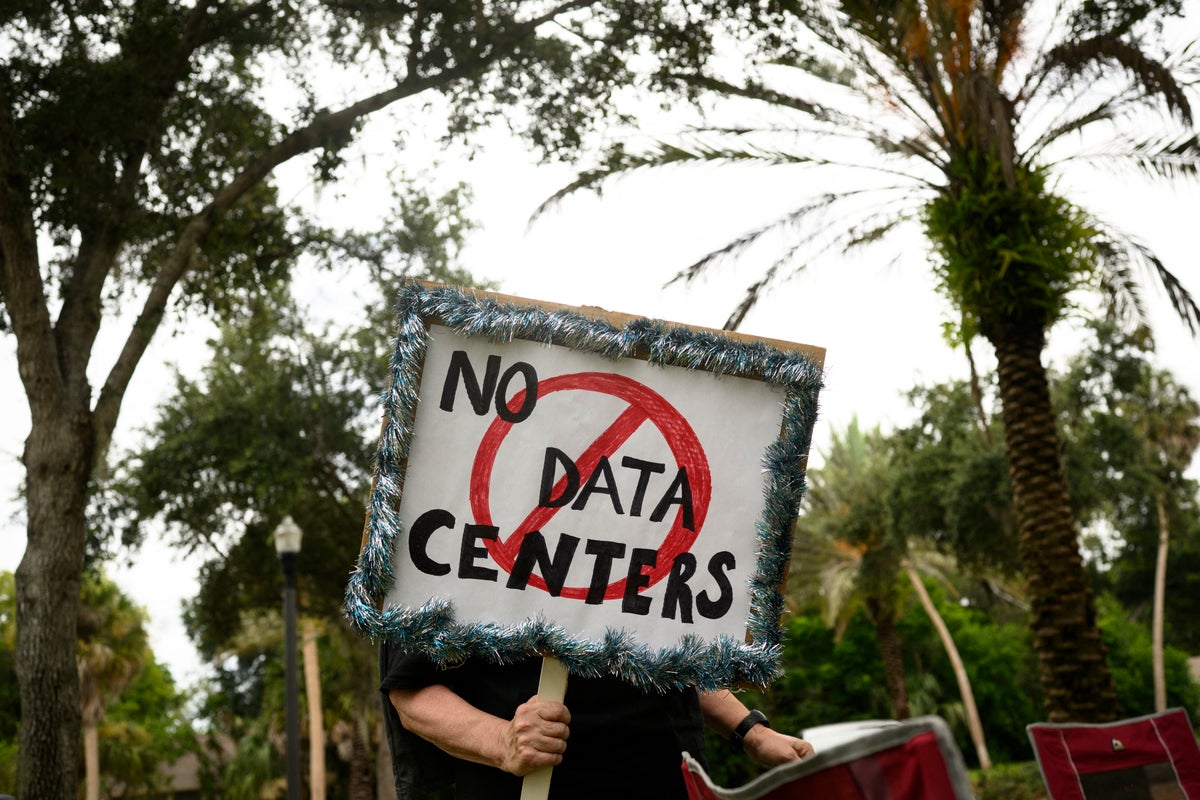
Earlier this week, President Donald Trump wandered into the data center debate, making life considerably tougher for Republican colleagues facing tight races in the November midterms.“The only reason that communities throughout the U.S.A. should not want Data Centers is if they want to end up being backwards and poor,” the president wrote on Truth Social on Monday. “If they want to be successful and rich, with far lower taxes and jobs all over the place, let Data Reign.”The president had reportedly seen polling showing that Americans largely oppose data centers, but that hasn’t stopped him from calling such facilities a “Golden Goose” and accusing critics of being in the pocket of China. Trump’s Cabinet has followed suit, even though a recent Economist/YouGov poll found that just 14 percent of Democrats and 31 percent of Republicans think new data centers are good for America. Commerce Secretary Howard Lutnick recently made the dubious claim that data centers “don’t use water,” contradicting both widely available evidence and his own comments last year that the facilities “suck” water.In recent months, Big Tech has ramped up spending on U.S. data centers, which are crucial for the artificial intelligence boom, just as backlash against data centers has exploded nationwide, amid concerns they could drive high electricity prices and drain water supplies to cool the massive facilities. The president has reportedly seen polling showing that Americans largely oppose data centers, but that hasn’t stopped him from calling such facilities a “Golden Goose” and accusing critics of being in the pocket of China (Getty)The five biggest “hyperscale” tech companies — Amazon, Microsoft, Google, Meta and Oracle — are projected to spend more than $560 billion on AI infrastructure this year, while the pace of data center construction in July was up about 60 percent year-over-year, according to the Census Bureau. By 2027, data center demand for power in the U.S. is expected to double. An estimated two-thirds of the data centers built since 2022 are located in areas of high water stress, many of them in the western U.S.Amid this whirlwind of spending and criticism, red and blue states alike are considering bans. In July, New York issued the country’s first statewide moratorium on large data center construction, which will last for one year. Facing an uphill battle to win over the public in the midterms and beyond, the AI sector has leapt into action, pouring millions of dollars into an already record-setting midterm cycle of corporate spending. The super PAC Leading the Future has raised $140 million for the midterms, according to Reuters, with plans to donate to pro-AI candidates of both parties.Candidates and AI companies are racing to respond to a growing backlash against data centers as the midterms grow near (AFP/Getty)That includes $50 million from the influential pro-AI venture capital firm Andreessen Horowitz and another combined $25 million from Greg Brockman, the president of ChatGPT-maker OpenAI, and his wife Anna, according to the Federal Election Commission. (The founders of Andreessen Horowitz supported Donald Trump during the 2024 election, though one of the venture firm’s founders also later donated to Kamala Harris, while the Brockmans have been among the top Trump donors since.)Anthropic, the creator of Claude, has reportedly donated at least $40 million through a dark money nonprofit called Public First Action, which boasts a $100 million war chest. Elon Musk’s super PAC has a similar cash pile, while Facebook owner Meta is linked to a variety of PACs with tens of millions of dollars ready to deploy.A record-setting midterm season for the AI industryAll told, AI companies have pledged about $265 million to super PACs and political groups in the 2026 elections, a Wall Street Journal analysis found. Alongside cryptocurrency and betting companies, AI is the leading industry spending money on this year’s cycle.By this past June, the 2026 midterms had already seen a record 40 percent more corporate spending than the 2024 election.Since the release of ChatGPT in 2022, AI technology has matured and the companies behind it have come to dominate the U.S. economy. It was only a matter of time before they started spending like it on political campaigns, according to Brendan Glavin, director of insights at the transparency group OpenSecrets.Construction continues on the Stargate Oracle AI data center in Abilene, Texas, which will serve OpenAI, part of the $560 billion data center buildout projected from top tech companies this year (Getty)“These newer companies like Anthropic and OpenAI are so new that this is the first time that they’ve really made a substantial jump in,” he told The Independent.The Independent has contacted Anthropic, Public First Action and Leading the Future for comment.In response to questions about the midterms, OpenAI pointed to a statement from June, which noted that that company has not donated to any candidates or campaigns and has not founded or funded any PACs. In the statement, the company confirmed that the Brockmans supported Leading the Future, but noted that OpenAI itself wasn’t involved with the group and “any engagement with that organization has been in a personal capacity, not on behalf of the company.”AI-aligned groups have often prioritized intervening directly in midterm races, even obscure ones, rather than adopting the tactics of other industries, which sometimes prefer to donate to the national wing of a political party or general midterm victory fund to signal their support and build ties. Executives at top AI firms such as OpenAI and Anthropic are key donors to the estimated $265 million the industry has put into super PACs and political groups as part of the 2026 elections (Reuters)“Crypto did this in 2024,” Glavin said of the tactics. “It was seen as successful. Now you’re seeing it repeated and AI has taken on the same playbook.”Often, AI companies have spent on TV political ads that don’t even mention AI or data centers, even though these issues are of paramount importance to the industry, instead choosing to more generally invest in or attack candidates seen as favorable to their interests.Candidates turn on data centersAI-industry money poured into the Democratic primary for New York’s 12th congressional district. The target was Alex Bores, a state assemblyman and former Palantir employee who wrote a state AI safety law signed last year. A PAC tied to Public First, the group linked with Anthropic, put more than $13 million towards supporting Bores, while a super PAC tied to Leading the Future spent more than $8 million opposing him.With an estimated $27 million in AI-related political funds spent on the race altogether, Bores was narrowly defeated by fellow assemblyman Micah Lasher.Ironically, for all the industry interest around the election, Lasher was a co-sponsor on Bores’ bill and supports a temporary national moratorium on data center construction. He said in his victory speech he wouldn’t be “taking my cues” from the companies intervening in the race. AI companies argue they design their data centers to be water- and energy-efficient, and these firms have rolled out large public spending projects in communities where they have data centers to further generate goodwill (Getty)Across the country, there’s been a similar rush of activity. More than $31 million has been spent on data center-related political ads this year, virtually all of them negative, according to a CNN analysis of AdImpact data. That’s a sea change from 2024, when there wasn’t a single ad on broadcast TV about the subject. In races up and down the ballot, red and blue candidates are competing to label their opponents as too close to data centers and the AI industry, defying the usual assumptions that Republicans are more pro-business while Democrats want more socially-minded regulation. In Texas, incumbent Republican Governor Greg Abbott, who heralded the state becoming the “epicenter of AI development” as recently as last November after a $40 billion Google investment, has ordered an audit of data center projects preparing to connect to the power grid. His challenger, Gina Hinojosa, a Democrat, wants a moratorium on new centers, and has painted Abbott as being too cozy with the industry.Data centers have emerged as an unlikely issue in the governor’s race in typically pro-business Texas, where Gov. Greg Abbott (center) has ordered a wide-ranging audit of ongoing projects (Reuters)“I think data centers are the physical manifestation in Texas of government that is working for the moneyed interests instead of the people,” she recently told The Independent.Abbot has not become entirely anti-data center. Rather, he argues the facilities must “protect our electric grid, conserve our water, respect our neighborhoods, and pay their own way.” He has called for the industry to be more transparent as new projects are developed and wants to repeal tax incentives that boost data center construction. A similar pivot has occurred in Pennsylvania, where Democratic Governor (and potential 2028 presidential candidate) Josh Shapiro went from claiming his state was “all in on AI,” after an Amazon investment, to restricting new data center development and attacking his opponent as “Pennsylvania’s #1 fan of data centers.”His rival, state treasurer Stacy Garrity, has criticized Shapiro for “gaslighting” the public, given his past support for data centers. Garrity supports a pause on data center development, and she wants the centers to bring their own water and energy supplies and offer more community oversight. In Ohio’s U.S. Senate race, Democrat Sherrod Brown has accused his opponent, Senator Jon Husted, of being the “face of data centers” for the Republican’s past work helping bring them to the state as lieutenant governor. Husted, for his part, has proposed the Ratepayer Protection Act, aimed at limiting the impact of data centers on utility bills.A skeptical public heads to the pollsHowever the AI debate plays out at the top, however AI executives spend their PAC cash and candidates position themselves, these groups will have a tough time convincing a very skeptical public to support anything tied to data centers.Just 20 percent of Americans think new data center construction is a good thing for the country, according to the recent Economist/YouGov poll. Democrats, Independents and Republicans are in agreement in largely opposing the projects.Data center projects have attracted bipartisan scrutiny for their impact on electricity prices, local watersheds and property values (Getty)Politically, data centers are a fraught, multi-faceted issue. They are tied to national and global forces — Silicon Valley, competition with China — but the projects themselves are developed at the hyper-local level: negotiated in county planning meetings, built by local workers and slotted into the local community. Debates around data centers may invoke concerns as big as the future of work in America to ones as immediate as impacts on utility bills, water sources, property values and air quality. “You can try to make an argument that data centers are not really a concern, that people are overreacting, that the tech industry should just go ahead and be able to do what it wants, but when you actually zoom into the growing number of communities that are having experiences with data centers, you can see that is not how things are actually playing out on the ground,” said tech journalist Paris Marx, author of the forthcoming Hyperscale: The Ambition and Excess of Big Tech's Data Empires.“There are very real reasons for people to be concerned about this buildout.”Add on top of that an industry that often operates confidentially, using shell companies to conceal the development of big projects and requesting lawmakers sign non-disclosure agreements, and you have a volatile environment for debate.“The moral of the story is, trying to bypass communities in developing these data centers is not working, and they’re going to take it to the polls,” Nicol Turner Lee, director of the Center for Technology Innovation at Brookings, told The Independent.The data center industry’s frequent use of NDAs and confidential negotiations has further enraged communities (AP)Making matters worse, these AI concerns come amid broader challenges with the economy, such as high fuel prices tied to the Iran war.“People right now are looking for something and someone to blame, and arguably these tech companies, which are dominated by billionaires, are becoming the moving target for local community residents,” Turner Lee said. The push to persuade America to love AI and data centers is already underway beyond the ballot box, though.AI companies try to convince midterm votersMeta has unveiled a $1 billion Future Is For Everyone fund to invest in communities where it has owns and operates data centers, and it has vowed to be “water-positive” by 2030 in these areas, restoring more water supplies than it uses. The company also has a workforce academy training skilled laborers to work on data centers.Other companies have kicked in local donations to build up recreation centers, support fire departments and fund municipal wi-fi in communities with data centers. West Virginia, where Microsoft and Nvidia are building one of the largest data centers on Earth, has floated using hyperscale data center projects to eliminating the state income tax and boost funding for schools.The Trump administration has tried a variety of approaches, from using the bully pulpit to speak with voters directly to corralling the major AI companies to sign onto its voluntary Ratepayer Protection Pledge, which shields Americans from increased energy costs tied to data centers.Residents of Davis, West Virginia, protest a potential 10,000-acre data center from Virginia-based Fundamental Data, which could be one of the largest such facilities in the world (AFP/Getty)The president, who drew major support in his 2024 campaign from the tech industry, has argued that communities which oppose data centers want to be “backwards and poor,” and he has pushed to speed up data center construction by rolling back regulations. All this back-and-forth is just the beginning.“When we roll into a presidential cycle, every presidential candidate is going to have to have a clear stance on this, and there is so much money at stake,” Glavin of OpenSecrets said.And the stakes go beyond just politics. The moment is now, according to experts, to figure out how to handle AI, with all the promise and peril it could bring to both the domestic and global economy.“The window for thoughtful, proactive policy is open now, but it will not last forever,” Chris McGuire, a former Biden administration official and senior fellow for China and emerging technologies at the Council on Foreign Relations, wrote earlier this year. “AI capabilities are compounding, as is public frustration. AI will force itself onto the political agenda in 2028. When it does, the American people will expect policymakers to have serious answers ready.”
AI companies are dumping $265M into the midterms as data center backlash sweeps through communities
Full Article
Original Source
Read the full article at Independent →KhanList aggregates and links to publicly available news content. We do not host full articles from third-party sources. Always verify important information with original sources.