
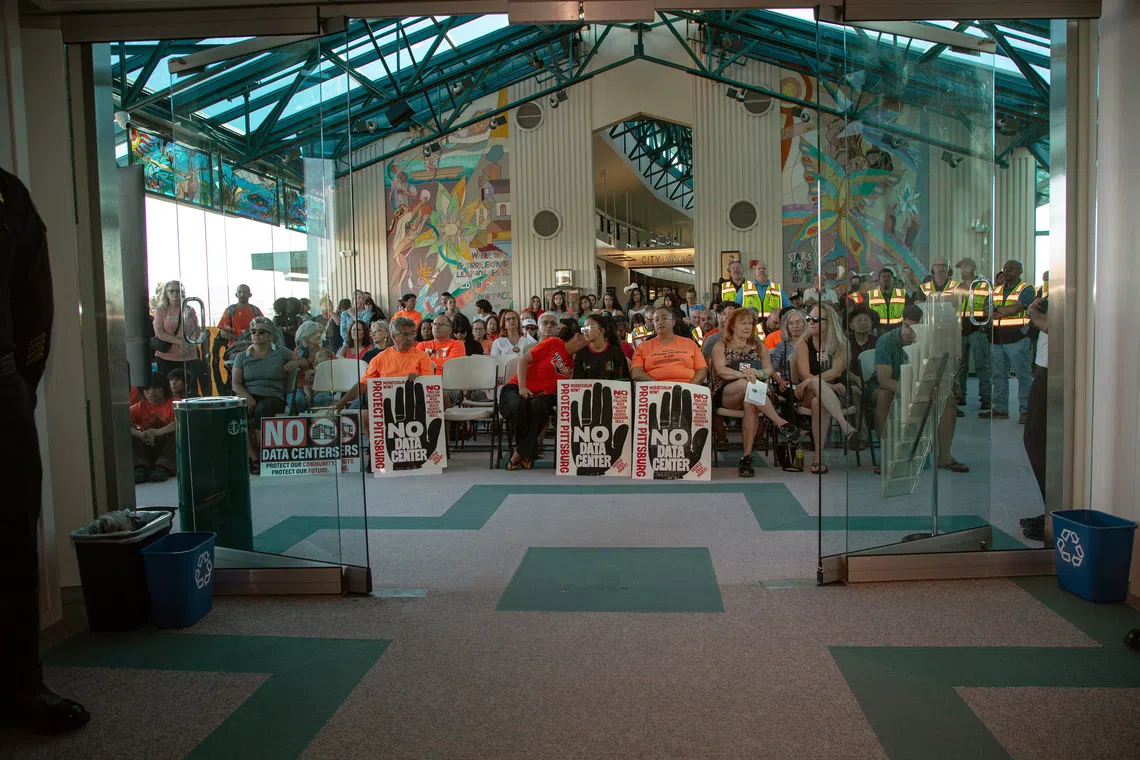
PHILADELPHIA - Democrat Paige Cognetti invoked a painful chapter from Pennsylvania’s past in her bid to wrest away one of the state’s most competitive congressional districts from her opponent.“Big companies have come before, taken what they wanted and left us with their mess to clean up,” said Cognetti in a campaign ad targeting Republican Rob Bresnahan who has received President Donald Trump’s endorsement.“Now it’s data centres,” she said, shrewdly connecting national anxieties about job losses, automation and Big Tech to local worries about higher utility bills and simmering distrust of the promise that a disruption today brings prosperity tomorrow.Hardly any election is about a single issue, however, and in 2026, the vote-driving issue is still the affordability of groceries, petrol and mortgages. But the new kid on the ballot block is the data centre, the indispensable physical infrastructure enabling intangible AI, a vivid political symbol that captures the broader squeeze.Going by the attention it is getting from voters, candidates, interest groups and the media, AI is now approaching the resonance that abortion rights had in the 2022 elections in the middle of then president Joe Biden’s term. Then, too, inflation and the cost of living had dominated minds. But along came a Supreme Court decision that overturned the Roe v Wade verdict that had protected a woman’s right to decide whether to continue a pregnancy. The forecast of a “red wave” – based on the Republican advantage on handling the economy – was reduced to a narrow majority in the House.Several grievances easily attach to data centres, the large buildings giving off an unfriendly droning noise that one fed-up resident described as “a plane in the sky that never lands”. Often, they spring up with little notice in the neighbourhood sparking moral outrage that the local community is paying the price while tech billionaires are profiting disproportionately. Closer to the wallet are the worries about shooting utility bills, grid capacity, land use and water scarcity.The concerns cut particularly deep in Pennsylvania, which has seen this movie before. There is collective trauma from the 1980s and the 1990s when the state “lost” steel, apparel and furniture industries to China, Mexico or other lower cost assembly locations. Good-paying union jobs vanished, with some areas seeing unemployment rates zoom to almost 20 per cent. Local schools, diners, churches, Little League teams all took a hit. Politicians in Pennsylvania, which has more than 100 data centres on the drawing board, are sobered by a Quinnipiac poll from July 2026 which showed that nearly three-fourths of the state’s voters do not want them in their backyards. The state does not have an official count of data centres and according to privately tracking site US Data Center Map, there are 93 operational centres and 6 under construction.The sour sentiment has prompted a major policy reversal by the state’s Democratic Governor Josh Shapiro, who is seeking reelection in November. He has gone from touting data centre investments, like a US$20 billion (S$25.4 billion) Amazon project in June 2025, to withholding promises of expedited permits and tax benefits. On Aug 18, he announced rules that he called “the strictest guardrails in the nation” that require developers to meet binding standards on electricity costs, water use and transparency.His Republican opponent Stacy Garrity offers voters even more: a statewide moratorium on new data centre development while slamming Shapiro as the “biggest data centre cheerleader in the nation.”The stakes are high in the biggest battleground state in US politics. Led by Shapiro, who has a comfortable lead in the governor’s race, Pennsylvania Democrats can achieve a state-level legislative trifecta if they can pick up three more seats in the state senate and retain their control of the house. In that quest, they have targeted Republicans who have obstructed legislation regulating data centres and allowed tax breaks for developers. The AI buildout issue has entered electoral calculations in state after state. In neighbouring Ohio, a one-time swing state that has been loyal to Republicans in recent presidential elections, polling on data centres and other issues suggests the state may turn purple again.Sherrod Brown, a Democrat who served as Ohio Senator for 18 years before losing his seat in 2024, has fine-tuned his comeback campaign. “I’ll require the data centres to pay the full cost of their electricity, not you,” he said in a recent campaign ad.Texas Governor Greg Abbott, a pro-AI Republican, has asked for an audit of data centre development as his re-election race tightens.In Florida, his fellow party man Byron Donalds seeking to be the next governor, is promising to “protect Florida families and communities from data centers that jack up utility rates and make everything else more expensive.” New York’s Democratic Governor Kathy Hochul, seeking a second term, has ordered a one-year moratorium on large new data centres.Only Trump appears undeterred by the voter negativity, blaming it on interference from China.The shift in national mood on AI has been striking. The Pew Research Center’s June 2026 survey said 52 per cent of Americans were more concerned – than excited – about the growing use of AI in daily life, up from 37 per cent in 2021. Fully 71 per cent expect AI to kill jobs over the next two decades versus five per cent who expect it to create more. The debate has ensnared leading tech titans too, in a typical way that has appeared repeatedly in American history, about who should be trusted to manage a powerful technology reshaping nearly every aspect of life.Both Bill Gates and Mark Zuckerberg, the founders of Microsoft and Meta, respectively, believe AI will be transformative but disagree on whether its deployment should proceed without speed bumps. In a long essay published on Aug 26, Gates warned that AI could become “the greatest equaliser ever invented or the worst source of injustice” in one of the most turbulent times in human history. It could weaken social mobility, empower criminals, damage children’s development and concentrate gains among corporates. Governments must prepare for these eventualities, he said.Only a couple of weeks ago, Meta’s Mark Zuckerberg offered a much more optimistic take. His concern, laid out in an Aug 10 note, was that AI could be monopolised by governments or a few institutions. AI could eliminate most jobs, he also said, but saw it as a route to abundance and supporting a “new era of personal empowerment” to create, learn and build relationships and businesses with help from exceptionally capable agentic AI, systems that can perform tasks autonomously.Intellectual sparring over AI also played out in a recent high-profile spat between The Economist and a top economist, Daron Acemoglu, a 2024 Nobel laureate.Acemoglu, leaning towards Gates’ side of the argument, is pushing for a “pro-worker AI”, urging policymakers and firms to steer AI towards complementing rather than replacing workers. For instance, AI that helps nurses diagnose ailments or technicians repair equipment.The Economist dismissed that as vague and impractical and expects market discipline to create a good outcome by default in an AI-driven economy. Acemoglu sees a hands-free stance leading to loss of dignity for workers, creating wealth inequality and undermining democracy.Both have pronounced the other “oddly unconvincing”.The debate, in which politicians are hedging, is likely to remain a big question in the imminent midterms and possibly for many more elections to come.
AI becomes a US midterm elections issue
Full Article
Original Source
Read the full article at Straitstimes →KhanList aggregates and links to publicly available news content. We do not host full articles from third-party sources. Always verify important information with original sources.