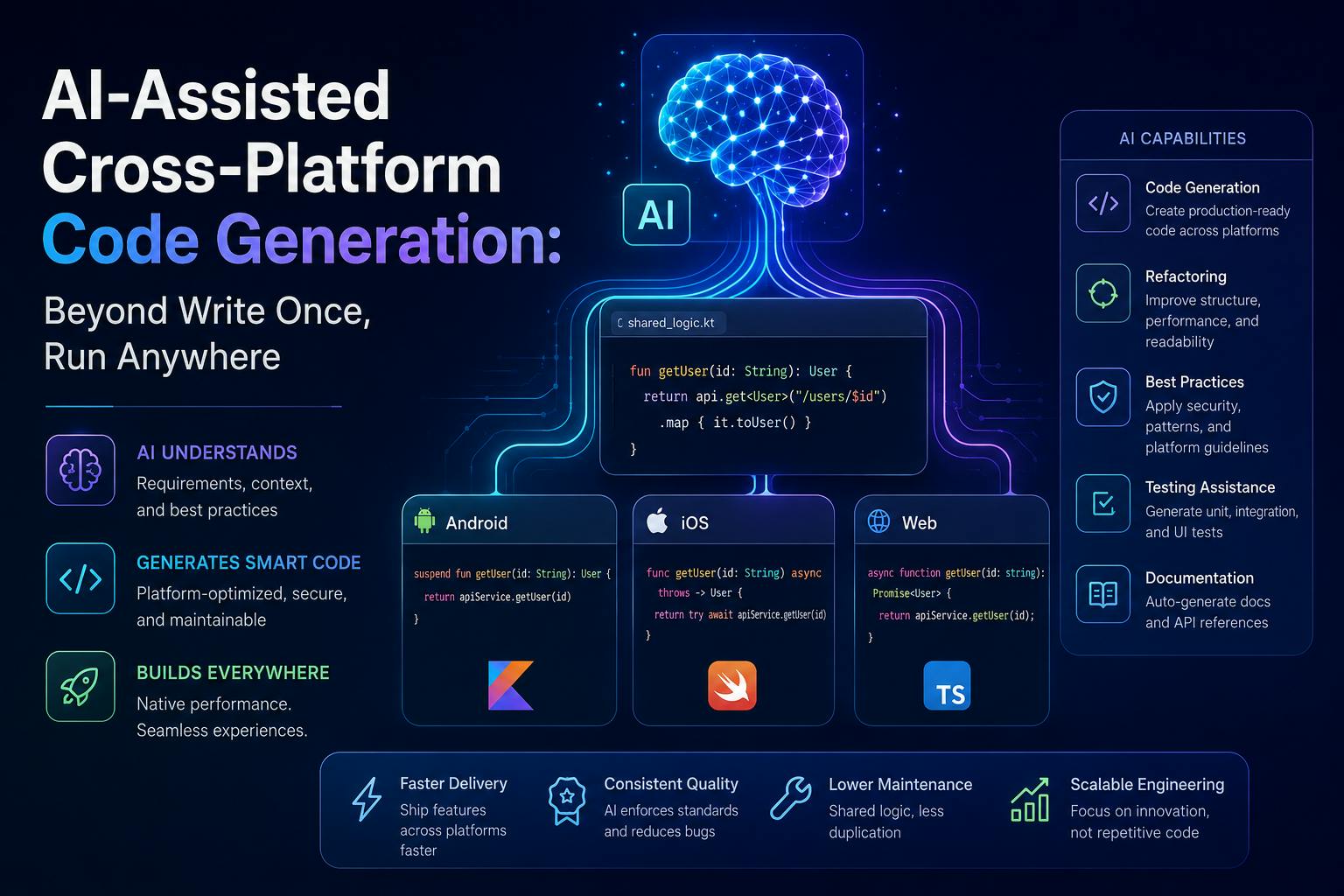
Cross-platform development has always promised leverage, but production software has rarely matched the fantasy of one codebase erasing every platform difference. Modern frameworks already reflect that reality. React Native renders through native platform APIs instead of emulating widgets, Flutter documents platform channels and Pigeon for structured host integration, and Kotlin Multiplatform explicitly supports selective sharing of business logic, UI, or both, while keeping escape hatches for native code when needed. At the same time, coding agents have moved beyond autocomplete into repo-aware systems that read codebases, edit files, run commands, and prepare pull requests. The result is a different model of cross-platform engineering not one universal artifact, but AI-assisted generation of shared logic, typed adapters, and platform-specific implementations from a controlled set of contracts. Cross-Platform Development Has Become Selective, Not Absolute The phrase “write once, run anywhere” has become less useful than “share deliberately, specialize explicitly.” Kotlin Multiplatform’s current guidance recommends separating app entry points from shared modules and, when necessary, splitting shared business logic from shared UI so native presentation layers do not inherit unnecessary dependencies. React Native’s New Architecture makes the same point from a different direction such as typed specifications define the boundary, and Codegen generates Android and iOS interfaces from that specification. Flutter reaches a similar destination with Pigeon, which generates structured, type-safe channel code rather than relying on manually coordinated string-based messaging. The common thread is that the winning abstraction is not universal rendering. It is typed intent with controlled native seams. That change matters because AI is strongest where the problem is high-volume, repetitive, and constrained by contracts. Real software engineering evaluation has already moved far beyond single-function completion. SWE-bench was created from real GitHub issues and corresponding pull requests, and its authors emphasize that these tasks require coordinated edits across multiple files, long contexts, and execution-aware reasoning. Code-oriented models have likewise advanced toward long-context reasoning and infilling rather than mere next-token completion. In practice, this means AI is increasingly useful for generating the predictable parts of cross-platform systems, such as DTOs, validation layers, adapter code, test scaffolds, and native bridge stubs, while humans still define the architectural boundaries and review the semantic correctness of the result. Typed Contracts Are the Real Source of Reuse The most reliable pipeline starts from a machine-checkable contract rather than a natural-language prompt alone. OpenAI’s Structured Outputs feature is designed to keep model responses aligned with a supplied JSON Schema, which makes it practical to ask a model for a feature manifest instead of raw source files. That manifest can then drive deterministic generators for Kotlin Multiplatform modules, React Native native specs, Flutter Pigeon definitions, or web clients. In other words, AI should produce the intent model, while standard build tooling produces as much code as possible. This reduces drift, shrinks the review surface, and keeps future regeneration cheap. A production pipeline often benefits from a schema that describes shared entities, target platforms, and explicit native capabilities. The generated artifacts should remain disposable. A concise example is a sealed feature manifest in which the model returns only validated structure: jsonCopy{ "feature": "deviceTrust", "targets": ["android", "ios", "web"], "sharedEntities": ["DeviceProfile", "TrustDecision"], "nativeCapabilities": ["biometrics", "secureStorage"], "deliverables": ["sharedValidation", "platformAdapters", "contractTests"] } Once that manifest passes schema validation, a generator can emit platform folders, typed interfaces, and test placeholders. This pattern mirrors what React Native and Flutter already formalize in their own tooling, a typed specification feeds code generation for platform boundaries. AI becomes the front end for authoring the specification, not the only author of the final code. Native Seams Should Be Generated, Then Kept Explicit Cross-platform code becomes fragile when native assumptions are hidden inside shared logic. Kotlin Multiplatform’s expect and actual mechanism is a useful pattern for AI-assisted generation because it lets shared code depend on a platform-agnostic API while each target provides its own implementation. A minimal example looks like this: kotlinCopyexpect suspend fun isBiometricAvailable(): Boolean class LoginPolicy { suspend fun canOfferBiometrics(deviceTrusted: Boolean): Boolean { return deviceTrusted && isBiometricAvailable() } } The shared rule is deterministic and testable, while Android and iOS each provide the actual implementation. This is exactly the kind of code AI can generate safely when the contract is narrow and the target surface is known. It also aligns with Kotlin documentation, which positions expected and actual declarations as the standard way to access platform-specific APIs from common code. The same principle applies in React Native and Flutter. In React Native’s New Architecture, a typed specification in TypeScript or Flow is consumed by Codegen to produce platform-specific interfaces for Android and iOS. In Flutter, Pigeon generates type-safe messaging code between Dart and host platforms. An AI agent can therefore generate the specification and the initial native implementation skeletons, but the build system remains responsible for turning that specification into concrete bindings. That division of labor matters because generated code is most stable when platform-specific lifecycles, permissions, and security APIs remain visible in their native homes rather than being abstracted away into opaque prompt output. Production-Grade Generation Requires Build, Security, and Evaluation Loops The jump from impressive demo to production asset does not happen inside the model. It happens inside CI, code review, and evaluation. GitHub Actions explicitly supports automated build, test, and deployment workflows, and matrix strategies make it straightforward to run the same change set across Linux, Windows, and macOS, or across different platform targets in one pull request. For AI-generated cross-platform code, this should be non-negotiable. Every generated patch should compile shared modules, compile each platform target, run contract tests, and fail fast on divergence between platform implementations. Security scanning belongs in the same loop. GitHub code scanning is designed to analyze repositories for vulnerabilities and coding errors, surface alerts, and prevent newly introduced problems from landing unnoticed. That matters because AI-generated bridge code often touches serialization, storage, permissions, and networking layers that become attractive places for subtle defects. Tool vendors also make the validation requirement explicit. Google’s enterprise documentation for Gemini Code Assist states that generated output may appear plausible while being factually incorrect and should be validated before use. The correct posture is therefore conservative and treat AI as a fast patch author, not as an exception to the normal security and quality gates. Evaluation is the last missing piece. OpenAI’s guidance on evals stresses that generative systems are variable and that traditional software testing alone is insufficient for AI architectures. For cross-platform generation, evaluation should cover both model behavior and artifact behavior. The model layer should be measured for schema compliance, target selection accuracy, and forbidden API usage. The artifact layer should be measured for build success, test pass rate, binary compatibility, and parity across platforms. Agentic tools from Anthropic, GitHub, and Google can read repositories, modify files, and automate development tasks, but that additional autonomy only increases the need for deterministic acceptance gates. The reliable pattern is not autonomous generation followed by trust. It is autonomous generation followed by compilation, scanning, evaluation, and review. Conclusion AI-assisted cross-platform development is most effective when it abandons the old dream of a single artifact replacing platform engineering. The more durable model is contract-first generation shared business logic where reuse is real, generated native adapters where repetition is high, and explicit platform ownership where operating-system behavior still matters. Current framework design already points in that direction through Kotlin Multiplatform source-set separation, React Native Codegen, and Flutter’s typed host integration. Current coding agents then add a practical acceleration layer by generating manifests, adapters, tests, and pull requests around those contracts. Production value emerges only when that speed is constrained by schema validation, matrix builds, code scanning, and evaluation. Beyond write once, run anywhere, the real opportunity is generate precisely, verify relentlessly, and specialize where the platform demands it.
AI-Assisted Cross-Platform Code Generation: Beyond Write Once, Run Anywhere
Full Article
Original Source
Read the full article at Hackernoon →KhanList aggregates and links to publicly available news content. We do not host full articles from third-party sources. Always verify important information with original sources.