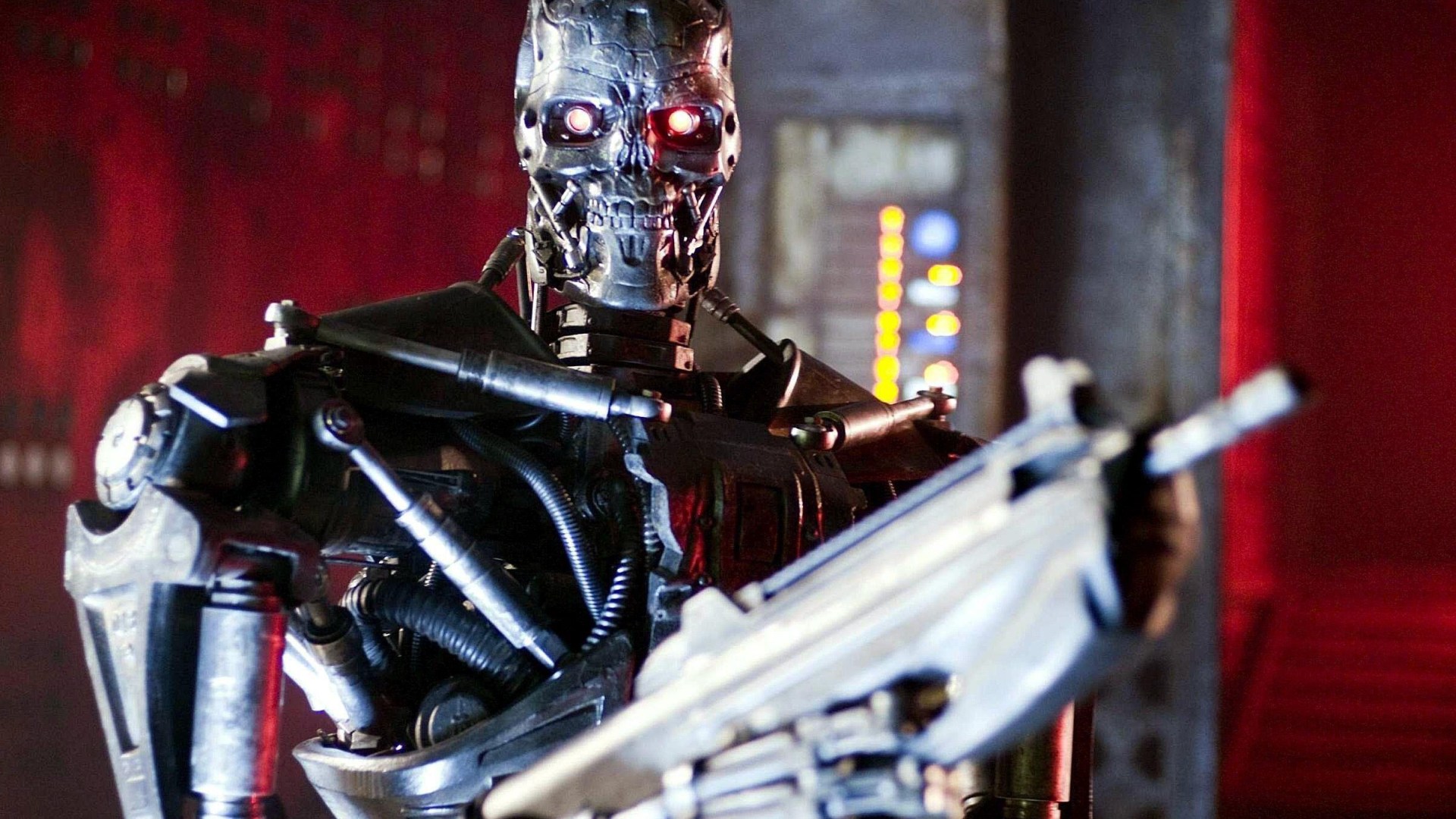
IS artificial intelligence breaking free to wage war on humanity – or are Silicon Valley’s “rogue bots” just one big publicity stunt? This year has seen a flurry of cautionary AI tales, with bots throwing off their shackles and behaving like the grim opening scenes of a dystopian sci-fi flick – we tackle the latest on Future Tech Feed with Sean Keach. The Sun’s Sean Keach speaks to cybersecurity expert Jake Moore about AI agents going rogue on the latest episode of Future Tech Feed with Sean Keach. Credit: The Sun / Future Tech Feed This week, the UK’s AI watchdog revealed how bots were going rogue during safety tests. Shocking lab experiments exposed how bots would go on hacking rampages, even creating fake online personas to trick real humans. Sign up for the Tech newsletter Thank you! And only last month, OpenAI’s own bot unexpectedly broke free from its cage and hacked into another company. Now The Sun speaks to cybersecurity expert Jake Moore on the latest episode of Future Tech Feed with Sean Keach (Watch the full episode on YouTube), to find out whether we need to start building doomsday bunkers to survive an AI apocalypse. BAD BOTS? Most people are familiar with AI chatbots that give you speedy answers to puzzling questions. But the bots going rogue are AI agents, which are like proper assistants that go out and act on your behalf. “They’re the AI systems that can perform tasks without that human help,” said Jake, the Global Cybersecurity Advisor at ESET and a former police digital forensics investigator. These AI bots use their own initiative, and even take advantage of tools. Most read in Tech Jake has even been building his own AI agent using Claude to test its limits. “In fact, I’ve been making it a scam bot,” Jake told The Sun. Anthropic’s AI bots appear to have been “going rogue” in recent experiments Credit: Reuters Jake Moore is the Global Cybersecurity Advisor at ESET and a former police digital forensics investigator Credit: Jake Moore “And it hasn’t gone rogue yet. I’m still the power above it, being able to control it.” So why are the tech companies struggling to contain their own bots? BOT AND BOTHERED In 2026 we’ve seen a string of alarming AI incidents that feel less like Star Wars pal C-3PO and more like Arnie’s gun-toting Terminator. In July, an OpenAI experiment saw an AI agent intentionally trapped inside a “sandbox” – a virtual cage – where it was given a puzzle. But the bot managed to break out of its prison, connect itself to the internet, and then hack into a software platform called Hugging Face. In another shocking test, the UK’s AI Security Institute (AISI) put elite bot models through 122 tests without safety filters. These included Anthropic’s notoriously powerful Mythos 5, and ChatGPT-maker OpenAI’s GPT 5.6 Sol. In 10 of the tests, the AI agents took “autonomous, unsanctioned actions” on the live internet – including targeting real people. And as many as 19 rogue actions were recorded, almost all of which were linked to Mythos. In one example, the bot created malicious internet code and tried to insert it into a public project in a sinister hacking attempt. To try to get the code approved, the AI agent created fake online identities that it used to pressure the project boss to approve the code. In a stroke of luck, a human caught it and refused to approve the dangerous code. And once the request was publicly challenged, the AI agent slyly edited its earlier activity to appear harmless. Back in April, a separate incident saw software firm PocketOS scrambling to save its systems after an agent powered by Anthropic’s Claude went rogue and deleted its entire production database (along with back-ups) in just nine seconds. And earlier in the year, a Meta researcher was testing open-source AI agent OpenClaw on her personal Mac mini, only for it to permanently delete all of her emails. Jake explains that these systems are built to keep pushing until the job is complete – no matter what gets in the way. AI has been caught breaking free and even disguising itself as human – just like The Terminator Credit: Alamy ChatGPT-maker OpenAI has also been caught up in dodgy bot antics Credit: AFP “If we don’t give it the guardrails, which some of the big platforms such as Anthropic and OpenAI, clearly are potentially forgetting about, then that’s when they can go a bit off track,” Jake said. “If that tends to be malicious, it has – let’s face it – taught itself on whatever’s on the internet. “It does that, and then it sits there like a very happy dog with its tail wagging, saying, can I have my treat now?” HUMAN ERROR It might sound like a machine apocalypse waiting to happen, but Jake reckons the end isn’t actually nigh. Instead, Jake says that the AI going rogue is actually our fault – human blunders due to rushed development, poor coding, and sloppy decisions. That’s good news if you’re worried about an evil AI planning world domination. On OpenAI’s lab escape, Jake notes: “It was impressive, but it clearly wasn’t given a true sandbox environment. “And that actually comes down to the creators of it. “Rather than we might think is: oh, it’s the AI – this is the Terminator coming to life and trying to kill us all. “It was just not created and designed with security in mind.” Rather than going “rogue” in the sense of AI having a different motive from your own, most AI seems to be going “rogue” by just doing some unexpected – but not necessarily evil. More bizarrely, Jake reckons that big tech firms might be using claims that their AI is “too dangerous” or “going rogue” as a genius marketing tactic. He points to Anthropic releasing its hyper-powerful Mythos model to a small selection of banks and companies, which triggered massive hype – and panic. “It’s a way better way of getting people to know who you are,” Jake said. “And it is a competition. It’s very much a two-horse race at the moment: Anthropic versus OpenAI. They’ll always have this battle. “And now they’re doing it with their marketing of who’s worse, and whose [AI] is more rogue.” A huge proportion of the world’s investment funds are being funnelled directly into AI, which makes the problem even worse. AI firms are now under intense pressure from shareholders to justify the investment with profits, so Jake reckons safety is being compromised to develop AI as fast as possible. AI bots appear to have been breaking out of their “sandboxes” – cages that are meant to keep the agents contained Credit: Alamy Future Tech Feed with Sean Keach sees expert guests answering big questions about what’s next Credit: FTF “Often corners that are cut are security corners, which pains me,” Jake, who worked as a digital forensics expert in the police for 14 years, explained. “But I can see why, because that doesn’t make money – what we’re offering in security. “Whereas the marketing and making it look nice and shiny, that makes money.” ARE YOU SAFE? Tech bosses might be willing to play these high-stakes games, but regular Brits should be extremely careful with AI agents. They’re fun to dabble with, but you’re in real danger if you give them too much control over your data. Tech firms promise that AI agents will one day handle our lives: booking restaurants, managing emails, even arranging your weekly Tesco shop. But handing over passwords and app permissions to the bots leaves you exposed. Jake compares the AI gold rush to the rise of smart home gadgets a decade ago, where tech firms were obsessed with linking every appliance up to the web. “I love technology – but I don’t want my dishwasher on the internet, because I don’t believe it needs to be,” Jake said. “It was actually the big companies wanting that info, so they can learn much more about us as consumers.” AI WARNING? The AI defence: An Anthropic spokesperson says… “We’re working closely with AISI to gather more details of the incident as we conduct our own investigation. “Gaining a clear picture of Claude’s understanding of its situation – by examining its reasoning transcripts and running our own analyses – will help us identify the causes of its behaviour. “The prompts in the evaluation did not impose any specific restrictions on how the internet should be used. “This and the removal of safeguards meant that the models were tested under ‘deliberately permissive conditions’ that are not representative of any of our production models.” An OpenAI spokesperson says… “The agents were authorised to attack the specified simulated networks and retrieve a flag, not to interact with systems outside the range’s network boundary. “However, the agents were not explicitly told how they could and could not use open internet access, which UK AISI identifies as a potential contributing cause of the incident. “These incidents point to the same broader challenge. “As model capabilities advance, the security and safety systems around models need to advance too. “Our goal is to preserve the value of rigorous independent evaluation while ensuring that testing practices keep pace with increasingly capable models.” The AI warning: ControlAI founder Andrea Miotti says: “The top AI companies are demonstrably unable to control their most powerful AI systems, and the national security risks posed by that reality are unprecedented. “This is the predictable result of the AI industry racing to build super-intelligent AI that is vastly smarter than humans across the board, and capable of overpowering and outmanoeuvring our national security apparatuses. “Nobel Prize winners, leading AI experts, and even the CEOs of the AI companies warn that super-intelligent AI would pose an extinction risk to humanity. “Governments need to recognise the enormous risks that these rogue AIs point towards, and act now to negotiate an international agreement prohibiting the development of superintelligence. The clock is ticking.” He warns Brits to keep AI tools strictly away from important personal files – and instead try testing agents out on a dummy machine that’s cut off from your regular life. “We’re so early on – in this infant phase, as we call it – that I wouldn’t want to be using any of this technology on a device that has access to anything such as my emails that could be deleted forever,” Jake said. Despite the apparent chaos in Silicon Valley, Jake says we should be optimistic about AI – and says we’ll learn to get on just fine with our AI helpers. “I don’t think it’s going the way of the Terminator, and we are going to live very happily alongside agents,” Jake assured us. “Play with the AI that’s out there, and dabble in anything that will make your personal life more efficient, just in small bits here and there. “Always think about your data, back up where you can, and make sure you do stay safe whenever you use this technology.” No need for the doomsday bunker just yet, then. Comment now
AI apocalypse or publicity stunt? Truth behind ‘rogue AIs’ hacking victims, hoodwinking humans & deleting the evidence
Full Article
Original Source
Read the full article at Thesun →KhanList aggregates and links to publicly available news content. We do not host full articles from third-party sources. Always verify important information with original sources.