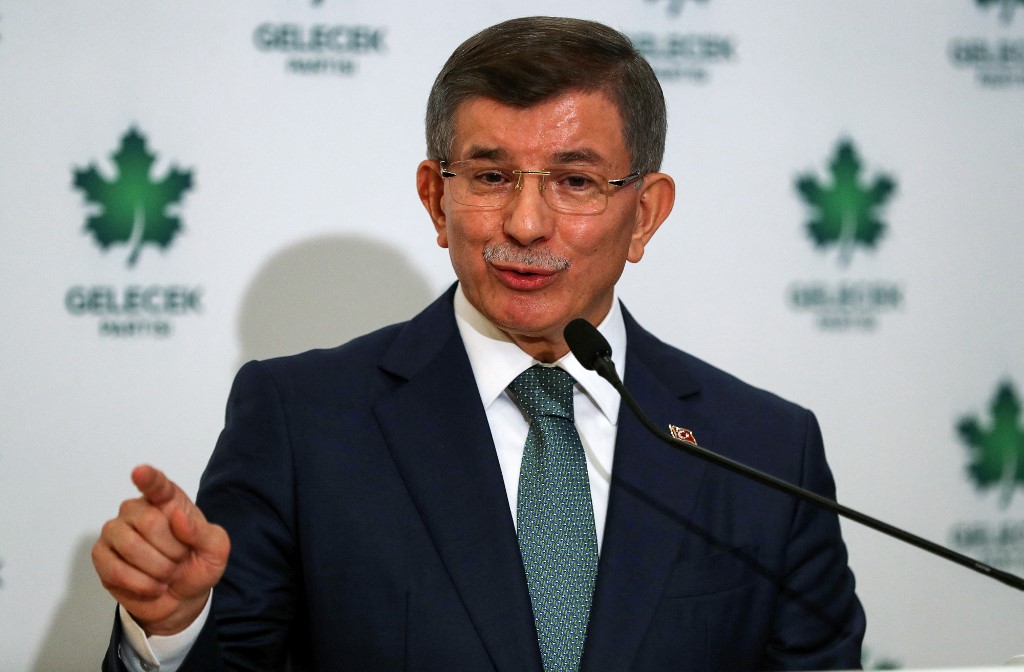
Davutoglu’s Future Party failed to challenge the ruling AKP despite securing parliamentary seats through an opposition alliance Former Turkish prime minister and Future Party chairman Ahmet Davutoglu gives a press conference after his party's meeting in Ankara, on 19 December 2019 (Adem Altan/AFP) Published date: 29 July 2026 21:19 BST | Last update: 7 sec ago Former Turkish Prime Minister Ahmet Davutoglu on Wednesday announced that he was dissolving his Future Party and withdrawing from party politics. Davutoglu, a former close ally of Turkish President Recep Tayyip Erdogan, said in a written statement posted on X that he was leaving “party politics” because of the country’s “dirty political climate”. “This is not a decision of surrender. It is a decision to distance ourselves morally. This is not giving up on politics; it is a call for everyone to rethink politics,” he said. He warned that the introduction of the executive presidential system in 2018 had eliminated checks and balances and accelerated authoritarianism, which “could give way to a permanent authoritarian system.” Davutoglu founded the Future Party in 2019, hoping to draw voters away from Erdogan's long-time ruling Justice and Development Party (AKP) and create an alternative conservative movement with democratic credentials. New MEE newsletter: Jerusalem Dispatch Sign up to get the latest insights and analysis on Israel-Palestine, alongside Turkey Unpacked and other MEE newsletters However, his plans failed to gain traction. The party struggled to present itself as a credible alternative to the AKP and received only 0.11 percent of the vote in the 2024 local elections. Davutoglu’s decision to join the Table of Six opposition coalition and support Kemal Kilicdaroglu, then-chairman of the Republican People’s Party (CHP), in the 2023 presidential election also eroded his standing among conservative voters. Many conservatives have long harboured reservations about the CHP’s secularist positions, dating back to the founding of the Turkish republic. The coalition still pushed the Future Party forward to secure 10 seats in parliament in the 2023 general election. The party currently has four MPs after others defected to the AKP and other opposition parties. A person familiar with Davutoglu’s thinking told Middle East Eye that the party had been experiencing financial difficulties and was finding it increasingly challenging to maintain and fund its organisation. Erdogan shuts down Turkish university linked to rival Davutoglu Read More » Several Ankara-based political sources told MEE last year that Davutoglu had held negotiations on merging the Future Party with the AKP. However, Erdogan opposed the inclusion of Davutoglu and one of his close associates, former AKP official Selcuk Ozdag, leading to the collapse of the talks. Known as a doctrinaire foreign minister and a well-regarded academic, Davutoglu sought to deepen Turkey’s engagement with the Middle East and North Africa through his “zero problems with neighbours” policy, marking a departure from Ankara’s traditionally cautious approach to relations with Arab states. He became prime minister in 2014 after Erdogan was elected president, initially serving as one of his most trusted deputies. Tensions between the two men steadily increased in 2015, particularly after Davutoglu led the AKP to victory in the November 2015 snap election. Davutoglu was said to have argued privately that political power should rest with the office of the prime minister rather than the presidency, citing the parliamentary nature of Turkey’s constitution at the time. The infighting eventually led to his removal from office in 2016. He was further sidelined following the 2018 presidential election. The closure in 2020 of Istanbul Sehir University, which Davutoglu founded, further deepened the rift between the former allies. Middle East Eye delivers independent and unrivalled coverage and analysis of the Middle East, North Africa and beyond. To learn more about republishing this content and the associated fees, please fill out this form. More about MEE can be found here.
Ahmet Davutoglu, former PM turned Erdogan critic, ends political career
Full Article
Original Source
Read the full article at Middleeasteye →KhanList aggregates and links to publicly available news content. We do not host full articles from third-party sources. Always verify important information with original sources.