
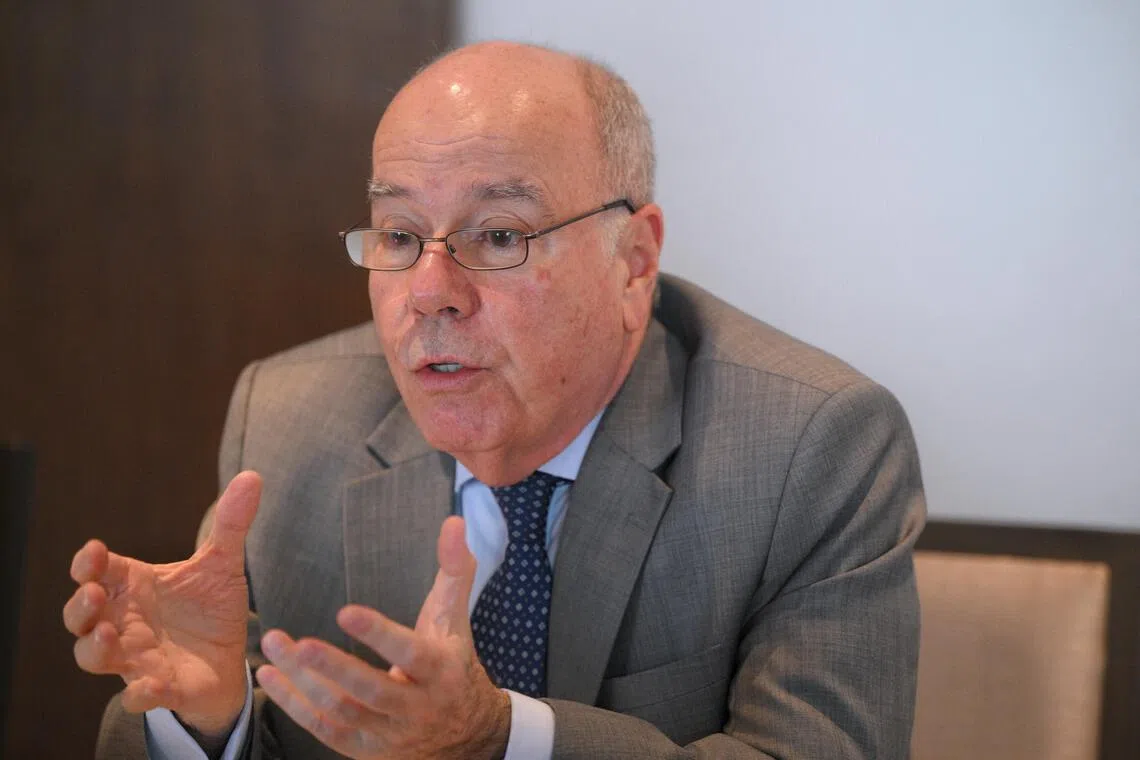
SINGAPORE – Days before leaders from around the world gather in New Delhi for the 18th BRICS Summit, Brazilian Foreign Minister Mauro Vieira has cautioned against characterising the grouping as an anti-Western bloc.He also dismissed claims that BRICS – an 11-member bloc of emerging markets – intends to challenge the US dollar and refuted speculations that the bloc is pursuing de-dollarisation or attempting to create a joint BRICS currency.A few BRICS leaders, including Brazilian President Luiz Inacio Lula da Silva, had previously entertained the possibility in their public addresses. However, the bloc has made no formal proposals for de-dollarisation or a BRICS currency.“I think it’s a mistake to say that BRICS is looking for the promotion of de-dollarisation or creating a new currency. It’s not,” Vieira said.Instead, he highlighted efforts by BRICS countries to establish voluntary, low-cost payment mechanisms that allow member states to settle bilateral trade in a currency of their choice, whether their own, euros, or dollars.“It’s not going away from the dollar; it’s creating new ways to promote trade and to have a fast system, direct system, and, of course, also a cheaper system of bilateral trade among countries,” he added.Increased transactions in local currencies, however, even if not aimed at de-dollarisation, can create a de facto shift away from the dollar.While some BRICS members under Western sanctions, such as Iran and Russia, have leaned towards a more confrontational, anti-Western and de-dollarisation stance, others, including Brazil and India, have championed non-alignment and economic realism.Lacking the consensus needed for drastic moves like a common currency or forced de-dollarisation, the bloc’s financial strategy appears to be leaning towards the lowest common denominator – building flexible payment channels that lower transaction costs and allow states to trade in preferred currencies that serve their national commercial interests.Instead of a monetary union, Vieira highlighted the potential of using newer instant payment systems with lower transaction friction and bank fees, such as Brazil’s Pix and India’s UPI.“We have in Brazil the Pix, which is used by 80 per cent of the Brazilian population. It is very fast, efficient and free. I’m sure that other systems similar to this one will be put in place in the future for payments among countries,” he said.Vieira spoke to The Straits Times while on an official visit to Singapore, ahead of stops in Bangkok and New Delhi. During his time in the city-state, he met Foreign Minister Vivian Balakrishnan, Minister for Sustainability and the Environment Grace Fu, and Minister of State Alvin Tan.“We had a good discussion on strengthening our longstanding partnership, including growing our economic links in agri-trade, the digital economy and sustainability. The Mercosur-Singapore Free Trade Agreement, which entered into force between Singapore and Brazil on 1 August 2026, will create more opportunities for our businesses and bring our economies closer together,” Balakrishnan wrote in a Facebook post following their meeting.The Mercosur-Singapore Free Trade Agreement (MCSFTA) is Singapore’s first trade deal with the founding states of Mercosur, a South American economic and political trade bloc, and Mercosur’s first free trade deal with an ASEAN country. In addition to Brazil, the agreement has already entered into force for Singapore with Paraguay and Uruguay, while ratification procedures are ongoing for Argentina.“We also discussed Brazil’s growing engagement with ASEAN and how we can advance ASEAN-Brazil cooperation during Singapore’s ASEAN Chairmanship next year,” Balakrishnan wrote.ASEAN was Brazil’s fifth-largest trading partner in 2025, with bilateral trade reaching US$38.2 billion, nearly rivalling Brazil’s US$40 billion in trade with Mercosur.Vieira told ST that Brazil’s trade volume with ASEAN is nearly equal to that with its neighbours, underscoring the importance of the region and of Singapore to Brazil. He further noted that the ASEAN countries and Brazil share “similar visions with relation to international affairs, to international law, and the rule of law in international relations”.While in Singapore, Vieira also delivered the 7th International Institute for Strategic Studies (IISS) Raffles Lecture on Brazil’s global strategy in a changing world.In his lecture, he said that while the prevailing international order has yielded some positive outcomes, it needs urgent reform as it does not serve the interests of developing countries in the Global South or provide them with the recognition they deserve.“Brazil is a developing nation, striving to chart its own path towards development amid a global order in disarray. As a leading voice of the Global South, Brazil has never shied away from criticising the flaws and limitations of the international order,” he said.“On international finance, the Bretton Woods institutions have served important purposes over decades, but their governance structures have not kept pace with the shifting weight of the global economy. Emerging economies contribute more and more to global growth, yet their voice in these institutions remains disproportionately limited,” he said.BRICS, now a major grouping of developing economies representing over a third of global gross domestic product, is increasingly seen as a potential counterweight to the wealthy, influential G7 countries.“The current paralysis of the World Trade Organization is no longer tenable. The WTO does need reform, an urgent and profound one. A reform that better reflects the interests of developing nations, restores its dispute settlement branch, and adapts the Organization to new economic realities,” he added.He cited the New Development Bank (NDB) as an example of an institution developed by the BRICS countries for equitable governance and inclusive institutional design, which he said older institutions overlooked.The NDB, formerly known as the BRICS Development Bank, was set up in 2015 to mobilise financial resources for development projects in emerging economies.The expansion of BRICS in the last two years has occurred amid an increasingly transactional US foreign policy and tariff environment under President Donald Trump, who has also withdrawn the US from various international institutions and treaties.The grouping was formalised in 2006 with Brazil, Russia, India and China as its founding members. Membership expanded to include South Africa in 2011, Egypt, Ethiopia, Iran, Saudi Arabia, and the UAE in 2024 and Indonesia in 2025.On new members joining BRICS, he said: “It brought a new breath to BRICS and a new vision of the world. I believe that it’s a place to discuss issues of development and inclusion in world affairs of countries who are looking for a place to make their voices heard.”
Ahead of BRICS summit, Brazil’s top diplomat rejects anti-West framing for the group
Full Article
Original Source
Read the full article at Straitstimes →KhanList aggregates and links to publicly available news content. We do not host full articles from third-party sources. Always verify important information with original sources.