
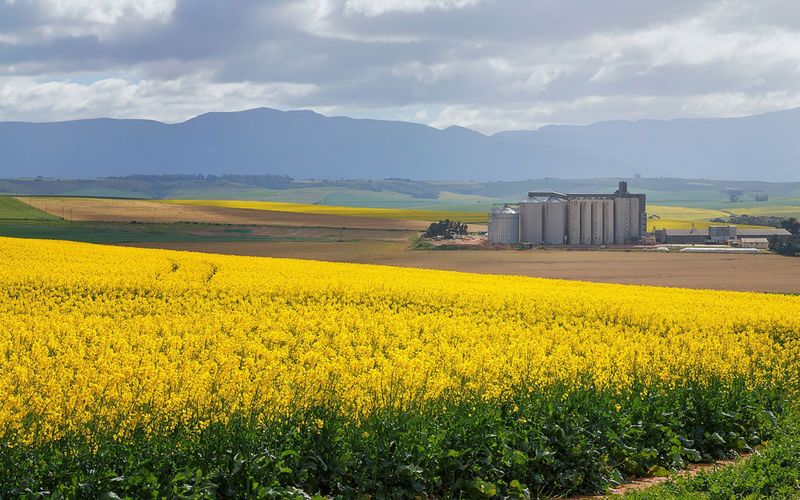
Several agricultural commodities and value chains have shown admirable progress in South Africa. We see such success in fruits like citrus, berries, grapes, as well as various nuts. The grain and oilseed industries have also seen success in recent years. Take soybeans, for example – South Africa now produces about 3 million tonnes a year. Not long ago, however, the country was a net importer of soybean oilcake for animal feed. Investment in crushing or processing plants sparked a surge in area plantings and reversed the trajectory of South Africa’s soybean industry to the extent that today, South Africa is a net exporter of soybeans. This happened between 2014 and 2020. But the success is not limited to that. We see impressive expansion even in smaller oilseeds. Consider the canola industry, for example.Such progress across multiple crops and value chains should inspire further expansion across the broader sector. Since South African farmers began commercial planting of canola on 17,000 hectares in 1998-99, the area has increased to an estimated 197,890 hectares in 2026-27.Like soybeans, the increase in canola plantings is driven, among other things, by rising domestic demand for oils and oilcake. Some areas have also switched from wheat to canola because canola has been more profitable recently. Net canolaSouth Africa is now a net canola exporter, having shipped to countries such as Germany and Belgium in recent years.Canola is a winter crop. As a result, production is primarily in the Western Cape, a winter-rainfall region.With canola plantings of 197,890 hectares, South Africa now expects a record harvest of 368,270 tonnes, up 20% year on year. We are late in the season, and while the weather in the Western Cape has not always been favourable, the canola crop has done reasonably well, and we are confident that the expected ample harvest will probably materialise.Looking at these figures, and how far the canola industry has come, we think it’s fair to say that canola is one of the success stories of South Africa’s agriculture, alongside the soybean industry and many of our fruits. Spatial distribution of agricultural soil potential in South Africa, showing areas of high, moderate/limited and low or no suitability for agriculture. (Source: Human Sciences Research Council - Agricultural land potential and spatial pressure in South Africa)As we have argued several times, the objective is to see not only increases in various commodities, such as canola, but also general improvements in agriculture across other areas of the country that haven’t been part of the South African agricultural success story, such as the former homelands, along with the new government land that is currently being released with title deeds. This is a substantial area of 2.5 million hectares. The details of the land release are still being finalised, but it is earmarked to boost commercial agricultural production; therefore, collaboration with commodity associations and agribusinesses is key.Land allocationIndeed, the land is not only for field crops and fruit, but also for livestock and poultry, which are key to South Africa’s agricultural progress. Achieving this does not require a new plan; it aligns with the ambitions of the existing Agriculture and Agro-processing Master Plan, which agricultural stakeholders and other social partners broadly embrace and co-created. What is required now is consistent implementation, with the Department of Agriculture, along with the Department of Land Reform and Rural Development, leading the efforts on both land release and on pushing for the productive utilisation of the land.The Overberg in the Western Cape is a major producer of wheat and canola. (Photo: Michael D Kock / Gallo Images) As we progress, efforts to boost agricultural production must be linked to expanding export markets into new and attractive regions of the world, while retaining existing markets in Africa, Europe, the UK, and the Americas, among others. The Middle East and Asia also offer a range of markets. Such a deliberate effort would ensure that the success we see in canola is replicated in other crops, while also bringing shared prosperity to the country. DMWandile Sihlobo is South Africa’s agriculture and land envoy, and the chief economist of the Agricultural Business Chamber of South Africa. His new book, Balance and Reason: A Growth Path for South Africa’s Agriculture, will be in stores from 9 November.
AGRICULTURAL SECTOR OP-ED: From imports to exports — canola success offers SA a farming blueprint
Full Article
Original Source
Read the full article at Dailymaverick →KhanList aggregates and links to publicly available news content. We do not host full articles from third-party sources. Always verify important information with original sources.