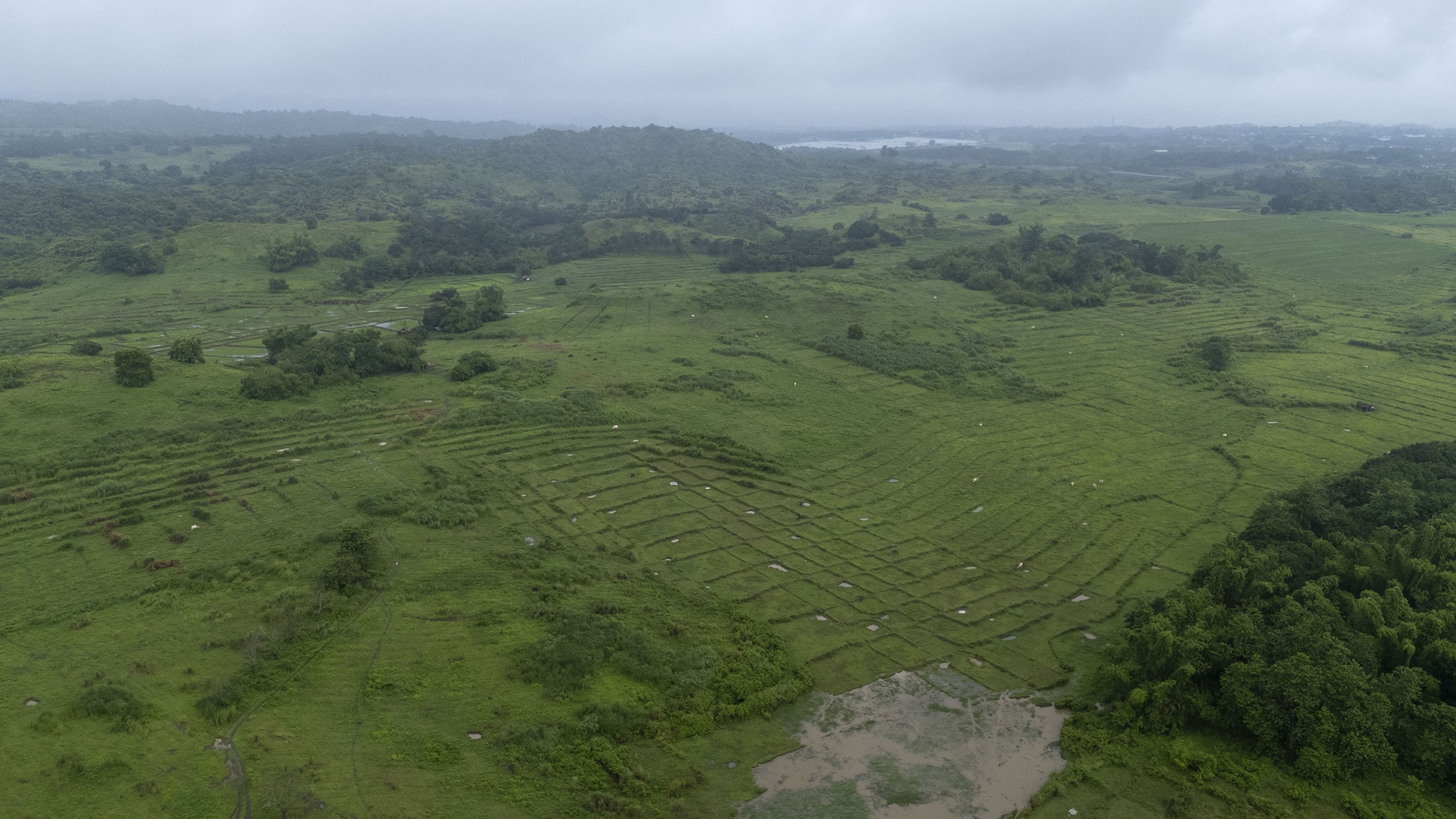
An aerial view captures the proposed 1,620-hectare Pax Silica site at New Clark City in Capas, Tarlac, on Sunday, July 27, 2026. The Philippine government has designated the area as a major hub for artificial intelligence and advanced manufacturing under Pax Silica, a US-led global coalition aimed at securing supply chains for critical minerals, semiconductors, energy, and logistics. —Inquirer photo/Grig C. Montegrande SUBIC BAY FREEPORT, Philippines — An agricultural workers’ group on Sunday (July 26) opposed the country’s participation in the US-led Pax Silica initiative, warning that its planned economic security zone in Central Luzon could worsen land displacement, suppress wages, and cause environmental degradation. The Unyon ng mga Manggagawa sa Agrikultura (UMA) said the proposed economic security zone under Pax Silica would accelerate land conversion in Central Luzon while threatening food security and exposing nearby communities to environmental risks. The group’s statement came ahead of President Ferdinand Marcos Jr.’s fifth State of the Nation Address on Monday. Article continues after this advertisement Pax Silica is a US-backed initiative aimed at strengthening supply chains for artificial intelligence and semiconductor manufacturing. READ: SBMA sees revenue, jobs boost with Pax Silica Earlier this week, the Bases Conversion and Development Authority (BCDA) and the Subic Bay Metropolitan Authority (SBMA) signed a memorandum of understanding designating the Subic Bay Freeport as the preferred maritime gateway for the project, while Clark is expected to host the economic security zone. UMA national chairperson Ariel Casilao said the project would further entrench low wages in rural communities instead of improving workers’ livelihoods. “Instead of raising the low wages in rural areas, Marcos Jr. is using them to attract imperialist investors,” Casilao said. Article continues after this advertisement READ: Myths vs facts: BCDA allays fears on controversial Pax Silica project The group also questioned BCDA’s projection that Pax Silica could generate around 190,000 jobs, arguing that it failed to disclose the quality of employment being offered. Article continues after this advertisement UMA noted that the minimum daily wage in much of Central Luzon stands at P570 for agricultural workers and P600 for nonagricultural workers, far below the estimated family living wage of P1,312 a day. “What do Marcos Jr. and the BCDA want—that we should be grateful that rural wages are low?” Casilao asked. According to the group, promoting these wage levels as a “competitive advantage” for foreign investors would only reinforce what it described as “slave wages” in the countryside. UMA likewise raised concerns over the project’s projected demand for water and electricity, saying it could further strain resources amid existing supply challenges. “Pax Silica reflects the country’s semi-colonial and semi-feudal conditions,” Casilao said, urging the government to abandon the initiative. Your subscription could not be saved. Please try again. Your subscription has been successful. The government has promoted Pax Silica as part of its strategy to position the country as a hub for advanced manufacturing and secure semiconductor and artificial intelligence supply chains. /cb
Agri workers’ group warn Pax Silica could worsen land, labor issues
Full Article
Original Source
Read the full article at Newsinfo →KhanList aggregates and links to publicly available news content. We do not host full articles from third-party sources. Always verify important information with original sources.