
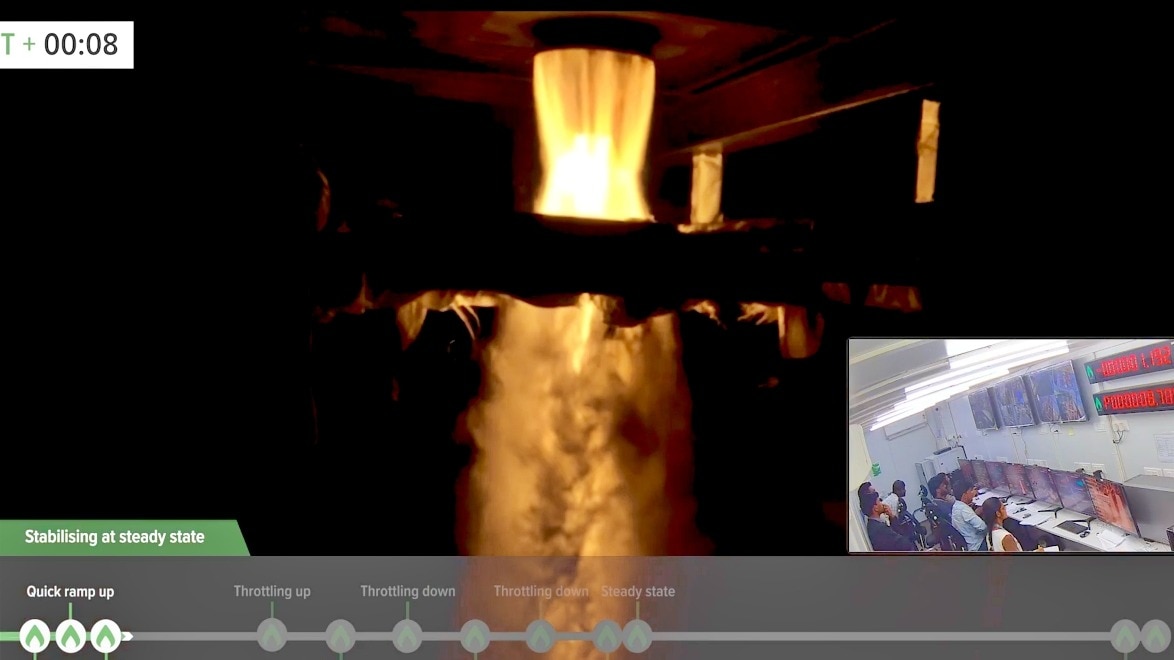
Agnikul Cosmos has fired its Agnite semi-cryogenic engine with thrust sweeps and a long-duration run. The test adds confidence in the 3D-printed engine as the company moves towards Mission-02.The company also said the engine was operated for a duration well beyond the maximum burn time. (Photo: Agnikul)New Delhi,Oct 6, 2026 18:46 ISTIndian space startup Agnikul Cosmos has successfully fired its Agnite semi-cryogenic engine, bringing its Agnibaan rocket another step closer to its next major mission.In an update shared by the company, Agnikul said it had conducted a series of thrust sweeps during the latest engine firing.These tests are designed to understand how the engine behaves as its thrust is varied, an important capability for controlling the rocket during flight.The company also said the engine was operated for a duration well beyond the maximum burn time of some of its ascent-phase engines. The long-duration firing is intended to provide additional confidence in the engine's performance and endurance. Humbled to post an engine firing video of our single-piece Agnite engine. Here we completed a few thrust sweeps - something that is needed to understand throttling - and later, we let the engine run for a duration well beyond the max. burn time of some of our ascent phase engines. Also, for the first time, this video gave us all a few good Mach diamonds to cherish. Mission - 02 is getting ever so closer. As a refresher, Agnite is our booster stage semi-cryogenic engine - it stands 1 metre tall & the entire engine is 3d printed in a single shot, as a single piece of hardware. It is powered by electric motor-driven pumps. @srinathr155 @moin_spm @satchakra_iitm @isro @INSPACeIND @iitmadras @iitm_respark @IITMIC @IndiaDST @tdbgoi @ANRFIndia @TIDCO_1965 @startupindia @TheStartupTN @TN_SIPCOT @Guidance_TN @startup_mission #Agnibaan #AgniteRocketEngine #ElectricPumpFedEngines #SinglePieceEngine #3dprinting #AdditiveManufacturing— AgniKul Cosmos (@AgnikulCosmos) October 6, 2026 The test also produced what engineers call Mach diamonds, the distinctive bright, repeating patterns visible in an exhaust plume when hot gases leave a rocket nozzle at supersonic speeds.The engine being tested is Agnite, Agnikul's booster-stage semi-cryogenic engine. The company says the engine stands about one metre tall and is manufactured as a single-piece, fully 3D-printed engine. Unlike conventional rocket engines that use complex turbomachinery to drive propellant into the combustion chamber, Agnite uses electric motor-driven pumps. This approach is intended to simplify the propulsion system while allowing precise control of propellant flow.Agnite is being developed to power Agnibaan, Agnikul's orbital launch vehicle designed to carry small satellites into low Earth orbit.The latest test comes as the company prepares for its next major flight milestone, which it refers to as Mission-02.Agnikul previously made history in May 2024 when its Agnibaan SOrTeD mission lifted off from India's first privately operatedlaunchpad at Sriharikota, demonstrating several technologies including the company's 3D-printed semi-cryogenic engine.With the latest firing, Agnibaan's development is moving another step closer to an orbital mission, and Agnikul says Mission-02 is getting ever closer.- Ends
Agnikul closer to launch, fires 3D-printed engine that will power space rocket
Full Article
Original Source
Read the full article at Indiatoday →KhanList aggregates and links to publicly available news content. We do not host full articles from third-party sources. Always verify important information with original sources.