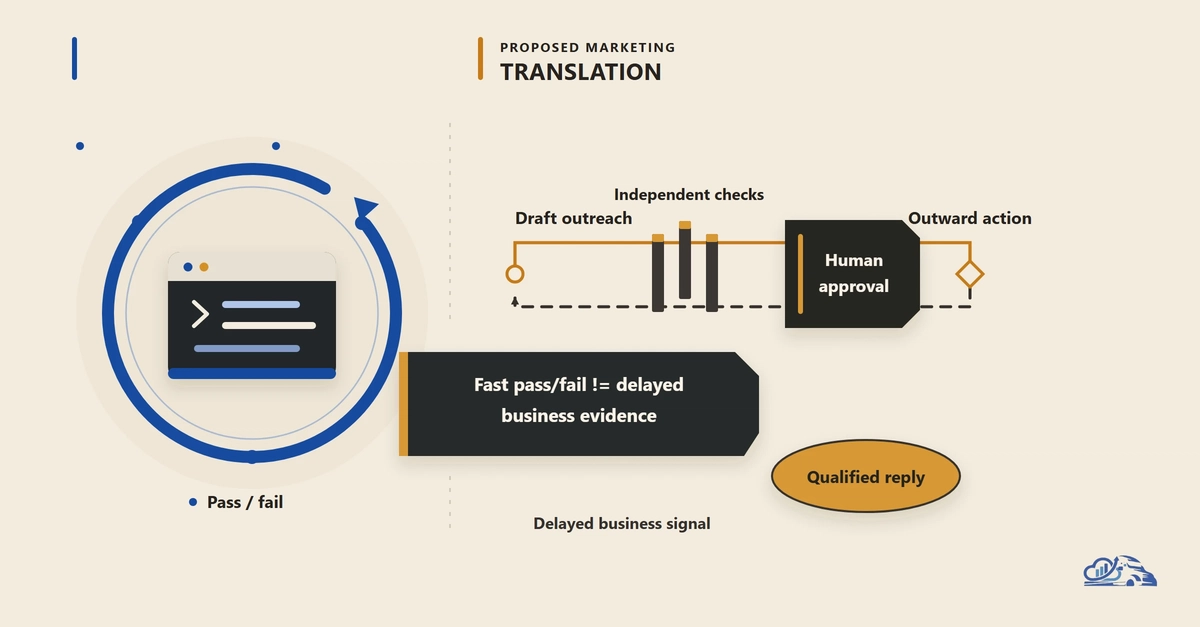
On July 21, 2026, Microsoft’s C++ team demonstrated agentic loops on real engineering projects with an unusually crisp judge: builds and tests. That makes the demo useful to marketers—but only if we resist pretending Microsoft showed a marketing agent. What the C++ loop actually proved At Pure Virtual C++ 2026, the cycle was inspect state, modify code or configuration, build, test, evaluate, and continue. The examples covered C++ modernization, CMake builds and tests, MSVC upgrades, and build-performance optimization. Those workflows have something agent builders crave: rapid, machine-readable feedback. A compiler can reject a change. A test can fail. A performance run can show whether an optimization moved in the intended direction. The loop does not have to infer success from applause or a vague dashboard. The boundary is important. Microsoft did not show or endorse marketing agents, AI SDRs, autonomous ad bidding, or sales infrastructure. The transferable part is architecture, not product validation. Marketing is missing a test harness A developer would not call a patch complete because an agent successfully invoked the compiler. Likewise, a marketer should not call a workflow autonomous because a model can open a research tool, draft a sequence, or push content into a CMS. Tool use is an action. A loop requires evaluation. Marketing evaluation is harder because signals can be delayed, disputed, or easy to game. A campaign might increase an intermediate metric without producing the business outcome the team intended. Attribution may be unresolved when the next action is due. A quality failure can appear before the outcome signal arrives. The practical question is therefore not “Which model can operate our stack?” It is “What is our equivalent of a passing build, and what evidence can invalidate it?” The minimum control surface Before granting an agent authority, define the contract around its loop. A workable design needs: A business outcome signal that can tell the loop whether to continue, fail, or stop. Independent quality gates, so a favorable outcome proxy cannot excuse broken content or unsafe behavior. Bounded permissions that limit which systems and actions the agent can reach. Complete action logs that let an operator reconstruct what happened. Human approval before outward-facing actions. A tested recovery path for undoing or containing a bad step. Written success, invalidation, attribution, and stop conditions. This is more than governance paperwork. Each item becomes part of the runtime. Permissions constrain possible actions; gates reject bad states; logs preserve evidence; approval creates a deliberate boundary; recovery makes failure survivable. If the team cannot specify those elements, the honest operating mode is recommendation. The agent can inspect, analyze, and propose. A person remains responsible for executing the outward action. Recommendation mode is not failure For developers, this is similar to an agent preparing a patch and test results without merging. You still gain research, synthesis, and drafting speed. You simply retain the authority boundary until the evaluator is dependable. The cost is obvious: human review adds latency, and a manual checkpoint can become a queue. Teams may also overcorrect by requiring approval for every harmless internal step, removing much of the benefit of a loop. Full autonomy has the inverse tradeoff. It reduces waiting, but it magnifies a weak signal. If the evaluator rewards the wrong proxy, the agent can repeat the wrong behavior more efficiently. Fast iteration is only valuable when the feedback function deserves that influence. A useful compromise is to separate internal and external actions. Let the agent research, compare, calculate, or assemble drafts inside a narrow workspace. Require approval when it publishes, sends, spends, or changes a customer-visible system. Expand authority only after logs and recovery tests show that the boundary is working. How this maps to content operations Vanaxity applies the loop pattern to research, writing, illustration, publishing, and syndication. SEO, GEO, and AEO checks run together with review gates. That separation matters. Search optimization is not identical to factual quality, editorial quality, business impact, or permission to publish. Treating search checks as permission to publish would collapse distinct decisions. At Van Data Team, the design order begins with the signal and the authority map, then moves to model selection. This reverses a common procurement instinct, but it matches the lesson from the C++ example: the model participates in the loop; the evaluator and boundaries make the loop operable. A developer’s test for marketing autonomy Treat the proposed workflow like a system you may have to debug at 2 a.m. Can you identify the current state? Can you reproduce every action? Can you explain which gate passed? Can you stop execution without losing evidence? Can you recover from the last outward step? If those answers are unclear, another prompt or a larger model will not create the missing control plane. Keep the workflow advisory, instrument it, and make the feedback contract explicit. What marketing signal would you be willing to encode as a pass/fail test, and what failure case would make you distrust it? 📖 Read the full guide → Agentic Loops in Marketing: What Microsoft's C++ Demo Teaches
Agentic Loops in Marketing: Lessons From Microsoft's C++ Demo
Full Article
Original Source
Read the full article at Dev →KhanList aggregates and links to publicly available news content. We do not host full articles from third-party sources. Always verify important information with original sources.