
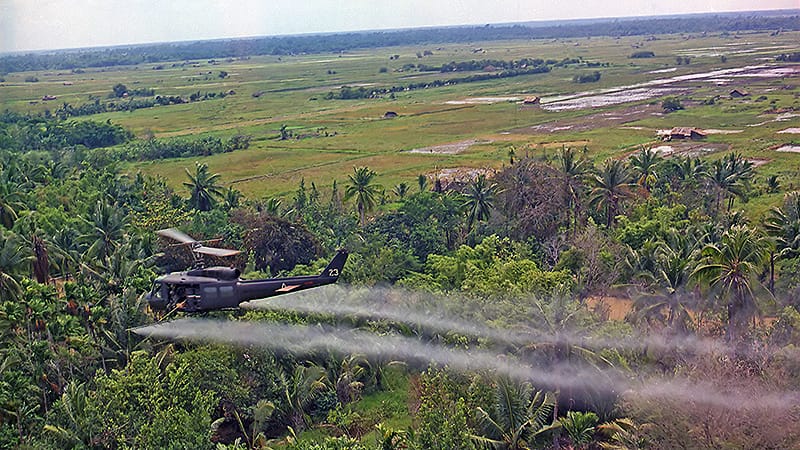
Exposure to Agent Orange, a weed killer used during the Vietnam War, is associated with a higher risk for Parkinson’s disease (PD) and related neurodegenerative disorders decades later, a new study showed.In a large study of nearly 4.5 million veterans, those with reported Agent Orange exposure had a 57% higher risk for PD, REM sleep behavior disorder (RBD), and dementia with Lewy bodies (DLB) combined. The risk for PD was 44% higher.Veterans who directly handled or sprayed the herbicide were 99% more likely to develop PD and had a 125% higher risk for RBD.Researchers said the findings are important because although Agent Orange was discontinued decades ago, one of its key ingredients — the herbicide 2,4-D — remains widely used in agriculture and elsewhere.“This is the first study in veterans to identify that increased risk of [PD] is associated with heavier exposure to Agent Orange,” co-senior investigator Gregory D. Scott, MD, PhD, associate professor of pathology at Oregon Health & Science University School of Medicine and a pathologist at the Veterans Affairs Portland Health Care System in Oregon, said in a statement. “We’re catching up with history in a way.”The study was published online on November 16 in JAMA Neurology.A Long-Standing QuestionReports suggest that between 1962 and 1971, more than 10 million gallons of Agent Orange were sprayed in Vietnam for defoliation and crop destruction. Veterans began raising concerns about the link between the herbicide and health problems in the mid-1970s. Prior studies have linked exposure to pesticides and herbicides, including 2,4-D, to PD; few have examined Agent Orange, and those that did produced mixed results.To assess this link, researchers examined health records from nearly 4.9 million veterans who served during the Vietnam War era. More than 4.4 million (mean age, 60.6 years; 98% men) were included in the final analysis and followed for an average of 12.5 years.About 23% had registry-reported Agent Orange exposure, and a smaller group had direct or occupational exposure, including veterans who handled or sprayed the herbicide.Researchers looked at PD, RBD, and DLB diagnoses and accounted for factors including age, smoking, traumatic brain injury, and healthcare use.Higher Exposure, Higher RiskExposure to Agent Orange was associated with a 44% higher risk for PD (hazard ratio [HR], 1.44; 95% CI, 1.37-1.52), rising to nearly twice the risk among veterans who directly handled or sprayed the herbicide (HR, 1.99; 95% CI, 1.71-2.32).Registry-reported exposure was also linked to a 78% increased risk for RBD (HR, 1.78; 95% CI, 1.68-1.89) and a 66% increased risk for DLB (HR, 1.66; 95% CI, 1.32-2.09). Direct or occupational exposure was associated with more than twice the risk for RBD (HR, 2.25; 95% CI, 1.87-2.7), although no statistically significant association was found for DLB.When the three conditions were considered together, Agent Orange exposure was tied to a 57% greater risk for PD, RBD, or DLB (HR, 1.57; 95% CI, 1.50-1.63).At 15 years, veterans with registry-reported exposure had 4.6 additional PD cases per 1000 people compared with those without exposure. For those with direct or occupational exposure, the difference was 15.4 additional cases per 1000 people.The findings were similar after accounting for differences in healthcare use. However, the observational design, inability to determine how much Agent Orange veterans were exposed to, and potential diagnostic errors limit conclusions. Most participants were older men, which may limit generalizability.A Long-Awaited AnswerFor veterans who have long suspected a connection between Agent Orange and PD, the findings may offer some validation, said co-investigator Lee Neilson, MD, formerly of Oregon Health & Science University and now at University of Iowa Health Care in Iowa City.“Veterans have been talking about this for years and years,” Neilson said in a statement, adding that he hopes the results help veterans feel “validated and heard.”The long delay in recognizing the potential health effects of Agent Orange also highlights the importance of identifying risks from chemicals still in use today, Scott added.“I think this adds weight to the idea that we ought to get on top of this and not wait 50 years for the next herbicide to be linked to neurodegenerative disease,” Scott said.Beyond the BattlefieldOne of Agent Orange’s ingredients, 2,4-D, is commonly used in agriculture and in places such as lawns, golf courses, and roadsides, wrote the authors of an accompanying editorial led by Samuel M. Goldman, MD, Division of Occupational, Environmental, and Climate Medicine, University of California, San Francisco.“The war has ended, but the exposures have not,” wrote the editorialists, who were not involved in the study.Today’s exposure to 2,4-D is not the same as exposure to Agent Orange, which contained 2,4,5-T contaminated with dioxin during manufacturing. The effects of 2,4-D alone on brain health remain unclear, they cautioned.Still, they warned that “many are unaware of its use, and most do not know its risks,” and called for greater efforts to reduce exposure to potentially harmful pesticides.Disclosure information for study authors is available in the original study publication. Dr Dorsey reported personal fees from multiple pharmaceutical and biotechnology companies; a pending patent with Chorea Index; and ownership interests in Atria Health and Research Institute, Health Mediflix, SEMCAP, and Synapticure. His work was supported by the Edmond J. Safra Foundation and the B. Thomas Golisano Foundation.
Agent Orange Exposure Tied to Parkinson’s Risk Decades Later
Full Article
Original Source
Read the full article at Medscape →KhanList aggregates and links to publicly available news content. We do not host full articles from third-party sources. Always verify important information with original sources.