
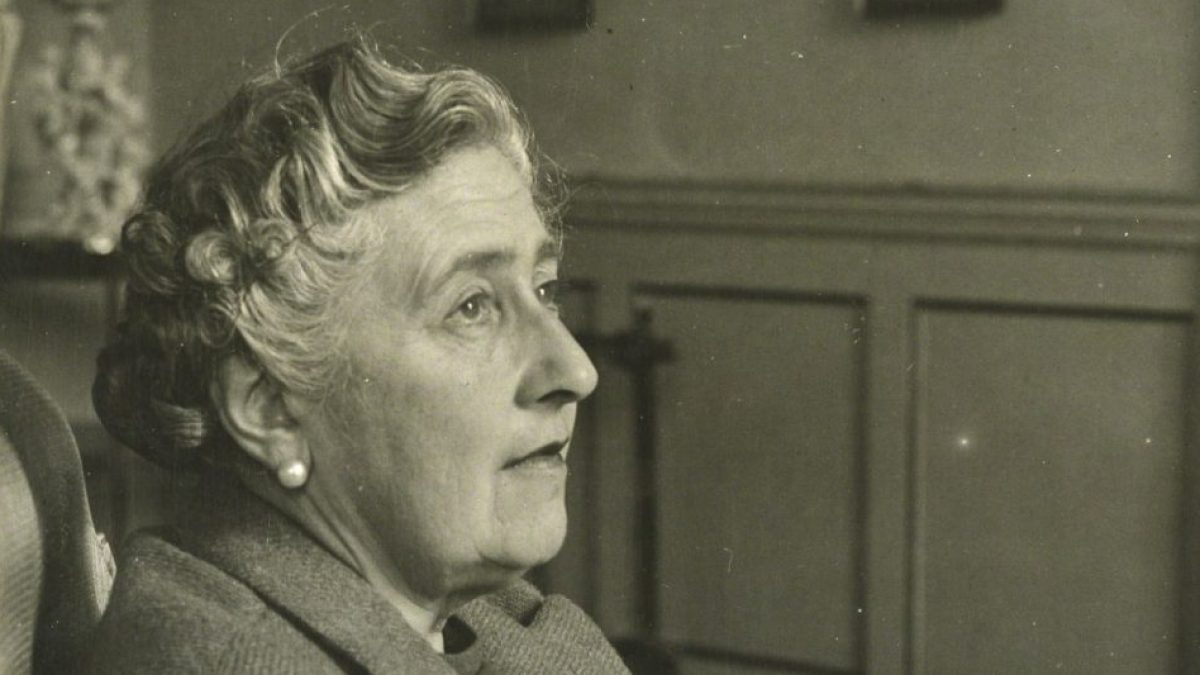
Who? Why? When? How? Where? Which? These are the questions that greet visitors to a new exhibition at the British Library. They’re a series of inquisitions designed to build the perfect crime, and they’re written on a scrap on notepaper, across from a sheet bearing the scrawled words “Body in Library”. This is the inner world of Agatha Christie, her motives and modus operandi. Christie is by some measures the most successful writer in history. Thanks to her 66 novels and 14 short story collections, she has become the world’s bestselling novelist, shifting a billion copies in English and a billion more in translation. Her work has been adapted for screens big and small, for video games and boardgames and immersive experiences. She has been called the Queen of Crime and has come to define the most lucrative genre in publishing. And yet, there has always been an air of mystery about the writer herself. At the height of her celebrity, she demurred from the limelight. She was popular but private. Now, collaborating with her descendants on a new exhibition, Agatha Christie: World of Mystery, the British Library has been able to pull the real Christie out from the shadows cast by her famous detectives. If her look is more Miss Marple – she appears in rare newsreel footage, looking like a harmless septuagenarian, to celebrate the 10th anniversary of The Mousetrap in 1962 – then her mind is pure Poirot. Her papers show her as inventive, methodical and fiendishly practical. For her novels – from 1921’s The Mysterious Affair at Styles to the last she wrote, 1973’s Postern of Fate – draw heavily from the many lives she lived.She was once a schoolgirl in Torquay, the daughter of a wealthy gentleman who demonstrated a precocious interest in the written word. In an old schoolbook from 1894, she records her favourite virtue as “gentleness”, her chief characteristic as “fidgetting [sic]” and the fault for which she has “most toleration” as “mischief”. This restlessness – memorialised in her own florid cursive – would be present throughout her life and novels. It drew her, early, to fiction. The first page of an unpublished novel, Snow Upon the Desert, appears in this exhibition, though the remaining pages remain locked away in a bank vault somewhere. Christie would later self-deprecate on these early explorations, giving hack author Salome Otterbourne, a character in Death on the Nile, a novel called Snow on the Desert’s Face. A young Agatha Christie playing the mandolin (Photo: British Library) She was later an army nurse, volunteering with the Red Cross in 1915, who would go on to become a pharmacist during the Second World War. In a barely legible hand, she scrawled the words “poisons… possibilities for books” before detailed pharmacological descriptions of poisons from strophanthus to nitrobenzene. Of all the great crime novelists, Christie was most drawn to the subtleties of poison: two thirds of her novels feature a poisoning. From strychnine at Styles Court to the horror of thallium in The Pale Horse, Christie’s wartime experiences were imprinted on the page. She was a traveller. In 1922, Christie embarked on a world tour, an unusual indulgence then, particularly for a young woman. She was accompanied by her husband Archibald “Archie” Christie through South Arica, Australia, New Zealand, Hawaii and Canada. In South Africa, the Christies learned to surf. In the crashing surf of Waikiki, Agatha became possibly the first British woman to upright surf. In photographs she poses next to her trusty surfboard, which she named “Fred”. Yet only one of her novels, South Africa-based The Man in the Brown Suit, is set in one of the countries she visited on this grand sweep of the globe. It was her later travels – through Europe and the Middle East – that would most inform her fiction. She was a pioneer of ancient archaeology. After the collapse of her first marriage – which precipitated her infamous 1926 disappearance, which is mercifully glossed over in this exhibition – Christie struck up a relationship with the young archaeologist Max Mallowan. Thirteen years her junior, she accompanied him on expeditions throughout the Middle East and North Africa, which became the basis for a series of novels including Death on the Nile, Appointment with Death and Murder in Mesopotamia. Rather than sitting prettily with the wives and porters, Christie set to work filming the digs and photographing the discoveries. If the footage of Mallowan’s excavations of Ur and Nineveh is rough and grainy, the photographs of small artefacts, taken for cataloguing, are impeccable. Christie in her VAD nursing uniform (Photo: British Library) Then she was a dramatist, the most performed female playwright in history. Her most famous play The Mousetrap has passed 30,000 performances at St Martin’s Theatre in the West End. When it opened, Winston Churchill was Prime Minister and Elizabeth II had just ascended to the throne. Before the show had even opened, Christie gifted the rights to her nine-year-old grandson, Matthew, whose voice echoes through the final room of the exhibition. “Her books were of an admirable length,” he says now, at the age of 83. “They’re easy to pick up and put down and very comfortable and very easy to read.” Rather faint praise after such an accomplished life. And then there’s Christie’s last iteration; her afterlife. The exhibition is speckled with works that she has influenced, from Jeremy Vine’s Murder on Line One and Richard Osman’s Thursday Murder Club to Ragnar Jónsson’s Snowblind and Vaseem Khan’s Midnight at Malabar House. Ronald Knox, one of Christie’s contemporaries in the Detection Club (a group of prominent detective novelists who met for dinners and to solve puzzles) , may have set the “rules” for detective fiction – including outlawing supernatural agencies, secret passages and identical twins – but it is Christie who has provided the blueprint. Time and again, the peerless original reasserts itself. On the walls of the exhibition, small screens show Albert Finney, Peter Ustinov, David Suchet and Kenneth Branagh as Poirot; Margaret Rutherford, Angela Lansbury, Joan Hickson, Geraldine McEwan and Julia McKenzie as Miss Marple. The British Library has engineered this exhibition vaguely around the 50th anniversary of Christie’s death in 1976. “We wanted to show her extraordinary life and how much of that inspired her work,” the exhibition’s lead curator, Lucy Rowland, tells me. “And also, to show that she was much more of a surprising woman than people realise.” Christie and Max Mallowan aboard a Nile paddle steamer SS Sudan, circa 1931 (Photo: British Library) Yet it is also clear that the show is riding a wave of enthusiasm for Christie’s work, led by her family’s willingness to embark on new projects. An upcoming BBC show, Hercule, will reimagine Poirot as a young (sexy) Belgian detective. Crime novelist Lucy Foley recently authored the first Miss Marple continuation novel, while Toni Collette has become the new voice of the spinster sleuth for a full-cast audiobook of Murder at the Vicarage. More worryingly, an AI-reconstructed Christie has been licensed to the BBC’s Maestro series, to provide a 12-video guide to her “storytelling secrets”. There are just 20 years left on the copyright to Christie’s works – which expire 70 years after an author’s death – and so the Christie industry is in full-swing. Visitors to the exhibition will enter through a well-stocked gift shop, featuring everything from puzzles and crockery to clothing and stationery, all produced with the collaboration of Agatha Christie Limited. This exhibition captures Christie in her contradictions – worldly yet capable of evoking the most parochial of scenes, fiendishly creative yet prone to repurposing her lived experiences – but nothing is more striking than the contrast between Christie’s personal preference for privacy and the global brand that she has become. It is the waste byproduct of her brilliance. From the disorder of the 20th century, she created a series of perfect little works that still resonate today. Influential yet inimitable, our fascination with Agatha Christie, and her detectives, shows no sign of waning. ‘Agatha Christie: World of Mystery’ is at the British Library to 27 June 2027
Agatha Christie’s biggest mystery was her own private life
Full Article
Original Source
Read the full article at Inews →KhanList aggregates and links to publicly available news content. We do not host full articles from third-party sources. Always verify important information with original sources.