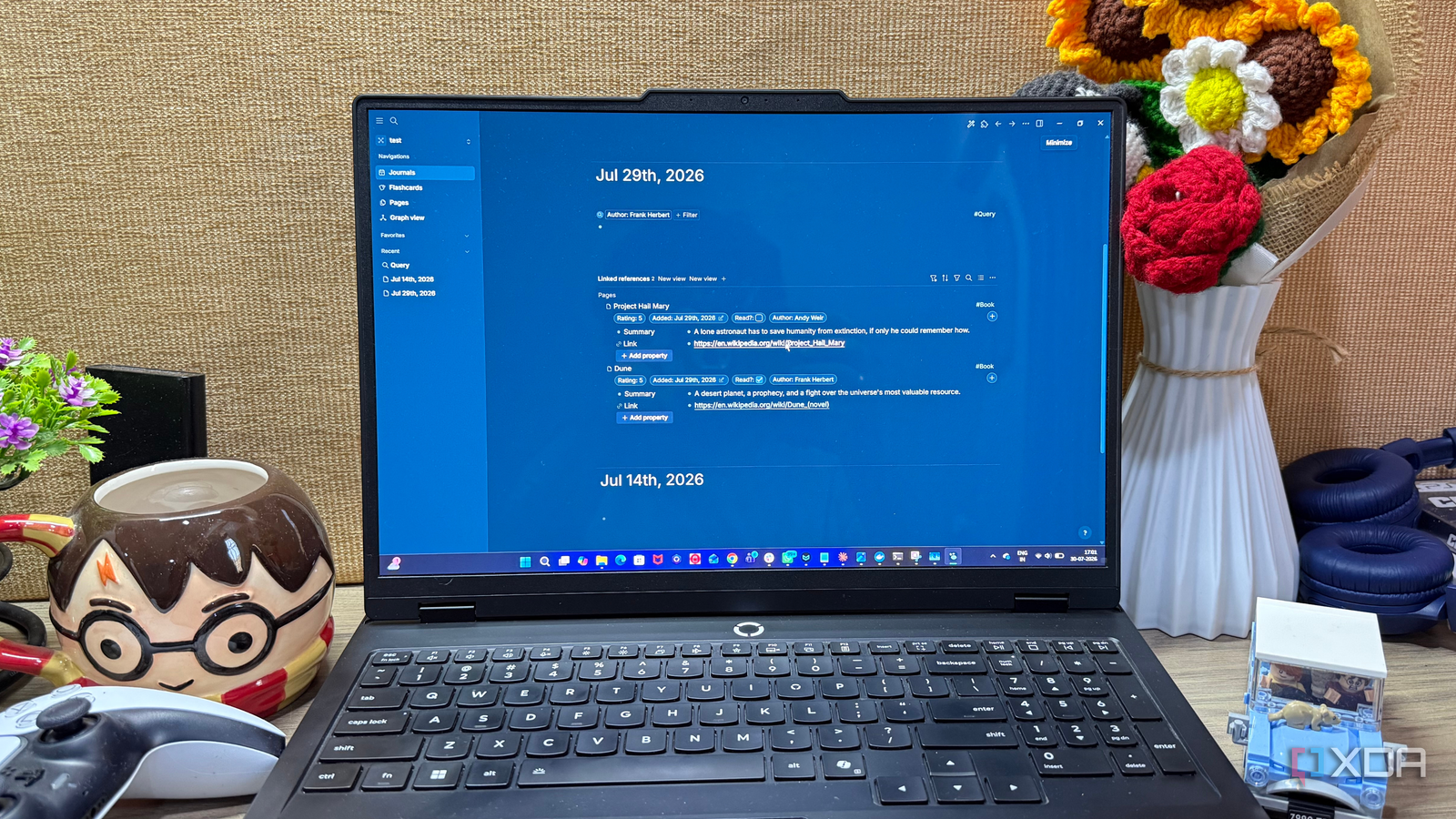
Published Aug 3, 2026, 7:30 AM EDT Beginning his professional journey in the tech industry in 2018, Yash spent over three years as a Software Engineer. After that, he shifted his focus to empowering readers through informative and engaging content on his tech blog – DiGiTAL BiRYANi. He has also published tech articles for MakeTechEasier. He loves to explore new tech gadgets and platforms. When he is not writing, you’ll find him exploring food. He is known as Digital Chef Yash among his readers because of his love for Technology and Food. For years, every app that claimed to be an Obsidian alternative ended the same way for me; I tested it for a few days, appreciated a few ideas, and went right back to my existing vault. Obsidian simply offered the right mix of flexibility, reliability, and a mature ecosystem that was hard to beat. That's why I didn't expect Logseq 2.0 beta to change my mind. But after spending time with the latest release, I realized this wasn't just another update. For the first time, I found myself wondering whether my long-term note-taking setup still belongs in Obsidian. Logseq didn't just get a redesign It got a new foundation When I first opened Logseq 2.0 beta, I expected a cleaner interface and a few new features. Instead, it quickly became clear that this is a much bigger update. Under the hood, Logseq has moved to a new database-based foundation that changes how the app stores, organizes, and works with information. Previous versions of Logseq always felt like they had great ideas but weren't quite ready to replace Obsidian. The outliner workflow was powerful, but the app often felt experimental. Logseq 2.0 changes that impression. Everything feels more cohesive, and the new foundation opens the door for features that simply weren't possible before. What stood out to me most is that Logseq no longer feels like an app that's trying to catch up. It feels like it's heading in a different direction altogether. Instead of building another Markdown editor with plugins, it's becoming a knowledge management platform with structured data at its core, and that's what made me start questioning my long-term setup in Obsidian. Native databases solve a problem Logseq always lacked Markdown Mirror removes my biggest concern about database apps For me, the biggest limitation of older Logseq versions wasn't the interface; it was the lack of a proper way to manage structured information. My notes worked well, but as soon as I wanted to organize things like books, articles, projects, or writing ideas, the workflow started to feel limiting. I could make it work with pages, tags, and properties, but it never felt like the right tool for the job. Logseq 2.0 changes that with native databases. Instead of forcing everything into pages, I can create structured collections with custom fields, filter and sort them, and switch between different views depending on what I'm working on. Whether it's tracking my article pipeline, managing software I'm testing, or organizing research, the workflow feels far more natural than before. The fact that it's built into the app instead of relying on plugins makes it even more appealing. The feature I liked the most is Markdown Mirror. Database-powered note-taking usually comes with one big concern: getting locked into a proprietary format. Logseq takes a different approach by automatically generating standard Markdown files that mirror the content in the database. That means my notes remain portable and accessible outside the app. I can browse them in my file system, back them up with Git, or even open them in another Markdown editor if I ever decide to switch. As someone who has always valued owning my notes, Markdown Mirror makes Logseq's database-first approach feel far less risky and much easier to trust. The app feels more polished Small refinements make a big difference Beyond the big architectural changes, what impressed me most was how much better Logseq 2.0 feels to use every day. With the beta, I spent less time figuring out the app and more time actually working in it. The graph view is probably the best example. In older versions, I rarely opened it because it felt cluttered and wasn't particularly useful once my notes grew. The new graph is much smoother and easier to navigate, making it simpler to explore relationships between notes without getting overwhelmed. It will be useful to rediscover old ideas, connect research across different topics, and spot links that I probably would have missed in a traditional folder structure. It finally feels like a practical knowledge exploration tool instead of just a visual showcase. I also noticed plenty of smaller improvements throughout the app. The editor feels smoother, navigation is more intuitive, and working with attachments like images and PDFs is much cleaner than before. None of these changes are groundbreaking on their own, but together they make Logseq 2.0 feel like a polished application rather than an interesting project that's still finding its footing. I'm not leaving Obsidian just yet Logseq 2.0 beta has genuinely impressed me, but I'm not ready to move away from Obsidian today. My vault represents years of notes, carefully refined workflows, and a plugin ecosystem that still fits the way I work. Switching isn't just about finding a better app; it's about rebuilding habits that have evolved over time. That said, this is the first time I've felt that another knowledge management tool offers a compelling reason to consider the effort. I'll be watching Logseq's progress closely, and if the stable release delivers on the promise of the beta, my primary note-taking app might not be Obsidian forever. Logseq An open-source and privacy-focused knowledge management app for taking notes and managing information
After years in Obsidian, Logseq 2.0's database approach is making me reconsider everything
Full Article
Original Source
Read the full article at Xda-developers →KhanList aggregates and links to publicly available news content. We do not host full articles from third-party sources. Always verify important information with original sources.