
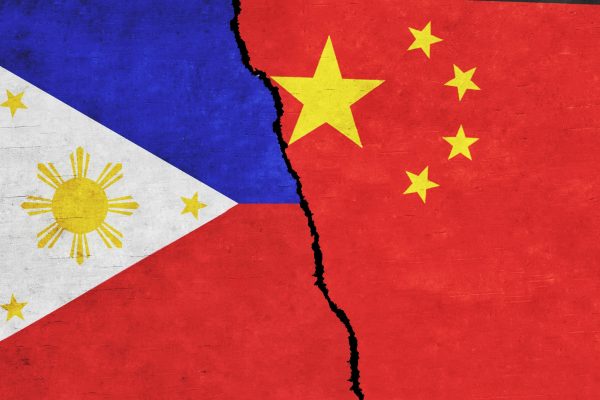
China on Friday expressed willingness to improve its relationship with the Philippines, but admitted that relations were at “an extremely sensitive and critical juncture” due to the actions of unnamed “outside forces.” The two governments have been engaged in a war of words since Friday, when Jing Quan, China’s ambassador to Manila, declared that China could “easily win” a war with the Philippines. Jing was responding to a remark by Philippine Defense Secretary Gilberto Teodoro, who the day prior described China as the lone “troublemaker” in Southeast Asia, due to its aggressive actions in contested parts of the South China Sea. Speaking to the press after a Diliman Dialogues organized by the Philippines-China Studies Center of Diliman College in Quezon City, Jing said that the remark was “nonsense.” “We should feel fortunate enough that you have a neighbor like China in this region,” he said. “If we want to use force, we may easily win. But no, we will not choose force, and we love peace. In this region, we enjoy peace.” Asked on Friday about Ambassador Jing’s remark, Philippine President Ferdinand Marcos Jr said that it “sounds very much like a threat” and that he would summon the ambassador to provide an explanation. Jing, who began his posting last December, was previously summoned by Marcos in July, after a Philippine marine was injured in a melee with the China Coast Guard at Second Thomas Shoal in the Spratly Islands and the subsequent publication of a video by the state-run China Daily depicting Filipinos as monkeys and U.S. puppets. Yesterday, the Chinese embassy issued a statement in which it said it considered the Philippines a “close neighbor and friend with deep historical and cultural ties.” It also said the Philippines need not choose between China and the United States and that the two sides “should maintain dialogue, manage differences, and expand cooperation in trade, investment, people-to-people exchanges, and law enforcement.” At the same time, it said that China-Philippines relations were “at an extremely sensitive and critical juncture and require prudent, careful handling” and lambasted “anti-China politicians” who it said, “deliberately ignore China’s clear and consistent position on China-Philippines relations, instead twisting its words out of context and maliciously distorting the facts for political gain.” It concluded by saying that differences “should be managed through dialogue” and that “outside forces” – i.e., the United States and its allies – “should not be allowed to steer bilateral relations toward confrontation.” “China is ready to work with all sectors of Philippine society to promote dialogue, deepen trust, and expand mutually beneficial cooperation,” it added. Such exchanges have taken place periodically between the two governments over the past few years, often linked to events in the South China Sea, where the two nations have overlapping maritime claims. Besides, Chinese and Philippine coast guards have engaged in a string of confrontations, some involving the use of physical force, which have pushed relations to their worst point in years. Jing’s comments were preceded by a chain of public comments and responses emanating from the Philippines’ fractious domestic politics, hinting at the apparent growing polarization of foreign relations along partisan lines. This began on October 6 with the airing of allegations that Chinese entities had sent just over $5 million in remittances to a Philippine company linked to the husband of Vice President Sara Duterte, a major rival of Philippine President Ferdinand Marcos Jr. The claims, which came to light during Duterte’s ongoing impeachment trial in the Senate, prompted Marcos to state that the involvement of Chinese money made the issue “a national security issue.” “If it is true, it is a threat – a threat at the highest level to the republic,” Marcos said on October 12. Duterte responded the same day by stating that the Philippines was becoming the main “troublemaker of Southeast Asia” by treating business ties with China as a national security concern. Teodoro’s comment about China being the main “troublemaker” in the region was a direct response to Duterte. At this point, Jing made his incautious entry into the “debate,” turning the domestic war of words into a potential diplomatic incident. The incident is notable for what it says about how bitter political rivalries in the Philippines have the potential to impact Manila’s delicate balancing of relations with China and the United States. In late 2016, the administration of President Rodrigo Duterte, Sara’s father, initiated a bold turn toward China, downplaying maritime disputes in order to gain Chinese financial support for major infrastructure projects. The needle swung back under Marcos, who, after coming to office in 2022, strengthened the Philippines’ relationship with the United States and became much more forceful in his condemnations of Chinese behavior in the South China Sea. There is now some danger that as the country moves toward the next presidential election in 2028, the two rival camps will come to see benefits in depicting each other as agents of foreign forces (the U.S. and China, respectively). The impacts of this could stretch beyond the periodic diplomatic incident. Indeed, they could begin to impact Manila’s ability to maintain a stable and predictable approach toward the challenges posed by China’s aggressive actions in the South China Sea.
After War of Words, China Says Relations With Philippines at ‘Critical Juncture’
Full Article
Original Source
Read the full article at Thediplomat →KhanList aggregates and links to publicly available news content. We do not host full articles from third-party sources. Always verify important information with original sources.