
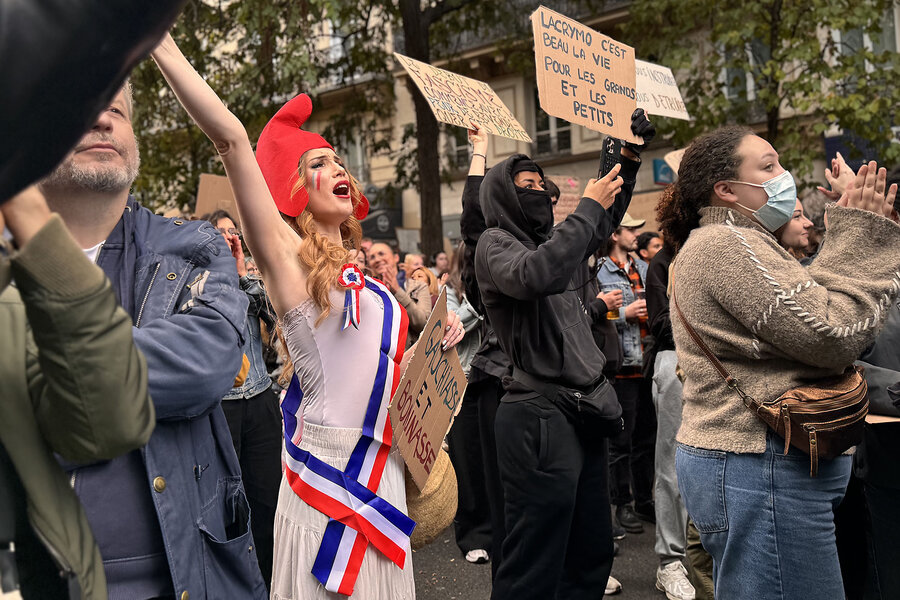
Paris | Oct. 19, 2026, 5:18 p.m. ET | 4 min read The French woke up in a state of shock and disbelief on Monday, after weekend demonstrations over education and the cost-of-living crisis spiraled into violence.In the southwestern town of Limoges, the city hall’s 19th-century bell tower crumbled under a mass of flames. In Paris, cars, bikes, and garbage cans were set on fire. Luxury stores and mom-and-pop shops around the country were smashed open and looted.But more than shock is a feeling of anger – over the estimated hundreds of millions of euros in property damage, as well as the nationwide violence that injured at least 150 law enforcement officers and led to a teenager losing a hand picking up a stun grenade in the town of Saint-Étienne. Anger is initially what drove upward of 800,000 people into the streets of France on Saturday, in calls to block budget cuts to public services, restore purchasing power, and improve conditions at high schools and universities. All of this comes in a context of France’s skyrocketing public debt, making fulfilling protester demands nearly impossible.For the most part, demonstrations were peaceful. In Paris, the Nouveau Monde orchestra accompanied protesters in joyful music. High schoolers chanted, holding cardboard signs and joining hands with soixante-huitards – May 1968 protesters who once helped bring the country to a standstill in their calls for change.But late Saturday and again Sunday, the peaceful demonstrations were overshadowed by casseurs (“hooligans”) – agitators who often have little connection to the protests, intent on committing property theft and causing damage. The identity of the casseurs is hotly debated by politicians and in the media, but sociologists say they are generally a mix of far-left voters, urban youth, and thrill-seekers taking advantage of the moment to commit theft and cause property damage. Colette DavidsonCharred vehicles line the streets near République square after peaceful demonstrations turned violent the day before in Paris, Oct. 18, 2026. Now, with the country at the tipping point of social crisis, the French government faces criticism over its handling of the protests, as well as questions about how the country can move forward. On Sunday evening, French President Emmanuel Macron addressed the nation for the first time since youth protests began one month ago, calling for calm, unity, and respect. Change, he said, “never comes from disorder and damage.” Mr. Macron promised to prosecute those responsible for the weekend violence, as well as address young people’s concerns.But the French government has been criticized by political opponents and the public over how it managed the demonstrations – either with too much or not enough authority. Shopkeepers who’ve found their livelihoods suddenly at stake wonder where the police were while groups looted and pillaged with impunity. Meanwhile, anti-riot police have been accused of unnecessary force against peaceful protesters.“It really feels like the right to protest is getting trampled on in this country,” says Laurence, a woman whom the Monitor witnessed being forcefully removed by police from the République square on Sunday. She declined to give her last name after being accosted by authorities.With six months until the presidential elections, politicians of all stripes used the weekend chaos to promote their version of events. French Prime Minister Sébastien Lecornu and outspoken far-left leader Jean-Luc Mélenchon exchanged heated words on social media, each accusing the other of responsibility. Meanwhile, far-right leader Marine Le Pen said the country faced a “profound crisis of confidence and authority.”Mr. Macron rejected the resignation of Interior Minister Laurent Nuñez – who has taken the brunt of criticism over his handling of demonstrations – in what Mr. Macron called an effort to retain continuity. On Monday, several cities, including Paris, announced curfews. As cleanup crews filled French streets to clear debris, broken glass, and charred vehicles Monday morning, many French people say they don’t recognize their country right now and are ashamed of the images of destruction being broadcast around the world. Young protesters worry that their cause is being lost in the weekend chaos and political jockeying. Deepen your worldviewwith Monitor Highlights.Politics with respectGet political stories with respectful analysis.There‘s a world of new ideas in everyBooks newsletter.There‘s more to life, enrich yours withCulture & Learning weekly.Follow humanity‘s discoveries withScience & Nature stories in your inbox.Gain a spiritual perspectivefrom the stories in your inbox.Want to understand the deeper impact of critical events? Learn the Monitor‘s insight.Already a subscriber? Log in to hide ads. French youth, after all, were the impetus for Saturday’s demonstrations. On Monday, as high school students began a two-week vacation, university students once again blocked access to campuses around the country, as well as the Louvre Museum in Paris, in hopes that the public will not lose sight of their demands.“We’re not calling for a revolution,” says Flora, a 16-year-old student who, being a minor, declined to give her last name. Alongside classmates, she has blocked the entrance to her Parisian high school with garbage cans and metal barricades for three weeks. “We just want a better education.” ALREADY A SUBSCRIBER? LoginReal news can be honest, hopeful, credible, constructive.The Christian Science Monitor was founded in 1908 to lift the standard of journalism and uplift humanity. We aim to “speak the truth in love.” Our goal is not to tell you what to think, but to give you the essential knowledge and understanding to come to your own intelligent conclusions. Join us in this mission by subscribing.
After violent weekend, France reckons with its frustrated, fractured public
Full Article
Original Source
Read the full article at Csmonitor →KhanList aggregates and links to publicly available news content. We do not host full articles from third-party sources. Always verify important information with original sources.