
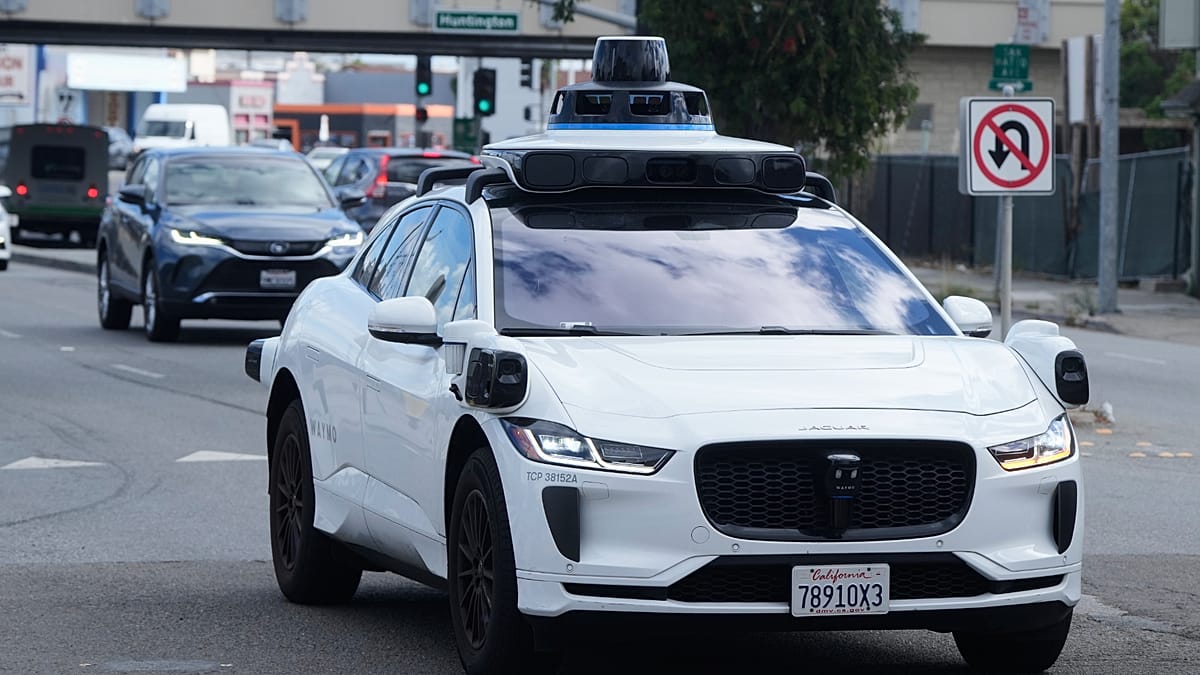
Alphabet, Google's parent company, plans to launch its Waymo driverless robotaxis for the public in Munich towards the end of next year, the company announced on its website on Wednesday. ADVERTISEMENT ADVERTISEMENT Until now, Waymo has only operated such taxis in the United States, London and Tokyo. The company said the first Waymo vehicles would appear on Munich's streets in the coming weeks, though initially they will still be manually driven during the trial phase. Drivers will first map the road network and carry out test runs with specially trained professionals at the wheel to ensure the autonomous system, the Waymo Driver, is properly adapted to the specific characteristics of Munich's traffic. During tests with autonomous Waymo vehicles in London in June, residents complained about noise pollution, according to media reports, as the cars frequently and noisily shunt back and forth while mapping the streets. According to Business Insider, Waymo will start in Munich with a small "initial fleet" of the upgraded electric Jaguar I-Pace models. "Munich is one of the absolute top locations worldwide for mobility and technology. Becoming part of this city is an important step in expanding our global presence," said Waymo co-chief executive Tekedra Mawakana. She added that the trust of local residents was a top priority as the service is prepared for launch, and announced plans to create highly qualified jobs as part of the project. One question still hanging over the launch, according to the German business magazine Clean Thinking, is how the cars will cope in winter. Snow and ice remain among the toughest conditions for self-driving cars, Waymo co-CEO Dmitri Dolgov has said. In the United States, the company still keeps safety drivers on board in cities with harsh winters for that reason. Germany's legal edge Bavaria's economy minister Hubert Aiwanger hailed Waymo's announcement as a "milestone". Christian Hirte, parliamentary state secretary at the transport ministry, said autonomous driving would shape the future of mobility. He added that Germany wants to become a leading global hub for developing and producing autonomous driving technology, pointing to the legal framework already in place. "Our ambition must be that these technologies are not only used in Europe, but also developed and operated here," he continued. For its future driverless service, Waymo still has to obtain the necessary regulatory approvals and is therefore working with the Federal Motor Transport Authority and the relevant state and local authorities. Germany has had legislation in place for driverless everyday road traffic since 2021. This will be Waymo's third market after the USA, the United Kingdom and Japan, and its first location in the European Union. The company points to more than 20 million completed journeys and over 350 million kilometres driven for the public without human control. Uber in Munich, VW in Hamburg Back in June, ride-hailing company Uber and Israeli AI firm Autobrains announced a joint robotaxi programme in Munich. In choosing the location, they cited the dense urban infrastructure, proximity to Germany's major carmakers and the legal conditions in Germany as decisive factors. Unlike Waymo, Uber/Autobrains are relying on software designed to enable autonomous driving with various car brands. Autonomous vehicles, albeit still with safety drivers on board, are also on the road in Hamburg as part of a Volkswagen project. Waymo stresses that its service is intended as a complement to public transport, cycling, and walking and points to the positive safety record of its vehicles.
After Uber, Waymo to launch the EU's first robotaxis in Munich
Full Article
Original Source
Read the full article at Euronews →KhanList aggregates and links to publicly available news content. We do not host full articles from third-party sources. Always verify important information with original sources.