
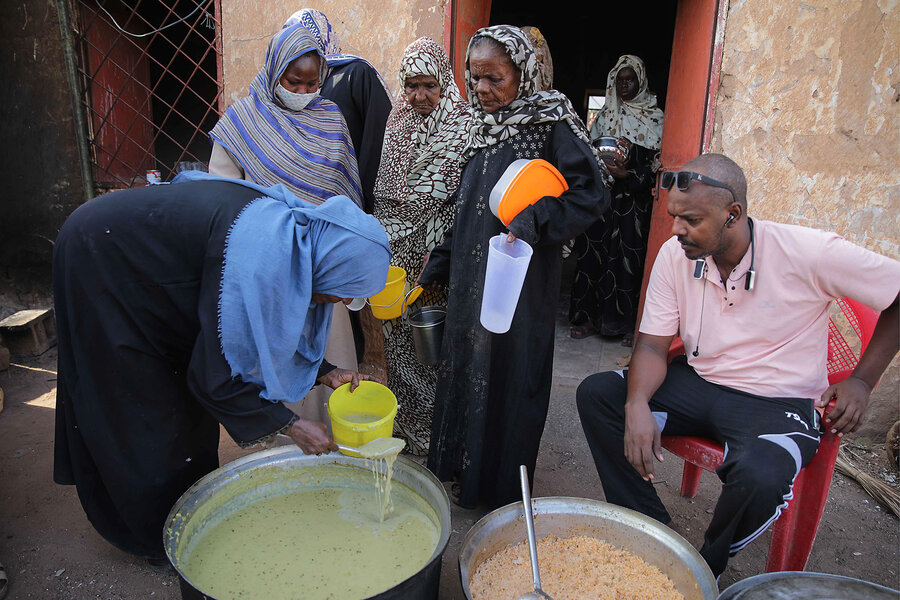
Cairo | Oct. 28, 2026, 1:09 p.m. ET | 4 min read A.M. measures the impact of Sudan’s runaway inflation in ladles of soup. At the community kitchen where he volunteers in the capital, Khartoum, “we used to be able to give each person four or five spoons of stew,” says A.M., who the Monitor reached by phone, and who is being referred to by his initials because belligerents in the country’s civil war target relief workers and critics. “Now, we are giving everyone just a couple.” Since May, the already-weak Sudanese pound has lost more than half of its value, disrupting food supplies and causing prices to skyrocket. This, in turn, is putting more pressure on local volunteers and international aid organizations already catastrophically overstretched after three years of brutal civil war between the paramilitary Rapid Support Forces and the Sudanese Armed Forces (SAF), the national army. Thirty-one Western countries, including the United States, sounded the alarm in a statement Monday calling for “urgent action” to prevent the hunger crisis from escalating. “Because the [value of the] currency is changing every day, many traders are not selling their food,” says A.M, who is part of a network of grassroots mutual aid groups known as Emergency Response Rooms. What little food is available is sold at prices the ERR can scarcely afford. “There are so many mouths to feed," A.M. says. An unraveling economyBefore Sudan’s civil war started three years ago, its currency traded at 600 to the dollar. By May 2026, around 4,000 pounds bought a dollar on the black market, where most exchanges currently take place. It has now surpassed 10,000. Marwan Ali/APPeople buy bread at a bakery in Khartoum, Sudan, Sept. 22, 2026. Food prices are rising in the country. The conflict has collapsed vital export sectors, disrupted seasonal harvests, and destroyed livelihoods. Military leaders on both sides have also plundered Sudan’s vast gold reserves, smuggling much of their takings out of the country. This leaves the de facto SAF government without enough foreign currency needed to stabilize the pound’s value. Sudan is one of Africa’s largest gold producers, and before the war, gold accounted for 70% of its export revenues. Now, however, more than half of its annual production is smuggled out by traders, generals, and militia leaders, according to United Nations experts and other analysts. Because that smuggled bypasses official export channels, proceeds from the sales go directly into the pockets of the war’s belligerents, rather than into government coffers. The SAF-backed government uses its proceeds to shower generals and allied militia leaders with lucrative salaries and gifts to maintain their loyalty, says Suliman Baldo, an expert on the war economy and the founder of the Sudan Transparency and Policy Tracker, a think tank. “The SAF has washed its hands completely from spending on essential services for the population,” he says. For its part, the RSF controls the western regions where much of Sudan’s gold is found, allowing it to smuggle the commodity through neighboring Chad and South Sudan to enrich its own leaders and fund its war efforts.Neither the RSF nor the SAF responded to a question from the Monitor about their role in the gold trade.Struggling to copeMeanwhile, civilians are left to deal with the effects of Sudan’s collapsing economy alone. Many residents of Khartoum fled at the start of the war when the RSF captured the capital and began occupying and looting people’s homes. Since retaking the city in March 2025, the-SAF backed government has encouraged citizens to return, but many returnees languish in the ruins of their homes without running water or electricity. El Tayeb Siddig/ReutersA farmer in North Kordofan, Sudan, clears land as drought and heat linked to El Niño threaten harvests, livestock, and water supplies, Sept. 12, 2026. In December 2025, two global relief groups estimated that 97% of households in Khartoum were already coping with food shortages. Now, rising prices are bringing many to the brink. A.M. estimates there has been a 10% increase in people coming to his ERR in need of food assistance since May, and he has heard from other ERRs that in some neighborhoods of Khartoum, the increase is as much as 40%. Many ERRs in the southern part of the city have shut down altogether, according to local news reports. Gada, who asked the Monitor not to disclose her last name for fear of reprisal from the SAF, stayed in Khartoum during the RSF’s reign. She now fears that the lawlessness from that time could return if people grow hungrier. “People are angry, and the city is getting more chaotic,” she says.Impossible choicesWith ERRs overwhelmed, United Nations agencies warn that they, too, are unable to respond to the magnitude of the crisis due to funding shortfalls.The U.N. has struggled to fill the gap left by the sudden withdrawal of American aid after Donald Trump became president last year. Its Sudan Humanitarian Need and Response Plan is just 46.5% funded. “The … number of people in need keeps getting bigger and bigger, and … the amount of money we have [from Western donors] keeps getting smaller and smaller,” says Denise Brown, the U.N.’s resident and humanitarian coordinator in Sudan.Ms. Brown adds that U.N. agencies are prioritizing the sprawling regions of Kordofan and Darfur, the latter of which is entirely under the RSF’s control. Both regions face a catastrophic hunger crisis and a worsening drought that is devastating yields. Children are particularly badly affected. In a recent U.N. survey of two displacement camps in South Darfur, about a third of children were acutely malnourished. Deepen your worldviewwith Monitor Highlights.Politics with respectGet political stories with respectful analysis.There‘s a world of new ideas in everyBooks newsletter.There‘s more to life, enrich yours withCulture & Learning weekly.Follow humanity‘s discoveries withScience & Nature stories in your inbox.Gain a spiritual perspectivefrom the stories in your inbox.Want to understand the deeper impact of critical events? Learn the Monitor‘s insight.Already a subscriber? Log in to hide ads. In their joint statement Monday, some three dozen Western governments underscored the urgency of the situation.“There is no time to lose to save lives,” they wrote. ALREADY A SUBSCRIBER? LoginReal news can be honest, hopeful, credible, constructive.The Christian Science Monitor was founded in 1908 to lift the standard of journalism and uplift humanity. We aim to “speak the truth in love.” Our goal is not to tell you what to think, but to give you the essential knowledge and understanding to come to your own intelligent conclusions. Join us in this mission by subscribing.
After three years of civil war, Sudan faces the threat of inflation
Full Article
Original Source
Read the full article at Csmonitor →KhanList aggregates and links to publicly available news content. We do not host full articles from third-party sources. Always verify important information with original sources.