
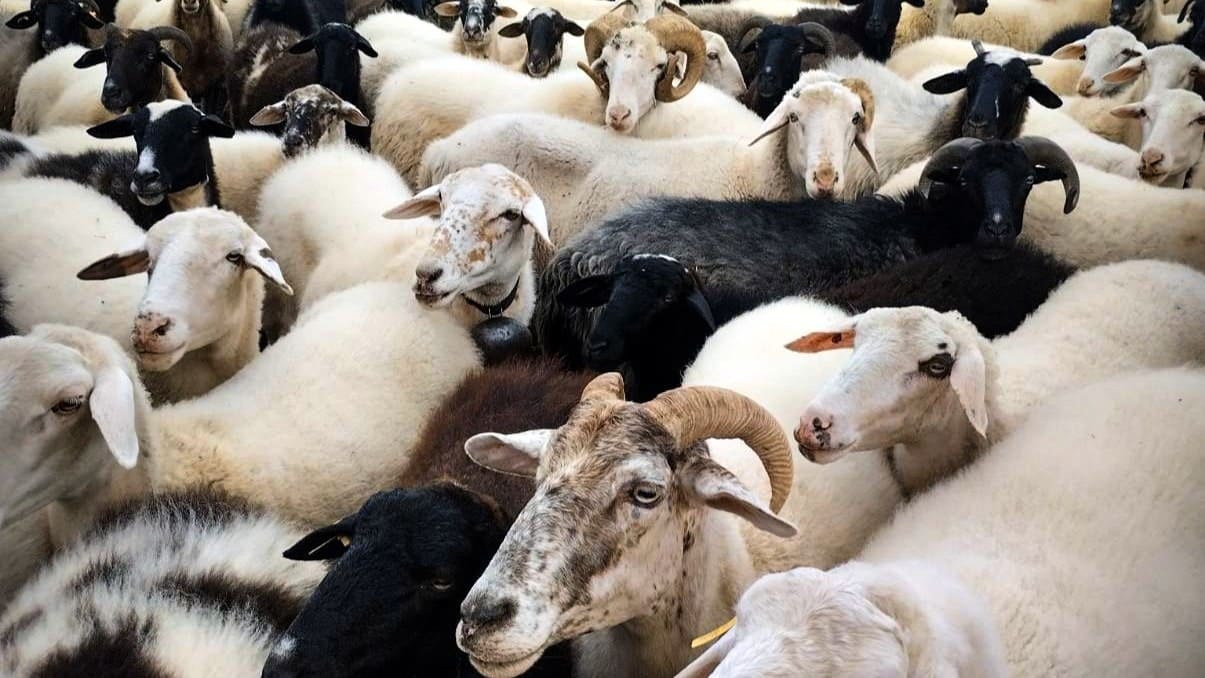
For generations, dusk fell on the hillside village of Mesotopos, Lesvos, to the sound of mothers singing traditional lullabies to their children. One of the best known ‘songs of the cradle’ begins, ‘Sleep, who takes the little ones, come and take this one too.’ Stavros, a shepherd, recalled another accompaniment to the end of the day: the bells of sheep, “little more than a distant echo”. “One sound belonged to our home while the other to the pastureland, but together they shaped the nights of these villages,” said Stavros. While the children would succumb to sleep, however, the sheep bells did not cease. “They simply passed through until dawn,” he said. “It’s only now that you notice they’re gone.” I arrived in Mesotopos in early summer, in the wake of the first foot-and-mouth epidemic in Greece in 25 years. The first case of the SAT1 strain was detected on the island of Lesvos in March, triggering one of the largest livestock emergencies in recent Greek history. By June, entire stocks had disappeared from some villages on the island as more than 30,000 sheep and goats – from a population of roughly 480,000 on Lesvos – were culled under European Union disease-control rules. Even farms that were not affected by the virus were subject to restrictions and unable to sell dairy or transport animals as they usually would. Now, empty pens and the silence left by culled animals have become as much a part of the landscape as the olive groves. Dairy heartland Stavros sitting on the vine-shaded patio of his taverna. Photo: Davide Marchesi.Less than 80 kilometres from Mytilene, the capital and main port of Lesvos, the road to Chrousos – a small coastal village in the municipality of Mesotopos – crosses the western side of Lesvos through low hills and sloping, silvery olive groves before reaching the coast. Come midday, the heat settles over the fields and the reeds barely move, while dust still hangs above the roadside long after the dirt track disappears beneath asphalt. Stavritsa, Stavros’s wife, was setting tables when I arrived at her family restaurant. From the terrace, the Aegean stretched out beyond a line of pine trees, although hardly anyone seems to notice the view anymore. Just weeks earlier, the couple had watched as their flock of around 500 sheep and goats was destroyed as part of the effort to contain the outbreak. As lunch was being prepared, Stavros strolled slowly through the yard, stopping every few steps to point to a stone wall or a flowerbed. “I built this,” he said, as if reminding himself. The restaurant has evolved over the time, shaped by what he calls his ‘sevdas’, a quiet, lifelong devotion, and ‘meraki’, meaning ‘to leave something of your soul in what you do’. After long days spent on building sites, Stavros would return in the evenings to lay another row of stones or tend the plants before dark. A pomegranate tree stood near the entrance, its branches reaching towards the fields beyond while geraniums and rosemary spilled over the garden’s low walls. Lunch arrived, starting with courgette flowers filled with rice and herbs, followed by wild greens and marathos dressed in lemon, as well as ladotyri cheese and bread that had barely had time to cool. Preserved in olive oil for months, the cheese brings together the two products that have shaped Lesvos for centuries, a marriage of sheep milk and olives. Few families could get by on one source of income alone; instead, they moved between their herds and their orchards and did seasonal work as required. In 2025 alone, Lesvos produced around 52,000 tonnes of sheep and goat milk. The island accounts for 5-6 per cent of Greece’s PDO feta production. When thousands of animals were slaughtered, those income streams disappeared overnight, with consequences for dairies, cheesemakers, feed suppliers and transporters. Almost everything on the table in front of me had come from the surrounding fields: so it was only a matter of time before someone noticed that much of what we were eating could easily have been absent. The conversation drifted organically from lunch to livestock. More than a flock Stavritsa with her homegrown vegetables, and a plate of gemisti kolokythoanthoi from her kitchen. Photos: Davide Marchesi.The island’s indigenous sheep [called the Mytilini or Lesviot breed] is a hardy variety adapted over centuries to the island’s steep terrain and sparse vegetation. According to the Ministry of Rural Development and Food, it is valued for its resilience, and high‑quality milk. It is considered one of Greece’s distinct local genetic resources, its conservation status monitored under national and EU agrobiodiversity programmes. “The Lesvos sheep is a breed with a long history of adaptation to the island’s difficult conditions,” said Dr. Kostas Theodorou, Associate Professor of Conservation Evolutionary Biology at the University of the Aegean’s Department of Environment. “It is hardy, productive and represents an irreplaceable genetic resource.” Before the outbreak, Lesvos supported one of the largest populations of indigenous sheep in the country; the 2026 cull therefore represented a significant loss of local genetic heritage, with some bloodlines disappearing entirely, according to Theodorou. “Apart from managing an animal disease, this is about protecting a breed that has been improved over decades through genetic selection schemes,” he told BIRN. Mesotopos alone recorded more than 20 outbreaks with cumulative losses estimated at over 9,000 animals – one of the highest concentrations of culling on Lesvos, where a total of 75 outbreaks were recorded from mid-March to early May. Many farms lost entire stocks. Stavros’s daughter-in-law was at the sheepfold when the refrigerator trucks arrived. “She knew what they were for,” he said with a sigh. “She almost fainted.” For a moment, no one spoke. ‘There isn’t a single animal left’ The garden entrance to the taverna. Photo: Davide Marchesi. Seventy years old, Stavros could not recall a time when animals were not part of his life. Before roads reached this section of the island he travelled with his father by donkey. His father bred sheep, and later Stavros grew his own flock before his sons took over much of it. It began with a handful of animals in 1987 and grew gradually, expanding whenever work and money allowed. Lambing season often meant finishing one job before starting another – construction work during the day, newborn lambs at night, and then back again the following morning. Stavros gestured towards the mounds beyond the terrace. From where we were sitting, I could just make out the family’s fold. “There isn’t a single animal left,” he said quietly, lifting a hand towards the hillside and tracing the ground where the livestock once moved with the seasons. I found it difficult to picture the countryside as he remembered it. I asked whether he still goes to the fold. He shook his head before I had even finished the question and said: “I can’t.” Like many breeders on Lesvos, the family was still waiting to learn what compensation they could expect and when. The Ministry of Rural Development and Food pledged to compensate farmers for livestock culled during the outbreak, as well as for lost income, destroyed milk and part of the additional feed costs, on a case-by-case basis depending on each animal’s age and classification. In late April, the ministry announced it had already paid out 22.8 million euros to 849 farmers across Greece, including 726,038 euros for the North Aegean region. However, it was not specified how much had been received by affected farmers on Lesvos, nor when every farm would receive its payment. Across western Lesvos, breeding was rarely left to chance. Rams were borrowed by one village from another to strengthen bloodlines, while older shepherds would give advice to the younger colleagues about which animals should be paired and which should not. Such information is embedded in the island’s oral tradition, passed from one generation to the next. “Every breeding decision, every season, every animal teaches you something,” said Stavros. “You learn to recognise each one. You know when something is wrong before anyone else can see it. Lose one, and you lose part from the other.” “Who will still be farming here in 10 years’ time?” He looked at me for a moment, as though the answer should already be obvious. Impact ‘far beyond the farms’ Stavros and Stavritsa’ restaurant at the time it first opened. Photo courtesy of the family.Lesvos is far from unique in its plight. Across the Mediterranean, declining profitability, labour shortages, climate breakdown and the abandonment of farming in marginal regions have steadily eroded the viability of extensive pastoralism that was never economically secure. Like many regions, the Greek island has seen its younger residents leave in search of more stable employment, while those who remained continued to farm despite ever narrower profit margins. “Without sheep, the effects spread far beyond the farms,” said Stavros. “Feed merchants lose customers, transport companies have fewer loads to carry, seasonal work becomes harder to find, and places like this begin to feel the shortage in quieter ways. People think it’s only the farmer who loses out. But everyone is tied to it, whether they realise it or not.” Sheep and goats maintain semi-natural grasslands and open woodlands, supporting wildlife and dispersing seeds while reducing the build-up of combustible vegetation that fuels increasingly destructive wildfires. They also sustain local food production, preserve livestock breeds adapted to harsh environments, and support rural economies with few comparable alternatives, as a form of environmental stewardship that produces public goods whose value is rarely recognised by markets or agricultural policy. At stake “is the economic and social identity of the island,” said Theodorou, adding that “prolonged restrictions and repeated outbreaks could persuade many breeders to abandon farming altogether”. Lack of environmental oversight Stavritsa’s vegetable garden behind the restaurant. Photo: Davide Marchesi.Containing the virus required the disposal of more than 30,000 carcasses, most of them buried on or near affected farms under emergency disease-control measures, raising environmental concerns that remain unresolved months later. Dr. Nasos Stasinakis, a professor of environmental engineering at the University of the Aegean, said a host of questions about the response have yet to be answered. “We still do not know how many burial sites exist nor how many animals were buried at each one,” he said. “There is no environmental monitoring protocol in place for nearby groundwater, wells or surface waters. The public should be informed as to whether these areas are being monitored and whether the results are safe.” According to Stasinakis, a lack of environmental oversight had resulted in “serious environmental degradation”. Environmental authorities should have supervised the burial process alongside veterinary officials, he said, while criticising an apparent reliance on police patrols to inspect burial sites. “Police officers cannot carry out environmental monitoring simply by looking at a burial site. That requires scientific sampling and specialist expertise.” Disease outbreaks, such as the one on Lesvos, expose how quickly decades of accumulated wisdom and community networks can dissolve. The disappearance of pastoralism would not simply mean fewer sheep on Mediterranean hillsides, but also greater vulnerability to hotter summers, increasingly variable rainfall and prolonged droughts, all while eroding forms of ecological heritage that have shaped these lands for centuries. Beyond the disposal of carcasses, Theodorou said the emergency measures themselves carry ecological consequences. The prolonged confinement of grazing animals has left large areas ungrazed, allowing combustible vegetation to accumulate and increasing wildfire risk across parts of the island. “This is a well-established ecological principle,” he said. By early evening, the light over Chrousos had begun to soften and the first customers were drifting into the restaurant. Across the table, Stavros had fallen silent. His eyes remained fixed on the hillside where his animals once grazed, so still that he too seemed to fade into the landscape. “You can buy sheep again,” he said at last. “But you can’t buy back the same flock.”
After the Flock: A Greek Island Mourns its Sheep, Ponders its Future
Full Article
Original Source
Read the full article at Balkaninsight →KhanList aggregates and links to publicly available news content. We do not host full articles from third-party sources. Always verify important information with original sources.