
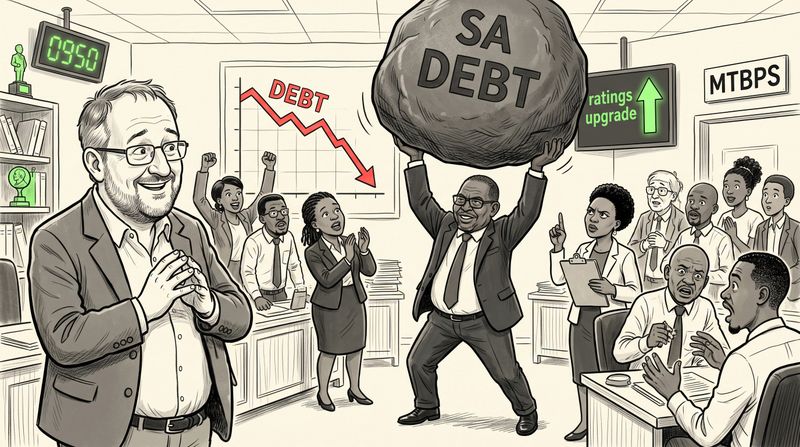
About three times in my life someone has trusted me enough to tell their debt story. In two cases, it was a person much younger than me, and the emotion on their faces sits with me still.Both had committed the folly of buying a car, had not checked the insurance was 100%, crashed it and still had to pay it off.The shame and the embarrassment and the sense of failure on their faces haunt me. And the twice-a-day reminder, as they sat in a minibus to and from work, and watching the debit order for the car still going off, was almost more than they could bear.The only happiness in both stories is the memory of the relief that lit up their faces when they were able to finally remove that burden from their shoulders.I think they genuinely felt they could finally live life again.Countries are slightly different.But wow! Debt matters.The entire reason bond yields in places like the US and the UK and France and Japan are spiking now is because of their high levels of debt and the cost of capital.Amazingly, despite the fact that you and I have been fated to live in interesting times, there is a very good story playing out that we don’t really pay attention to.Like so many positive processes, like the extension of our average life expectancy from about 31 in 1900 to about 74 now, there has been a huge change that you have to look to notice.Despite our slow economy and high youth unemployment, and all of the problems of State Capture and the parties that want to “radically” change everything, we have been reducing our debt.I don’t know exactly how they’ve done it, but frankly, if we keep going in this direction, someone, somewhere should be given some kind of Nobel debt-paying prize.On Wednesday, we will get a sense of how much progress the government has really made on this, when Finance Minister Enoch Godongwana delivers his Medium-Term Budget Policy Statement (and if you think it’s a lot to read that phrase, you should try saying it … it’s more than a mouthful).No matter what figures he comes with, he will have a really good story to tell. Economically speaking we live in a tough neighbourhood. Everyone has been hit so hard by oil prices that to pay back debt is really impressive.I know that when this happens there is likely to be quite a political firestorm about it, strange as it may seem.There are important reasons that activists, many of whom I think would happily accept the label “progressive” or even “left wing”, would say the government has implemented austerity measures to make this happen.And sure, “austerity” comes with huge costs. When you try to pay back debt it means that you are taking rands that could go to hospitals or schools and using them to pay some global financial institution.But I think, on balance, this is something we have to do.Because paying back debt can take so long and be such a bloody pain in the neck, you sometimes forget what happens when you actually do it.Just as those two younger people started to live life again, so our finances might be able to live a little again.Investec has reminded us how much this matters to those pesky ratings agencies.They reckon there’s a more than 50% chance that many of them will upgrade us to investment grade in the next two years.One of the key questions that will no doubt come, either explicitly in the MTBPS or in the commentary before and after, is whether there is an announcement of a fiscal anchor, a public statement that debt will not rise above a certain level. Considering that debt is going down, the fact that we have a lower inflation target and that things are moving in the right direction, this could be the final element we need to get that upgrade.But.And it’s a big “BUT”.Our politics has swallowed a lower inflation target and reducing debt thus far. Making an anchor explicit right now might just be a little more than parts of the ANC can accept.And you can imagine the argument from people who would insist that the government channel some of the money that’s going towards repaying debt into some kind of fuel price relief.Amazingly, there is no public evidence that the ANC is even discussing economic policy in its National Executive Committee or elsewhere. However, if I were Godongwana, I wouldn’t want to push it too far. On the other hand, if I thought I could get away with it, then I would go for it.And point out how much more money we will have to spend in the future because of what we’re doing now.Losing your debt, like losing weight, is incredibly hard to do. But the results live on. Literally for generations. DM
AFTER THE BELL: Escaping the debt trap could set SA on the road to fiscal victory
Full Article
Original Source
Read the full article at Dailymaverick →KhanList aggregates and links to publicly available news content. We do not host full articles from third-party sources. Always verify important information with original sources.