
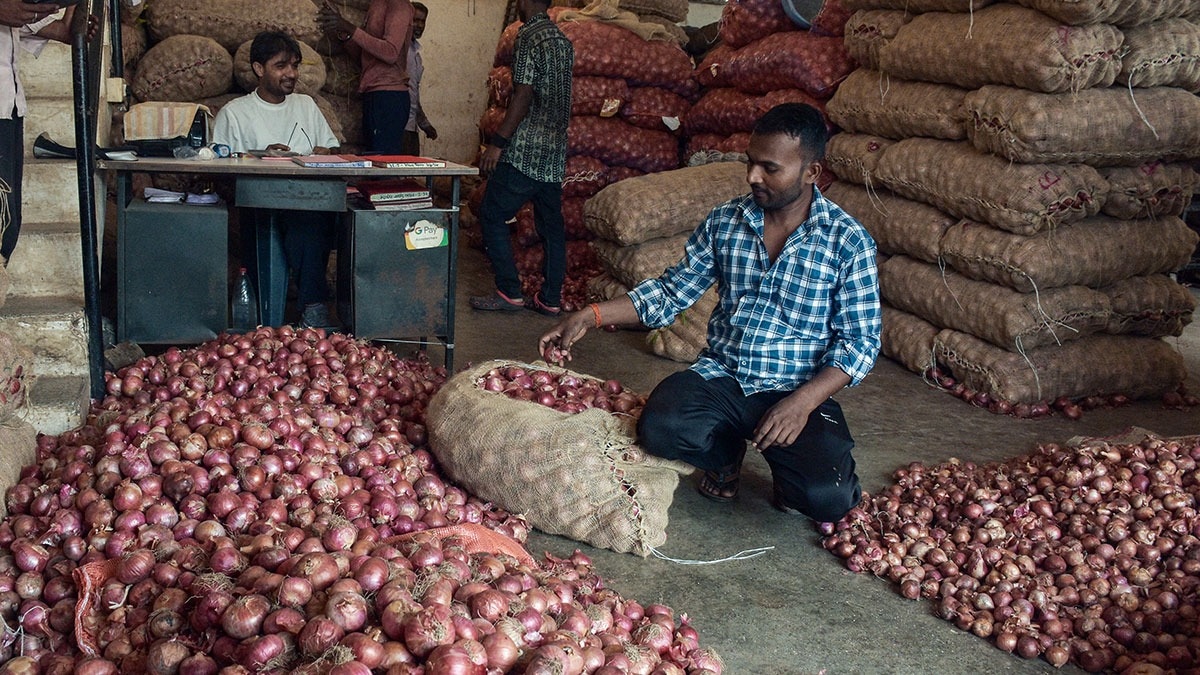
No production collapse; then why have average retail prices soared around 60 per cent nationally and how is the government handling the crisis?The onion is arguably India’s ‘most political’ vegetable, and it is once again testing household budgets and the government’s nerve. Retail prices in Gujarat have jumped from Rs 35-40 a kg to Rs 60-70 a kg in just 15 days, mirroring a nationwide spike that had pushed the average retail price up by 59 per cent year on year to Rs 43.53 per kg by August 24, with wholesale rates rising 68 per cent.This isn’t a production collapse. India’s 2025-26 onion output is estimated at 30.73 million tonnes, broadly flat against the 30.76 million tonnes the previous year—indicating the crop itself was fine. The crisis lay in the government’s buffer stock, the emergency reserve meant to cool prices when needed.The Centre set a procurement target of 0.2 million tonnes of rabi onion for the Price Stabilisation Fund—a fund meant to help moderate the price volatility of key agricultural commodities by procuring and releasing stocks strategically. However, NAFED (National Agricultural Cooperative Marketing Federation of India) and NCCF (National Cooperative Consumers’ Federation of India) together managed only 0.12 million tonnes—a 40 per cent shortfall against target. Compounding this, an estimated 30 per cent of what was procured has already rotted or sprouted in storage, against a normal spoilage rate of roughly 20 per cent.The damage also traces to unseasonal rainfall during this year’s harvest and sowing windows. Wet conditions during harvest hit both quality and shelf life of stored onions, accelerating rot in warehouses. Besides, delayed and inadequate rainfall during kharif sowing pushed back the next crop cycle—meaning fresh supply that should be easing the crunch isn’t ready. Farmers, sensing spoilage risk, began releasing stock in June-July instead of the traditional September start, and stronger wholesale prices pulled sellers away from government procurement altogether, starving the buffer just when it was needed most. In Gujarat specifically, traders report that farmers lost roughly a quarter of their stock outright to quality damage, with another quarter pulled from fields prematurely, leaving only half of the crop fit for market.Onion price spikes in August-September have become almost routine, driven by the seasonal gap between the exhausted summer crop and the still-arriving kharif harvest, layered with festive and wedding-season demand. What’s unusual this year is the scale of buffer-stock failure arriving at the same time.The Centre has moved on two fronts. First, physical supply. It is running dedicated ‘Kanda Express’ freight rakes from the Nashik buffer, carrying 800 tonnes to the five priority centres of Delhi, Chennai, Madurai, Ernakulam and Guwahati. NAFED and NCCF are trucking smaller consignments by road.Second, price relief. Subsidised retail sales at Rs 35 a kg have begun in Delhi through NAFED, NCCF and Kendriya Bhandar, with the wider National Capital Region (NCR) to follow. Officials say this mirrors last year’s mechanism, when 88,000 tonnes moved through 86 rakes to 16 cities, compared to just 12,000 tonnes via 14 rakes the year before. It was a scaled-up response, but reactive rather than preventive.Notably, Gujarat isn’t on the Centre’s five-city priority list despite onion prices matching or exceeding Delhi’s. That raises the question: is any buffer relief headed to Ahmedabad, Surat or Rajkot?Subscribe to India Today Magazine- EndsPublished By: Shyam BalasubramanianPublished On: Aug 31, 2026 19:54 IST
After sugar shock, why Indians are shedding onion tears
Full Article
Original Source
Read the full article at Indiatoday →KhanList aggregates and links to publicly available news content. We do not host full articles from third-party sources. Always verify important information with original sources.