
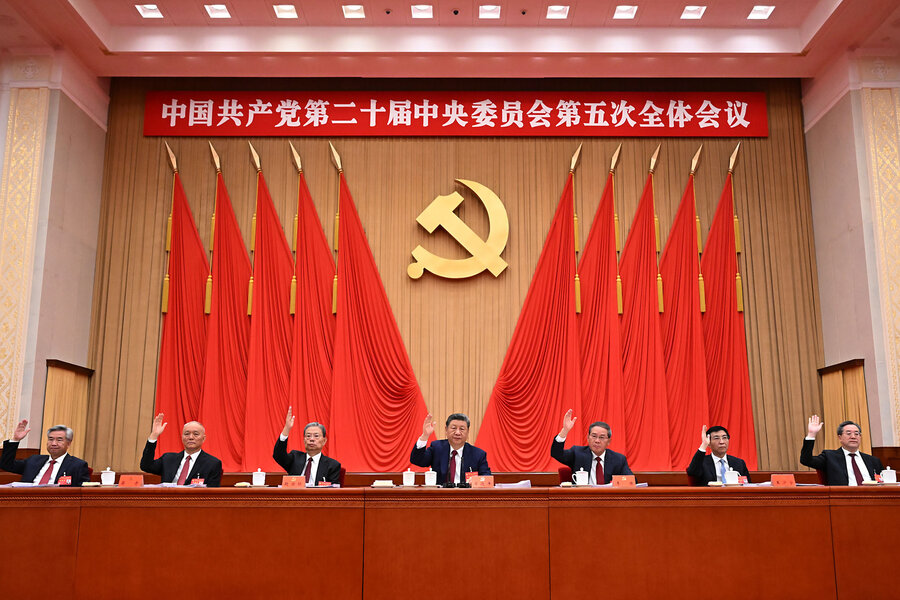
Beijing | Oct. 29, 2026, 1:53 p.m. ET | 3 min read The empty chairs say it all.As the Chinese Communist Party’s Central Committee – its top leadership body – convened its annual plenum this week in Beijing, only 279 of the 376 members installed four years ago attended. Dozens have been expelled, have been placed under investigation, or have disappeared from public view, according to a report by the Asia Society Policy Institute, based in Washington, D.C.The hollowed ranks reflect a sweeping purge of top military and civilian officials by Chinese leader Xi Jinping. Mr. Xi calls it “self-revolution” – the ongoing requirement for the party to oust officials deemed corrupt, profligate, or lacking in ideological zeal. Mr. Xi has intensified his purges in recent years, removing numerous close allies and tightening his grip over the 101 million-member Communist Party as he advances toward a likely fourth term at the party congress in 2027.“This is a feature of the system, not a bug,” says Jonathan Czin, a fellow at the China Center of the Brookings Institution and formerly the U.S. intelligence community’s top expert on Mr. Xi. “What it reveals is how intense Xi’s ideological fervor is. He is quite serious about having this kind of self-flagellation be part of how the party operates.”The party’s ruling Politburo has seen three of its 24 members fall since 2022 – the most extensive housecleaning of the top party leadership since the 1980s. Florence Lo/ReutersThe Chinese Central Military Commission's vice chairman, Zhang Shengmin, arrives for a ceremony to mark Martyrs' Day, a day ahead of the Chinese National Day, at Tiananmen Square in Beijing, Sept. 30, 2026. Vacancies left by senior military officers are also striking. Only one in five of the original uniformed Central Committee members remains. Gen. Zhang Shengmin – the military’s top anti-corruption officer – was elevated to the Politburo at the plenum, according to a communiqué issued at the meeting’s close on Thursday. The communiqué confirmed the expulsions of nearly three dozen party officials, including a slew of top generals. It praised Mr. Xi and the Central Committee for having the courage to “confront the grave situation” marked by “weak, hollow, and watered-down Party leadership.” But it said “formidable challenges” to the party remain from “corruption and moral decline.”Like past Chinese leaders, Mr. Xi faces the problem of how to control and rejuvenate the party – and hold members accountable – given its monopoly on political power. Mao Zedong promoted “continual revolution” to guard against party complacency, unleashing grassroots radicals to wage violent campaigns such as the 1966-1976 Cultural Revolution.Instead, Mr. Xi is using “self-revolution,” institutionalizing a party system that carries out continual purges and investigations of personnel, while keeping the broad policy direction stable. “Mao destroyed the party bureaucracy,” says Mr. Czin. Nowadays, “you have the operatic tumult on the personnel side ... but plodding policy continuity.”Indeed, senior Chinese officials are falling with head-spinning frequency. Xie Huanchi/Xinhua/APChinese leader Xi Jinping speaks at the fifth plenary session of the 20th Communist Party's Central Committee, held in Beijing, Oct. 29, 2026. In the past nine months alone, the country’s powerful Discipline Inspection Commission opened 800,000 investigations and punished 680,000 people, including more than half a million Communist Party members, according to state-media reports. Just last week, Beijing Vice Mayor and municipal party Standing Committee member Xia Linmao came under investigation for “serious” violations of discipline.“We have seen wave after wave of officials arrested for corruption and malfeasance,” says Victor Shih, director of the 21st Century China Center at the University of California, San Diego. “Anti-corruption has been a very elusive objective.” Beijing casts the personnel shake-ups and broader anti-corruption campaign as signaling the strength of China’s Communist Party rule – and something for other countries to emulate. “The Communist Party of China tempers itself with the courage to turn the blade inward,” the state-run Xinhua News Agency said in an article this week. The theme of this week’s Central Committee plenum was “full and rigorous Party self-governance.” Deepen your worldviewwith Monitor Highlights.Politics with respectGet political stories with respectful analysis.There‘s a world of new ideas in everyBooks newsletter.There‘s more to life, enrich yours withCulture & Learning weekly.Follow humanity‘s discoveries withScience & Nature stories in your inbox.Gain a spiritual perspectivefrom the stories in your inbox.Want to understand the deeper impact of critical events? Learn the Monitor‘s insight.Already a subscriber? Log in to hide ads. But as Mr. Xi’s anti-corruption purges cut deeper into the ranks of his close, handpicked allies, he is injecting high levels of mistrust in top party bodies. This could potentially jeopardize his own smooth succession, as he brings in a new crop of younger military and civilian leaders, experts say.“If [Mr. Xi] doesn’t trust people who are really inside ... his inner circle, is he going to trust a bunch of guys in their 50s and 60s?” says Mr. Czin. “He can replace the people, but he can’t really replace the trust.” ALREADY A SUBSCRIBER? LoginReal news can be honest, hopeful, credible, constructive.The Christian Science Monitor was founded in 1908 to lift the standard of journalism and uplift humanity. We aim to “speak the truth in love.” Our goal is not to tell you what to think, but to give you the essential knowledge and understanding to come to your own intelligent conclusions. Join us in this mission by subscribing.
After purges, China’s Central Committee praises the party’s ‘rigorous self-governance’
Full Article
Original Source
Read the full article at Csmonitor →KhanList aggregates and links to publicly available news content. We do not host full articles from third-party sources. Always verify important information with original sources.