
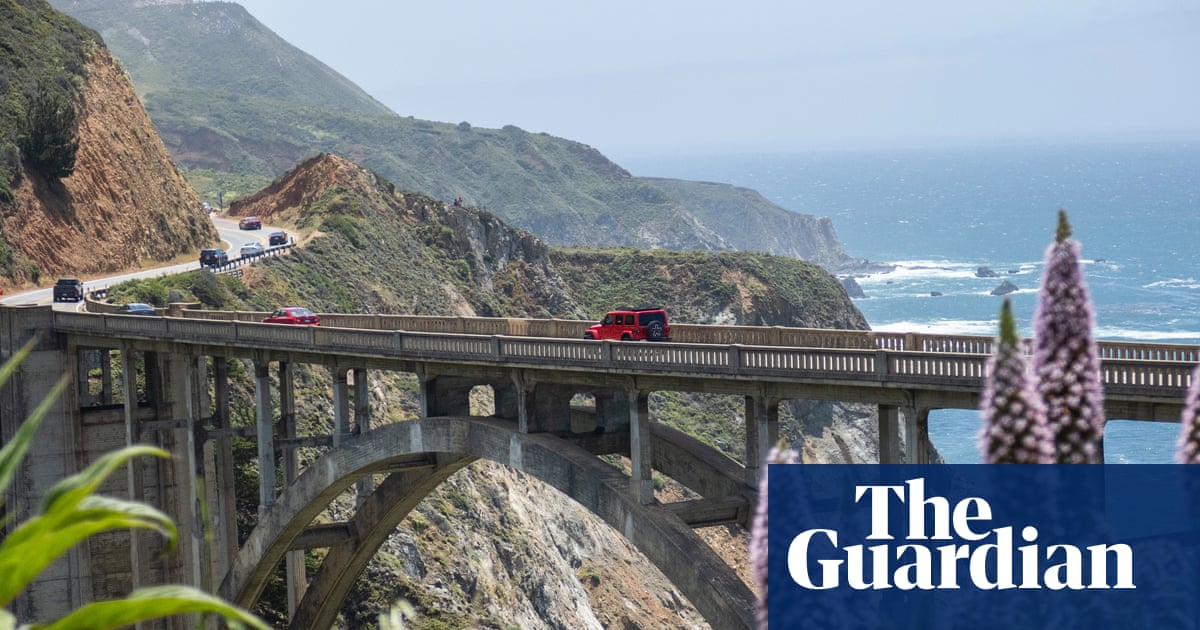
California’s rugged Big Sur coastline is often called a slice of heaven, 120 miles (195km) of unspoiled rocky promontories, sandy beaches and redwood forests at the foot of the Santa Lucia mountains. This year, it has endured a long summer of hell.Wildfires, road closures and repeated disruptions to the local hotel, restaurant and campsite businesses all have posed significant challenges in an era of climate change and unpredictable weather patterns. One large fire broke out in the highlands east of Big Sur in early August and is still less than 25% contained. A second fire erupted 30 miles to the south two weeks later and is so inaccessible to firefighters that it has grown bigger than the first and is barely contained at all.Residents of the area have long known that the threat of natural catastrophe is part of what it means to live in a remote and beautiful place. But for many, the events of this summer have renewed questions about the sustainability of mass tourism in the area, particularly in the age of Instagram.The tourist industry accounts for about 90% of the local economy, so visitors are certainly welcome. But nobody feels comfortable with chaos on the roads, tourists who leave their messes behind or a pair of recent traffic deaths that have plunged the community into mourning. Like other global hotspots, from Italy to the Galápagos, Big Sur is asking: how many is too many?Henry Miller once described this coast as a place imbued with “the peace of God, and the serene security created by a handful of good neighbors living at one with the creature world”. But many coastal residents worry that sort of peace is rapidly eluding their grasp.A reopening marred by selfie-snappersThe disruptions began at the beginning of the year with the long-awaited reopening of Highway 1, a two-lane road that provides the only vehicle access to Big Sur from the Monterey peninsula in the north to Cambria in the south. For three years, the route had been cut in two by extensive repair work in the wake of heavy landslides, another abiding natural threat. The region lost about 20% of its tourists over that time, at a cost of millions of dollars a month. Hearst Castle, on the southern end of the peninsula, lost as many as 40%.The reopening immediately caused visitor numbers to shoot back up, but residents and local officials noticed that along with the nature lovers and the hikers came many more tourists interested almost exclusively in snapping selfies at a handful of well-advertised locations before moving swiftly on.Tourists take photos at Bixby Bridge on 14 January. Photograph: Myung J Chun/Los Angeles Times/Getty ImagesSuch visitors weren’t shy about stopping in the middle of the road to take pictures at the spectacular, arched Bixby Bridge, even if it meant snarling traffic for miles in each direction. Local media was filled with stories of visitors trampling on plants, camping illegally and tossing their trash in all directions. In July, a selfie-ruining banner appeared on the Bixby Bridge that read: “Overtourism is killing Big Sur.” But it made little difference.“Visitor behavior has changed so much,” said Kate Daniels, who represents Big Sur on the Monterey county council and successfully pressed for a parking moratorium at the Bixby Bridge that went into effect last month. “This is one of the most beautiful places you’ve ever seen, yet people have decided their goal is to take a picture of themselves on a bridge … It’s really difficult and dangerous, and that road cannot handle it.”‘It was a nightmare’For many residents, the low point came in mid-August, when Monterey county hosted its annual Car Week extravaganza, featuring thousands of vintage and exotic cars and a line-up of events in and around the city of Monterey and the golf courses of Pebble Beach.Some of the event’s 100,000 visitors repurposed the Big Sur coastline as a playground for their souped-up coupes and convertibles. They had done much the same the previous year, but now the Timber fire was raging, every change in the wind was apt to carry the smell of burning forest and the community had no patience for it.Even as fire trucks were trying to set up defensive lines in an effort to save buildings and people, car aficionados were filmed making high-speed dashes down the straightest stretches of Highway 1, doing doughnuts at traffic intersections and gathering dozens of vehicles for group photographs. Photos and videos posted online showed fire trucks struggling at times to move on a highway clogged with brightly painted sports cars.“It was a nightmare,” Daniels said. “Car Week has been going on for decades and it never used to be like this, but now it’s this hyper-masculine racing culture thing. People kept saying that someone is going to die.”By the end, people did die.Crews put out spot fires from the Timber fire in Big Sur on 13 August. Photograph: Nic Coury/APOn the final weekend, a 20-year-old out-of-towner at the wheel of a Dodge Challenger coupe plowed into Brian Roberts, a popular figure in Big Sur who went by the nickname Brewski and, according to his friends, had spent many of the previous days railing against the behavior of the Car Week attendees. Accounts differ about how the accident happened – some of Roberts’s friends say he was crossing Highway 1 to admire the sunset, while others say he was in the road yelling at cars after he found them blocking the turn-off to Palo Colorado Road, where he lived.Days later, an 80ft skid mark was still plainly visible, along with circular burn marks where vehicles appear to have been doing doughnuts. One of Roberts’s friends, Brendon Shave, arrived on the scene shortly after the accident and found bloodstains smeared across the median line and on the tarmac.The following day, another 20-year-old visitor from outside San Francisco smashed a silver BMW convertible into a tree a few miles north of Big Sur, killing one of his passengers and injuring himself and two other friends. Police said the driver recorded a blood alcohol level of 0.13, well above the legal limit, and they were investigating the death as gross vehicular manslaughter.Traffic deaths are a fact of life in Big Sur, with news reports suggesting that one occurs every few months, either because drivers go too fast along the windy, narrow road or because they become distracted by the natural beauty and plunge off the side.Still, Roberts’s death has moved people to particular outrage.The Plaskett fire burns on a hillside in Big Sur on 27 August. Photograph: Ethan Swope/AP“The community felt disrespected because the land was on fire,” said Lindsey Kirk, a friend of Roberts’s from the San Francisco Bay Area who spends as much time as she can spare in Big Sur. “It’s crazy that the fire services couldn’t get through because of all the cars they brought in.”Shave, who runs a hair salon in Carmel, a 20-minute drive from where Roberts died, blamed authorities in Monterey county who, he said, used the beauty of Big Sur as a draw for big events – marathons and golf tournaments as well as the annual car show – but did little to look out for its residents. “People live here,” he said, “to get away from all the stuff that Monterey county keeps sending our way.”See Monterey, which promotes tourism in the region, has repeatedly urged visitors to Big Sur to stick to the speed limit and park legally and put out one statement headlined: “Big Sur Deserves Big Respect.”But the organization also encouraged Car Week attendees to explore far and wide, including the Big Sur coast. Eleven days after Roberts’s death, See Monterey put out a statement proclaiming “a banner year”, with hotel revenue up, visitor spending exceeding $100m and more than $4m raised for charity.The lunch crowd at Nepenthe restaurant in Big Sur on 30 May. Photograph: Myung J Chun/Los Angeles Times/Getty ImagesLeft unmentioned were the many area businesses that closed for the week or threw up metal fences and hired security guards so their parking lots would not turn into impromptu, days long motor sports rallies.The visitors noticed. The driver of a McLaren supercar denied entry to an In-N-Out Burger attracted national attention when his brother protested on his behalf: “That’s profiling! That’s racism towards cars.”‘We lost a good human being’Days after the last Lamborghinis and Porsches left town, a flare-up in the Timber fire sent cascades of sparks and ash down from Mount Manuel and prompted what many Big Sur residents felt should have happened much sooner: a comprehensive closure of Highway 1 encompassing most of the hotels and restaurants and some of the most heavily visited spots, including Pfeiffer Beach and McWay Falls.Authorities gave residents 24 hours either to stock up on essentials or leave town. Roberts’s mourners cheered – “Tourism is a problem, not a boon,” said Ivy La Velle, who described herself as his best friend – but others acknowledged it was never easy to make such a call.When the community shuts down, many of the hourly workers at the restaurants and hotels lose their source of income. If the fires force them to evacuate – dozens of them are housed by the resorts and campsites that employ them – their problems are compounded by unexpected housing and other expenses.Ryne Leuzinger, board chair of the Community Association of Big Sur, said his organization had been cutting $300 checks to help the neediest community members get by, and another group, the Big Sur Big Share, had spent the last several weeks making sure that people temporarily without an income had enough to eat.A memorial for Brian Roberts. Photograph: Andrew Gumbel/The GuardianBig Sur prides itself on its communal spirit, which was on vivid display the night before the closure, when 200 mourners crowded on to the back patio of the River Inn resort to pay homage to Roberts’s life, surrounded by flowers and crystals. Roberts worked as a maintenance worker and gardener at the Alila Ventana resort but also helped with firefighting efforts in the final weeks of his life and enjoyed a wide circle of friends.“Brian was a big member of the community,” Shave said. “We lost a good human being.”Speakers recalled how he would park a motorbike in the same spot at the River Inn, one of his favorite haunts, and spend his nights smoking and drinking rum and Cokes. “He had terrible taste in cocktails,” La Velle said afterwards, laughing. “It wasn’t even good rum.” Roberts’s parents, who had driven out from the midwest, did not pay for anything because his friends raised money to pay for their lodging, meals, funeral expenses and a $1,200 bill incurred when police towed his parked truck after the fatal accident.The next day, even as a bedraggled parade of dirt- and ash-covered cars and trucks made their way north before the closure deadline, mourners gathered at the makeshift memorial on the side of Highway 1 near the spot where Roberts was hit.Kirk, the friend from the San Francisco area, laid some lapis stones and a bouquet at a shrine that also featured a pack of American Spirit cigarettes, Roberts’s favorite brand, and an empty bottle of Sailor Jerry rum. “He was always around for anyone who needed anything,” she said. “He was a wonderful guy.”Sarah Sweeney, who in less uncertain times sells sushi from a truck, said Roberts embodied a certain Big Sur ethos now under threat, because he was passionate about a community that rejects the ordinary rhythms of modern life and, perhaps, wants to run away from them. “I call this place Neverland,” she said, “and we’re all Peter Pan. Or the lost boys. There are a lot of lost boys around here.”
After overtourism besieged Big Sur, the worst finally happened: ‘People kept saying someone is going to die’
Full Article
Original Source
Read the full article at Theguardian →KhanList aggregates and links to publicly available news content. We do not host full articles from third-party sources. Always verify important information with original sources.