
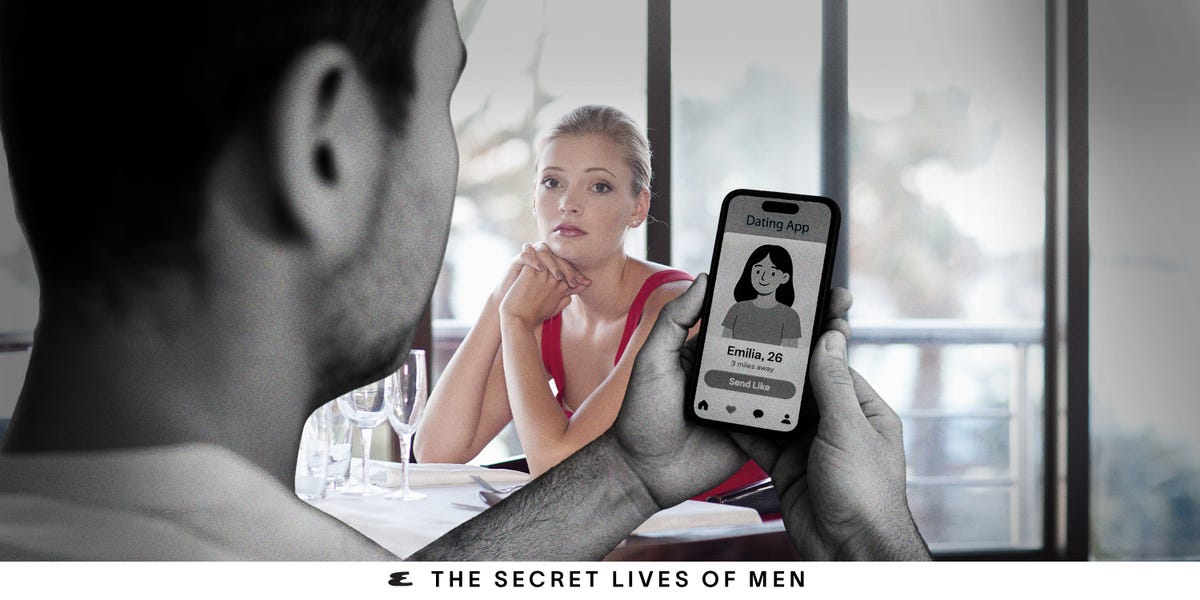
Getty Images / Art Illustration by Leigh Cohen10 min readEthical nonmonogamy relies on a foundation of total transparency. Partners openly agree to terms and continually negotiate them together. Betrayals such as infidelity can take many shapes and break the agreement a couple has made, monogamous or not. For people in recovery, however, the adrenaline of secret keeping can feel familiar. Clinicians call this behavioral, or process, addiction—in which compulsion lies in the thrill of the chase rather than the payoff. It doesn’t excuse betrayal, but it can help explain how a person committed to honesty ends up living a lie.For this installment of the Secret Lives of Men, we spoke to Owen,* a 36-year-old brand strategist with 13 years of sobriety who spent most of the first two years of his relationship cheating on the partner he plans to marry. His story begs the question: What does it mean to carry out “living amends,” an Alcoholics Anonymous term for permanently changing your behavior for the better, when you aren’t ready to confess?*Names and identifying details have been changed to protect anonymity. Owen, 36, Brand StrategistOnce a week, my fiancée has a therapy session over a video call that she takes from our bedroom. We both work from home, so while that happens, I’m usually barricaded in my office with noise-canceling headphones on, keeping up with work. Recently, I came out to the kitchen to pour a coffee after her hour was up, and she wasn’t home.She takes walks, so there was no reason to panic. But my mind went where it has gone a lot lately: She found out. By whatever cruel trick of fate, she knew, and she was out there walking it off, letting the anger curdle. When she came back, she would bring hell with her.I called once. She didn’t pick up. I didn’t try again. For half an hour, I paced the apartment unable to get a single thing done. I checked my phone every few seconds. I rehearsed what I’d say when she walked through the door: which parts I’d confess, which parts I’d still try to save. I worried myself sick. When she finally walked back in, it turned out she’d just been on a long phone call with her sister. She took off her headset, kissed me hello, and asked what I had in mind for dinner. My heart kept pounding long after she’d walked into the kitchen.Until two years ago, I could say with real pride that I had never cheated on anyone. Not once. Not even when I was drinking and doing all those drugs, back when I lied about nearly everything else. I’d had opportunities, but infidelity was the one line I never crossed.My mind went where it has gone a lot lately: She found out. By whatever cruel trick of fate, she knew, and she was out there walking it off, letting the anger curdle.Advanced 12-step work taught me a strange paradox: Sometimes you have to sit with the agonizing truth that you are doing something wrong. That you aren’t ready or able to stop. I’ve built 13 years of sobriety on the idea that we are only as sick as our secrets. But I should admit something up front: I’m good at telling stories, especially about myself. Even now, I catch myself deciding which parts to share. So here it is: For the better part of two years, I cheated on the woman I’m going to marry. She still doesn’t know.In recovery, you learn that the most dangerous thing that can happen to a person with an addiction isn’t getting caught—it’s getting away with it. And every time you skate by, the lie gets a little easier to tell. The disease gets a little more room to grow. I first learned that at 23. I had to learn it again in my 30s.I come from a long line of talented, tortured people. My father sold commercial real estate and spent years in and out of a quiet, high-functioning addiction to painkillers. He went away for treatment twice. My mother was raised by an alcoholic and carried a lot of anger. My parents divorced when I was young, both remarried badly, and neither of their houses was a safe place emotionally.At 19, while in college, I fell into a relationship I can only describe as wickedly codependent. We went through two miscarriages together and became trauma bonded. I didn’t know how to grieve, so I was drinking heavily and taking almost anything I could find: stimulants, psychedelics, dissociatives. Just before I turned 21, I caught my girlfriend in a lie so profound it ripped the wool off my eyes: She had been sleeping with my best friend for nearly the entire time we’d been together. One of the miscarried babies was actually his. I ended things the day I found out and took the situation as the perfect excuse to keep killing myself slowly.I didn’t make it a year out of college before the consequences caught up with me. The fall after graduation, I was driving home from a concert when I got pulled over for a dead taillight. I was relatively sober and polite and was sure I’d talked my way out of it—right up until the officer asked me to empty my pockets. Inside were a bag of powder that I’d been promised was Molly and a few pills I didn’t have a prescription for. They booked me and sent everything off to the state lab. For three months, nothing happened. Meanwhile, I painted myself further into the corner before the floor ultimately fell out. When the charge finally came, I began a year and a half of court dates and probation.For the better part of two years, I cheated on the woman I’m going to marry. She still doesn’t know.As a first offender, I pled into a court-mandated, recovery-focused diversion program with regular drug tests. I followed the program to a T, at least for a while.One weekend, when house-sitting alone for a neighbor, I took a drink out of boredom and pure spite. No test caught it. Then I lied about it to my counselors, the court, and my family. A month later, guilt finally won out, and I admitted it to my sponsor. A few days later, he brought it back up and told me I had to come clean to everyone.“The fact that you were willing to conceal that from everyone for this long,” he said, “is the only evidence you need of how sick you are.”The problem wasn’t the drink. It was how easily I hid it. I surrendered to the program and handed my life over to a higher power. I haven’t had a drink since.I went celibate by choice for three years. I did a lot of therapy and learned that I had swung from codependent to avoidant. I had finally regained control, and I didn’t want to hand myself to anyone. Then, in my late 20s, I decided to give dating another shot.Before long, I leaned into ethical nonmonogamy and dated as “solo poly,” which means I was seeing multiple people without a primary partner. Casual dating became my primary hobby. Some connections were purely physical; some were friends with benefits; some went emotionally deep. At my peak, I was sleeping with six people, two or three times a week. I felt I was winning at something. I was always honest with every partner about who I was, sobriety included. But I wasn’t honest with myself about why I needed so much of it.Then, later in therapy, I came to understand that the dopamine that keeps people in an addiction loop is driven less by the thing itself than by the anticipation of getting it. Dating apps are built on that anticipation. For me, there were three hits: the match, the first nudes, the first hookup. In the program, we say the disease of addiction wears as many faces as it needs to. The chase was one of those faces.I matched with Maya as she was getting ready to leave on a six-week work trip to Thailand. We messaged far longer than usual, trading long voice notes across the 11-hour time difference—her from hotel lobbies at night, me on morning walks. By the time we finally met, I already knew how she laughed. Our first date was electric, the best of my life. We sat at the bar until they started stacking chairs, talking about family, grief, books that had saved us. She was self-sufficient and emotionally deep. She was great at conversation. She was beautiful.A few months into our relationship, we curled up on her couch on a Sunday afternoon and talked about ethical nonmonogamy. We’d both dabbled in it, but neither of us had done it inside a primary relationship. I told her I wanted it. She was open to it. We agreed to start monogamous and build the foundation first, but we never said for how long.I got bored after six months.At my peak, I was sleeping with six people, two or three times a week. I felt I was winning at something.The truth is, our sex wasn’t great. Early on, I suggested something new in bed, and she went quiet and turned toward the wall. Neither of us brought it up the next morning. I internalized the idea that I couldn’t ask for what I wanted, that this was just how it would be until we opened things up. Instead of communicating, I let the resentment build.Then, one afternoon at a coffee shop across town, I ran into Bree, a woman I used to hook up with. She had been the perfect friend with benefits: incredible chemistry but no desire for a relationship. We stayed and talked for an hour. When she mentioned she lived ten minutes away, neither of us pretended not to know what that meant. By that evening, I was at her place. It was the first time in my life I had been unfaithful in any way, and I felt awful. When I went home, I waited for the consequences. They never came.A big part of addiction is justification. We were planning to be nonmonogamous, I told myself, so the way I’d just conducted myself was basically equivalent. It wasn’t that bad. I can see now how thin that logic was. Nonmonogamy runs on transparency and consent. I was keeping a secret.Over the next year and a half, my infidelities came and went. A few more times with Bree. A handful of times with anonymous women in other cities. Trans women, sex workers. I traveled for work, and I took advantage of the distance. I kept my phone face down, hid dating apps, used end-to-end-encrypted texting. For each time I followed through, there were five times I stopped myself. Each close call made me feel like I had it under control.Strangely, the woman I cheated with most also kept me from making worse mistakes. Bree became my confidante, the only person I was fully honest with about any of it. One night, I arranged to meet a sex worker. I was sitting in my car outside the hotel when clarity hit. The only thing I could think to do was call Bree. She talked me down. She and I ended up having sex that night. The program has a phrase for that kind of thinking: I want what I want when I want it.Meanwhile, the relationship I was betraying kept getting better. We slowly began to practice nonmonogamy, and it took us far longer than either of us expected. We listened to the audiobook version of Polysecure by Jessica Fern together. We’d pause so often to talk that a half-hour chapter took two hours. It gave me a way to ask for what I wanted without it feeling like an attack on her. One night, Maya paused the book and asked me, plainly, how she could do better. For the first time, I believed she meant it, and I told her. The sex got better. Then, much better.“The fact that you were willing to conceal that from everyone for this long,” my therapist told me, “is the only evidence you need of how sick you are.”The final close call came in June. Bored at my desk, I connected with someone on an anonymous hookup site, and we moved to texting. A few messages in, after I’d sent a couple of nudes, my phone lit up with a long blackmail threat. Attached was a screenshot of Maya’s Instagram. This kind of thing had happened four or five times before, back when I was single. Go ahead, I would say. I never considered paying, and no one ever followed through. But this time, I closed my laptop, walked to the bathroom, sat on the edge of the tub until my hands stopped shaking, and blocked the number. This time, I had something to lose. I was forced to face how stupid I was being.I shared the story in therapy. My therapist, who usually lets me do most of the talking, leaned back, looked at his clipboard, and said, “What the fuck are you doing? This is like the 20th time something like this has happened.”I didn’t have an answer. Nothing had ever happened to me. That was the whole point.This past August, on a weekend trip to the Catskills with friends, I proposed to Maya. She said yes before I could finish the question. I meant every word I said that weekend.Maya and I have now officially opened our relationship. We’ve mostly played as a couple. When she sees someone on her own, she tells me everything the next morning. Last month, I sexted with a woman for days and chose not to tell her. Though I have permission, I can’t seem to give up the secrecy.Growing up in the houses I did, I hid the truth to keep the peace. Recovery taught me to say it anyway, but I’ve only ever practiced with people who can’t leave, like a sponsor or a therapist. Telling Maya is different. Sometimes, I reverse the question: What if she were the one carrying a secret like this? I like to think that I’d find a way to accept it, because through everything I’ve done, I have never loved her any less.In the program, when you can’t make amends without causing further harm, you make what’s called living amends. It starts with stopping the behavior. Then you try to love better, act cleaner, and stay present day after day, without asking for absolution. That’s where I am now. I pray regularly that this pain is my consequence. If that’s my penance, I’ll carry it.
After I Kicked Drugs and Alcohol, I Found a New Addiction: Cheating on My Fiancée
Full Article
Original Source
Read the full article at Esquire →KhanList aggregates and links to publicly available news content. We do not host full articles from third-party sources. Always verify important information with original sources.