
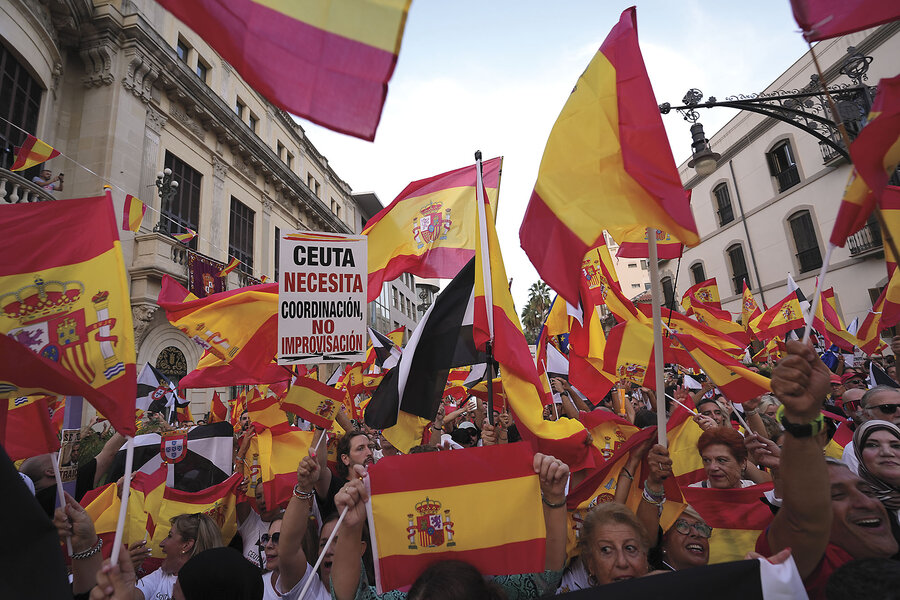
Ceuta, SPAIN | Sept. 30, 2026, 11:04 a.m. ET | 9 min read The Spanish enclave of Ceuta saw an unprecedented wave of migration this summer that has since put Spain’s immigration policy under the spotlight.Ever since 80,000 people swam across the sea border that separates Morocco from the Spanish exclave of Ceuta on the tip of northern Africa, Abdellah Mustafa hasn’t stopped moving.All day long, he fields requests: A Moroccan mother needs a bandage for her son. Two women want help completing their asylum dossiers. A migrant boy has just broken into a nearby car and needs to be taken to the police.Migrants continuously approach the makeshift tent Mr. Mustafa helped set up with a local aid organization in this Muslim-majority neighborhood, after the largest single migration flow in the exclave’s history, asking: Is there room for one more? “We need to carry on!” Mr. Mustafa, a cook and president of his neighborhood association, calls out to a friend across the street, pumping his fist in the air. Then he says defiantly, “The only reason I continue is that I cannot abandon these people.” Colette DavidsonAbdellah Mustafa, president of the Sidi Embarek neighborhood association, stands outside the migrant tent for women and children that he has been overseeing for nearly two months, Sept. 8, 2026, in Ceuta, Spain. This perch of land, just 7 square miles, has been ruled by Spain for thousands of years, well before Morocco became an independent state. It’s long been celebrated as a patch of coexistence. Roughly half of the population is Muslim, many of them like Mr. Mustafa – Spaniards born here of Moroccan descent. The other half is Christian, many whose families relocated from the Iberian mainland.Both Christmas and Ramadan are official holidays here. In the tidy city center, Muslims and Christians blend effortlessly in shops and cafés, sometimes holding hands in marriage, in a clear display of religious tolerance.But the sudden arrival on July 30 of tens of thousands of migrants has tested that coexistence. Many residents want the roughly 5,000 who remain sent back to Morocco and a return to normal. Yet the crisis has also exposed what “normal” obscured: deep inequalities, prejudice, and neglected Muslim-majority neighborhoods. Ceutis of Moroccan descent have led the efforts to help migrants, sometimes drawing resentment from other residents. In the process they’ve asked themselves not just how to restore the old coexistence, but how to build a stronger one.“I’ve had people tell me to go back to my country,” says Said Mohamed, a third-generation Moroccan Ceuti, who has been volunteering at a migrant camp for women. “My grandfather fought in the Spanish civil war. I’m more Spanish than anyone. We’re the positives of this story,” he says.“Must regain control”Spain has been at the center of Europe’s debate on immigration since Prime Minister Pedro Sánchez announced last April that the Spanish government would regularize half a million immigrants already living in the country.Since then, Mr. Sánchez has found himself increasingly at odds with his European neighbors on immigration. Italy has suspended its Schengen Area cooperation with Spain, reinstating passport and customs controls, while Finland and Denmark have threatened to cut Spain off from the European Union’s free travel zone. Ceuta is not connected by land to Europe, but European leaders worry that the crisis here threatens EU borders. In August, Germany’s Friedrich Merz told Spain that it “must regain control” of the city.The Moroccan government has claimed sovereignty over Ceuta and Melilla, Spain’s other exclave in Moroccan territory, ever since Morocco gained independence from France and Spain in 1956. Protruding northward from the Moroccan coast and just south of the Strait of Gibraltar, Ceuta sits at a strategic point between the European and African continents in terms of global security and trade.Though the Spanish government has said there is “no solid proof” that Moroccan authorities had any direct involvement in the recent migrant crossing, Spanish opposition parties have accused Morocco of orchestrating the crisis to destabilize Ceuta and challenge Spain’s hold over the territory. Ana Beltran/ReutersA settlement in Benítez Beach was created after the mass crossing of migrants from Morocco, Sept. 13, 2026, in Ceuta, Spain. In recent years, Spain has found itself trapped between Morocco and Algeria, two countries that deeply disagree over territorial ownership of Western Sahara, which was under Spanish rule until 1975. Days before the July migrant crossing, Prime Minister Sánchez made his first official visit to Algeria in six years to smooth relations between the two nations, which observers say could have angered Morocco.“We can’t ignore the possibility of political instrumentalization,” says Lorenzo Gabrielli, a researcher on Spanish immigration and border policy at the Universitat Pompeu Fabra in Barcelona. “The idea of a takeover is a feeling that has always been present in Ceuta.”Although other migrant influxes have challenged Ceuta, none has been this big or this contested. In a matter of 24 hours, a majority had given up on their European dream and walked back. But today, nearly two months later, thousands remain, most of them sleeping outside on streets, beaches, and hillsides. Ceuta’s prized beaches, like the Playa Del Trampolín, have turned into makeshift migrant camps. Young Moroccan men sit on the beach, cutting each other’s hair in the sun. Others jump in the waves or wander aimlessly along the road, a plastic bag in their hand carrying their life’s belongings.There have been allegations of violence – Ceuta’s chief prosecutor told the El País newspaper that the migrant influx had led to an exponential increase in cases of sexual assault since the end of July. Numerous migrants say they’ve had their cellphones stolen while sleeping in open fields and on hillsides.“Yes, of course, I’m scared,” says Ashraf, a 29-year-old migrant from the border town of Fnideq. The Monitor is using only first names of migrants for their protection. “I’m sleeping in the street. Anything can happen.”“We’re peaceful. Muslims are not our enemies.” Residents, too, say they’re afraid – that migrants, out of hunger and desperation, will steal from them as well.Jose Luis Castillo, a retired national police officer, has started carrying a bottle of pepper spray in his pocket, even to church, since the July 30 influx. Many parents say they didn’t let their children play outside for the whole month of August. In early September, Ceuta authorities deployed police officers outside schools for drop-off and pickup, following safety concerns by local parents. That concern, alongside frustration with the central government for not resolving the crisis fast enough, has culminated in near daily protests here. On Sept. 2, Spaniards across the country joined a nationwide demonstration in a rare showing of patriotism, in solidarity with Ceuta.Some Spaniards outside Ceuta view the protests as xenophobic, and the far-right Vox party has latched onto the demonstrations to promote its anti-immigrant agenda. But protesters say they’re not racist.“Any Ceuti will say the same thing. We’re peaceful. Muslims are not our enemies,” says resident Esther Sereno, rolling a large Spanish flag into a tight loop and propping it against her shoulder after a march in September. “But what’s happening now is not about coexistence. This is an invasion.” Colette DavidsonFriends (left to right) Coral Garcia, Reshma Mirchandani, and Esther Sereno protest against what they see as a migrant “invasion” in Ceuta, Spain, Sept. 7, 2026. The Spanish government has unlocked €309 million ($353 million) to deal with the migrant crisis in Ceuta, expanding temporary accommodation and processing requests for asylum. It has said that the majority of migrants do not qualify for international protection and will eventually be returned.But authorities remain overwhelmed by the influx. And residents say they’re exhausted by the situation.“It’s awful to see people struggling, but I don’t want to be scared anymore,” says Sara Mohamed, (no relation to Said Mohamed), a third-generation Moroccan, who lives in El Príncipe, another Muslim-majority neighborhood on the edge of the Moroccan border. “The only thing I share with these people is religion.”For the many residents here of Moroccan descent, who were born and raised in Ceuta, the influx has generated a complex reality. Since the start of the crisis, they have been on the front lines. Mr. Mustafa’s neighborhood association opened the local football field to give migrant women and children a safe place to stay. Others in this neighborhood, called Sidi Embarek, have donated food and clothing, offered rides into town, and invited migrants into their homes to shower or sleep. If residents hadn’t helped house and feed migrants, many say, the town would have seen far more homelessness and violence.Prizing diversityYet Ceuti Muslims have faced public attacks – for offering too much help to migrants or simply looking too much like them, a majority of whom are Moroccan.“I was riding by the beach on my scooter and a Spanish woman yelled, ‘Look, some of them even have scooters!’” says Omar Amesnaou, a third-generation Muslim who lives between Ceuta and Barcelona. “When I told her I was from here, in Spanish, she looked embarrassed and said she was sorry.”Protesters have taken to wearing red-and-yellow-striped bracelets – the colors of the Spanish flag – to show their opposition to migrants. Many Muslims participate in the protests, too, but even if they don’t, some wear the bracelet to protect themselves against demonstrators. That’s worrying to those who have always prized Ceuta’s celebration of diversity.“Coexistence is necessary for our small community to function,” says Carlos Rontomé Romero, a sociologist and director of the National University of Distance Education in Ceuta. “But it’s fragile, and it won’t continue if we don’t put in the work.” Few Muslim Ceutis associate themselves with the state of Morocco. That’s partly because for those whose families have been in Ceuta for decades, their Moroccan heritage feels far away. But it’s also based on a fear that they could lose everything their ancestors fought for – notably, the right to be Spanish and live in Spain. Colette DavidsonChurch services have been filled since the migrant crisis in Ceuta began, with parishioners seeking solace in community, Sept. 8, 2026. Though Muslims have been living for decades in Ceuta and Melilla, they were not eligible for Spanish nationality until 1986 when Spain passed its Ley de Extranjería. They did not have Moroccan nationality either.In 1986 and the years that followed, more than 10,000 Muslims in Ceuta and 14,000 in Melilla received Spanish citizenship. But observers say the scars from that era have left their marks.Though Spain does not gather official statistics on race or religion, surveys show that around 55% of Ceutis are Christian, 45% are Muslim, and around 2% are Jewish or Hindu. The city suffers from 22.2% unemployment, a majority of which is concentrated in its Muslim communities, like El Príncipe and Sidi Embarek, where Mr. Mustafa works.“Today there is this discourse of diversity, a city of four religions,” says Victor Albert-Blanco, a professor of sociology and researcher on religious diversity at the Open University of Catalonia. “But for decades, Muslims have had to reinforce their will to participate in public life and claim their rights. They’re constantly trying to prove that they’re integrated.”Forging a deeper integrationIn a way, the migrant crisis has become a catalyzing force for the Muslim community of Ceuta. For the past 45 days, Mr. Mohamed and a rotating group of neighborhood men have acted as unofficial bodyguards at an impromptu migrant camp for women and girls on the El Príncipe football field. They take turns waking up at 4 a.m. and sit at the edge of the field, yelling at passersby who try to take photos or watch the girls shower.“One girl told me she was doing bicycle kicks in the air all night so she wouldn’t fall asleep,” says Mr. Mohamed, his eyes red from lack of sleep. “I couldn’t live with myself if something happened to these girls.”Up the road in Sidi Embarek, at the end of a strip of orange brick apartments lined with satellite dishes and hanging laundry, a streetlight flickers on and off. Flies buzz over a pile of garbage, left to rot, as men sit idle on park benches. Deepen your worldviewwith Monitor Highlights.Politics with respectGet political stories with respectful analysis.There‘s a world of new ideas in everyBooks newsletter.There‘s more to life, enrich yours withCulture & Learning weekly.Follow humanity‘s discoveries withScience & Nature stories in your inbox.Gain a spiritual perspectivefrom the stories in your inbox.Want to understand the deeper impact of critical events? Learn the Monitor‘s insight.Already a subscriber? Log in to hide ads. This is what many Ceutis associate with this Muslim-majority community. But Mr. Mustafa is anything but idle – answering his buzzing cellphone, pouring insecticide into the puddles collecting in front of the migrant tent, and dealing with more requests for help. He’s tired, but hopes one day the rest of Ceuta will appreciate his efforts – and that this could help forge a deeper integration for his community.“When this happened, many people took the ferry and left. Our community stayed,” says Mr. Mustafa, taking a break in a red plastic chair. “I hope people will start to see how much we’ve done for these migrants and how good we are.” ALREADY A SUBSCRIBER? LoginReal news can be honest, hopeful, credible, constructive.The Christian Science Monitor was founded in 1908 to lift the standard of journalism and uplift humanity. We aim to “speak the truth in love.” Our goal is not to tell you what to think, but to give you the essential knowledge and understanding to come to your own intelligent conclusions. Join us in this mission by subscribing.
After historic migration wave, Ceuta works to rebuild a better sense of unity
Full Article
Original Source
Read the full article at Csmonitor →KhanList aggregates and links to publicly available news content. We do not host full articles from third-party sources. Always verify important information with original sources.