
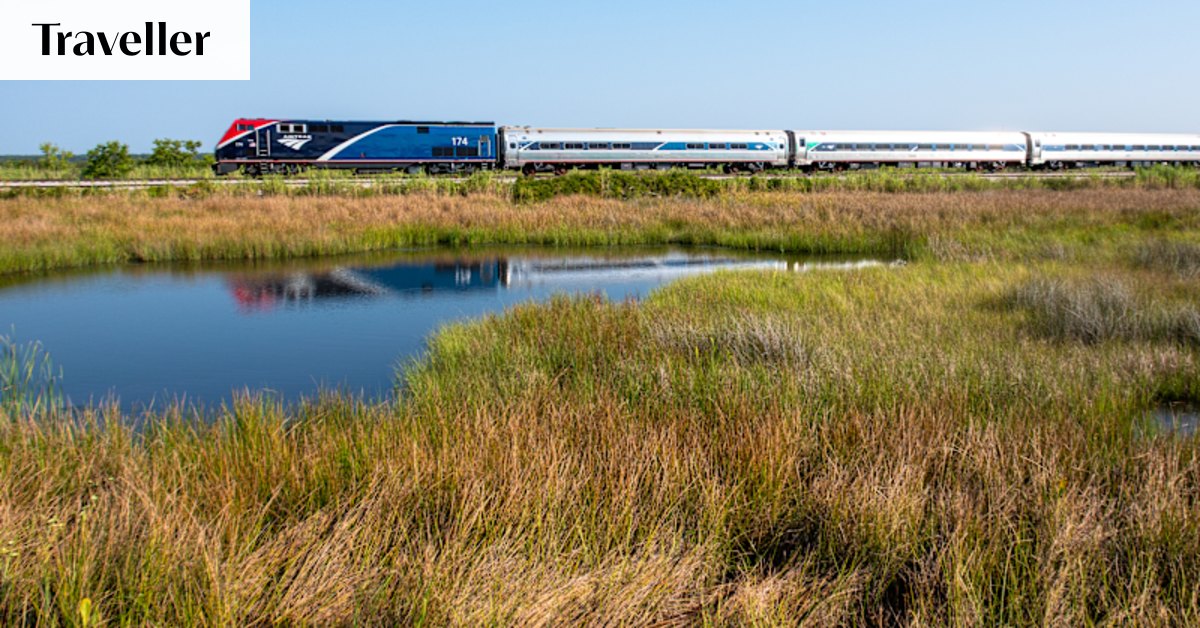
As Amtrak’s Mardi Gras service slithers through the Gulf Coast’s marshlands, a home perched on the longest of legs shimmers into view. “That’s the tallest house I’ve ever seen,” says a passenger, pointing through the train’s business-class picture windows.It’s a triffid sprouting from a swamp, a familiar shape hyperextended, yet the surreal sight serves as a reminder – as if one were needed – that these lowlands stood no chance against Hurricane Katrina’s tsunami-like storm surge. In the aftermath, new residential building regulations came into force (with elevation requirements depending on proximity to the coastline).Amtrak’s “Mardi Gras” service honours hard-partying New Orleans and Mobile, the two cities it connects. Matt Donnelly/AmtrakHurricane Katrina, the 21st anniversary of which falls on August 29, also wreaked havoc on the coastline’s rail infrastructure – but that’s not why Amtrak’s passenger service took 20 years to return. Freight trains were back on the line mere months later. But it took decades of legal and financial mediation between Amtrak, the freight carriers that own the tracks and the Surface Transportation Board – a federal agency regulating freight railroads – before the passenger service got the all-clear.In August 2025, the route relaunched. Historically part of Amtrak’s cross-country Sunset Limited Service, it has been rebranded as the Mardi Gras service to honour its hard-partying New Orleans/Mobile bookends. Immediately, it exceeded expectations, clocking 100,000 passengers in April, well ahead of projections.You can board the service in New Orleans and reach Mobile, a port city on Alabama’s Gulf Coast, less than four hours later. But I want to see how this coastal playground – sprawled just west of the Alabama-Florida coastline and nicknamed “the Redneck Riviera” – has recovered from Katrina. After chugging over bridges and bayous, past sunset-tinted grasses and startled birds, we pull into the Mississippi coast’s biggest hub of Gulfport (with heavy leaning on the horn) as darkness falls.Sign up for the Traveller Deals newsletterGet exclusive travel deals delivered straight to your inbox. Sign up now.Our base for a few days is the 16-room Hotel Vela that’s attached to Siren Social Club, a Michelin-recommended restaurant with a bar serving tiki-inspired cocktails. First up is a day of lazing on Ship Island, one of a chain of barrier islands. At Gulfport Yacht Harbour, I encounter Captain Louis Skrmetta whose entrepreneurial Croatian grandfather pivoted from shrimp and oyster fishing to running pleasure cruises across the shallow Mississippi Sound to Ship Island a century ago.The route relaunched in August 2025.The Mississippi coastline sprawls west of Alabama and Florida.A fishing resort operated from the island’s 19th-century fort and, as it was the 1920s Prohibition era, that inaugural vessel included slot machines for trips to the Isle of Caprice located beyond the 12-mile (19 kilometre) limit for gambling and drinking. The isle eroded away in 1932, but the owner’s descendant, Susan Hunt, still pays taxes on the sunken island in case it ever reappears (we bump into Hunt while lunching at Mary Mahoney’s Old French House in Biloxi).Skrmetta must have stories and then some; I ask about his most challenging times. Without missing a beat, he nominates 2010’s Deepwater Horizon oil spill. “The problem wasn’t the oil itself but the dispersants – horrible stuff,” he says. “You couldn’t breathe in the areas where that stuff was placed. It killed hundreds of dolphins, and seabirds of course.”It outweighed Katrina, says Skrmetta, when his fleet scooted inland and was roped together. “When the storm surge hit, our boats lifted up like an elevator and kept going and going,” he recalls. “All our lines snapped except for one heavy safety line. I’m thinking, ‘We’re going to lose our boats’. There were yachts breaking loose all around us.”On board the ferry to Ship Island.Then he asked Captain “Buck” (William Buckley, who’s about to skipper us to Ship Island) to snag a drifting jet-ski with a boat hook. “He climbs down on it with the wind blowing, debris flying through the air, roof shingles – you can imagine, 100-knot winds going – and he yells up to me, ‘It’s got a key in the cup-holder!’. So the crew reset lines in that wind … and we saved the boats with that jet-ski. It was one of those miracle things.”He’s not the only one saved by a hurricane miracle. In the vibrant artistic community of Bay St Louis, I meet Nikki Moon, former proprietor of Bay Town Inn – a historic villa that Katrina washed away. The 12-metre surge pushed Moon and her Scottish terrier, along with a hurricane hunter and a handyman, into an oak that they clung to for several hours. That tree later became a sculpture – The Angel Tree – now installed between the rebuilt inn and the castaway-chic oceanfront bar Blind Tiger. “When folks talk about New Orleans and what they went through [with Katrina], they were the man-made storm and we were the God-made storm,” says Moon. On a sunny afternoon, as I laze outside the bar within view of Moon’s tree, while slurping a soft-serve margarita and peeling boiled crawfish, it’s impossible to imagine what unfolded here.You get more of an idea at Ground Zero Hurricane Museum in neighbouring Waveland, which sounds like a cheesy water park but was Katrina’s “ground zero” epicentre. The museum occupies the former elementary school – the city’s only public building left standing after the storm. Most poignant is a water line painted high on the walls marking the building’s inundation level. Around town, Katrina’s ghost lingers in stubbornly vacant plots of land.In Biloxi – the “Vegas of the South” – it’s extraordinary to think that the surge pushed a casino barge atop the Ohr-O’Keefe Museum of Art’s Gallery of African American Art. The complex, which today includes Frank Gehry-designed shimmering sculptural pods, was taking shape in 2005 but had to start over. It honours George E. Ohr, the “Mad Potter of Biloxi”, but also lays bare another side of the South’s history. Its interpretive centre covers the Biloxi wade-ins – a years-long protest that finally led, in 1967, to African Americans gaining access to Biloxi’s beaches.Frank Gehry’s Ohr-O’Keefe Museum of Art in Biloxi, Mississippi. Getty ImagesStories of the state’s black musical history are shared at Bay St Louis’ 100 Men Hall. Another part of the state’s black history is 100 Men Hall in the Depot District near Bay St Louis’ railway station. The simple 1922-built hall, plastered with a mural that includes Etta James, was part of the Chitlin’ Circuit – an ensemble of venues where black musicians could safely perform. Volunteer Doug Page is a vintage-record store owner and blues lover who held his wedding here. Katrina, he says, ripped off the hall’s roof, but it survived the threat of demolition and is now the Mississippi Blues Trail’s southernmost landmark.“When I got involved it was already jumpin’ with regular events,” says Page, as he reels off the programming – Swamp(gr)Ass Get Down, Booker Fest (honouring local piano prodigy James Booker) and the summer’s 11am blues brunches. I can’t help but check Amtrak’s schedule. Yes, you could zip from New Orleans for a toe-tappin’ brunch and keep the party going on the fun train later that night.Mardi Gras madnessThe city of Mobile would like you to know it first celebrated Mardi Gras in 1703 – 15 years before that limelight-hogger New Orleans. If you’re visiting outside of Mardi Gras (which falls 47 days before Easter), learn about the season’s extravagances at Biloxi’s Coastal Mississippi Mardi Gras Museum or Mobile Carnival Museum. At New Orleans’ Mardi Gras World, see how the fantastical parade floats are made. Before the tour begins, try king cake – normally only available during the carnival season. A plastic baby – signifying the Christ child – is smuggled into each cake and, if you’re the one to find it, according to our guide, “you’re crowned royalty for the day”. See coastalmardigras.com, mobilecarnivalmuseum.com, mardigrasworld.comTHE DETAILSRIDEAmtrak’s twice-daily, round-trip Mardi Gras service connects New Orleans, Louisiana with Mobile, Alabama. The three-hour, 43-minute service stops at four cities in coastal Mississippi – Bay St Louis (pronounced Lewis), Gulfport, Biloxi and Pascagoula. One-way tickets between New Orleans and Mobile cost from $US19 (coach). Business class from $US59. See amtrak.com PLAYShip Island Excursions offers island round-trips from March to October, $US48 adult (add an ice-filled drinks cooler for $US12). The island is part of the National Park’s Gulf Islands National Seashore. Day-trippers can swim, birdwatch and tour Fort Massachusetts, a fortification built from a million bricks and completed in 1866 just after the Civil War. See msshipisland.com, nps.govSTAYRooms at Hotel Vela, Gulfport from $US169 a night; rooms at Pascagoula’s 16-room Hotel Whiskey from $US100 a night. See thehotelvela.com, hotelwhiskey.comFLYQantas (qantas.com) flies from Sydney and Melbourne to Dallas Fort Worth, Texas; oneworld partner American Airlines connects to New Orleans and Mobile.The writer was a guest of Travel South USA. See travelsouthusa.comKatrina Lobley is a Sydney-based freelance travel writer with expertise in ABC (art, bars, culture). She’s been writing for Traveller since 2006.Connect via email.From our partners
After devastation, It took 20 years for this train to get back on track
Full Article
Original Source
Read the full article at Smh →KhanList aggregates and links to publicly available news content. We do not host full articles from third-party sources. Always verify important information with original sources.