
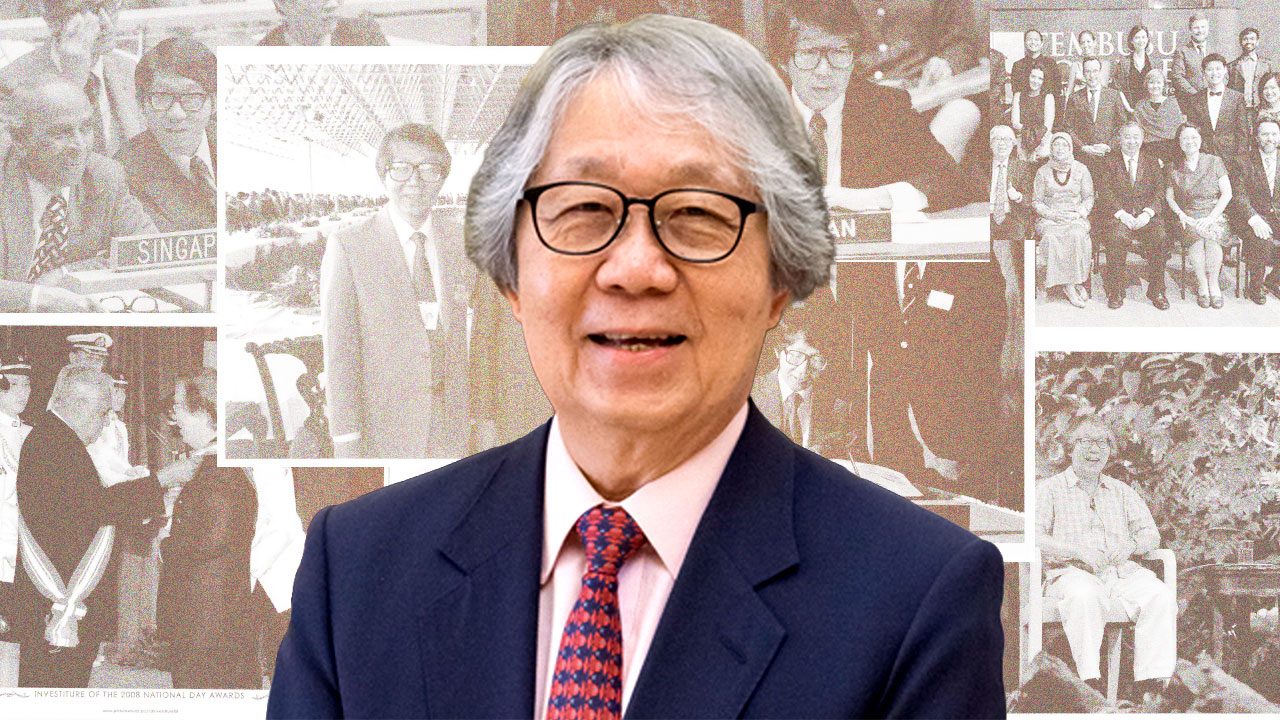
Profile 2026 Ramon Magsaysay Awardee Tommy Koh spent his lifetime shaping the youth, upholding peaceful coexistence, and preserving Singapore’s heritage Tommy Koh is Singapore’s youngest and oldest ambassador, who entered foreign service in 1968 and served as a permanent representative to the United Nations (UN). Before, other diplomats mistook him for the ambassador’s son. But he used his age to his advantage and asked the seniors to mentor him. And that’s how his career began. For 55 years, Koh has been at the center of Singapore’s peace talks, business meetings, and negotiations with other countries. It’s a daunting task; every decision he makes carries the weight of the nation’s future. This has been the 88-year-old diplomat’s life. In August, that chapter closed. But his influence on the youth, justice, and national heritage extends beyond his retirement. In the same month, Koh was named one of the 2026 Ramon Magsaysay Award recipients — the fourth in his country to receive the Asian equivalent of the Nobel Prize. The statesman was recognized for his leadership in international diplomacy and for shaping a new generation of advocates devoted to justice and human dignity around the world. COLLEAGUES. Tommy Koh along with his colleagues at National University of Singapore Tembusu College. Photo courtesy of Tommy Koh/Ramon Magsaysay Award Foundation Koh was the founding chairman of the National University of Singapore’s (NUS) Centre for International Law in 2009, and the founding rector of NUS Tembusu College in 2011 — one of the four residential colleges in the university that were the first of their kind in Singapore and Southeast Asia. He believes he was born to love and seek peace. For him, it has been the foundation of his illustrious career. Early influences In his early years, Koh loved reading. His father had a library of books and magazines, but he was also allowed to buy more books at a bookstore. His mother, who was an actress and dancer, exposed him to culture and the arts. World War II marked his childhood when Singapore fell under Japanese occupation for three years. During that time, the Japanese army tried to purge pro-British and anti-Japanese Singaporeans from the country. Some passed the screening, while others suffered a fate far worse. Years later, at just 12 years old, he made his first international trip to Kuala Lumpur. Koh was among those selected to represent Singapore’s Boy Scouts at the World Scout Jamboree. In college, he pursued a Bachelor of Laws at NUS. As a student, he regularly listened to the BBC World Service on the radio and read publications of the Royal Institute of International Affairs (Chatham House), an independent policy institute. He later obtained his master’s degree in law from Harvard University in 1964, and a postgraduate degree in criminology from Cambridge University in 1965. The ‘Great Negotiator’ In 2014, Harvard Law School hailed Koh as one of the “Great Negotiators,” a recognition given to individuals whose lifetime achievements in high-stakes negotiation and dispute resolution have left a lasting impact on society. DINNER. Tommy Koh spends his dinner with his mentor and the first Asian president of the United Nations General Assembly, Carlos P. Romulo, and his wife, Beth Day. Photo courtesy of Tommy Koh/Ramon Magsaysay Award Foundation But early in his career, Koh described himself as “young and ignorant” — that is, until his time with the UN, where he was mentored by former Philippine foreign secretary and UN General Assembly president Carlos Romulo. He considers Romulo one of his “most important mentors.” Koh recalled that Romulo taught him how the UN works and what the proper diplomatic practices were. “General Romulo, who had been president of the General Assembly, befriended me and mentored me. And I will always be grateful to him and to his wife, Beth Day,” Koh said in an online press interview last September 3. He also looks up to Mahatma Gandhi and Jawaharlal Nehru, who led India’s independence from British colonial rule. But Koh took to heart the lessons Romulo taught him. The diplomat represented his country and the UN on international law, environmental policy, trade, and disputes. From 1981 to 1982, he served as president of the Third UN Conference on the Law of the Sea or UNCLOS, helping establish a framework for the equitable and peaceful use of the world’s oceans. FINAL ACT. Tommy Koh signs the final act of the Third United Nations Conference on the Law of the Sea, in December 1982, in Montego Bay, Jamaica. Photo courtesy of Tommy Koh/Ramon Magsaysay Award Foundation From 1990 to 1992, he chaired multiple committees for the Rio “Earth Summit,” the UN Conference on Environment and Development, which established the United Nations Framework Convention on Climate Change or UNFCCC in 1992. He also served as Singapore’s chief negotiator in free trade agreement talks with the United States. A FRIEND. Tommy Koh accompanies former president of Indonesia, Suharto, at the Earth Summit in Rio de Janeiro, Brazil, in June 1992. Photo courtesy of Tommy Koh/Ramon Magsaysay Award Foundation Among his successful negotiations was siding with Cambodia in 1979. He led the Association of Southeast Asian Nations (ASEAN) diplomatic delegation to the UN after the country was invaded by Vietnam in the same year. Koh opposed the crimes committed by Vietnam under the Khmer Rouge, which included the Ba Chúc Massacre, where over 3,000 civilians were slain. He took part in negotiations, rejecting the legitimacy of the puppet government and criticizing it as foreign intervention and a violation of international law. In 1991, the Paris Conference recognized Cambodia’s sovereignty, independence, and neutral status. “Even though you're small, you must defend your rights and not allow the big country to bully you. You must have the courage to hold big countries to account when they violate the law and the UN Charter.” Tommy Koh He also represented Singapore in formal negotiations with China for the first time in 1990, when tensions arose because of military agreements with Taiwan. After going back and forth thrice, Singapore and China found common ground and established diplomatic ties. Today, Koh said that China is the country’s biggest trading partner. HONOR. Tommy Koh receives the Order of San Nila Utama, Singapore's third most prestigious national honor, from former Singapore president S. R. Nathan, in 2008. Photo courtesy of Tommy Koh/Ramon Magsaysay Award Foundation He helped resolve the dispute between Russia and Latvia, Lithuania, and Estonia after the Cold War, and the decade-long territorial dispute between Singapore and Malaysia. He also assisted in the formation of the ASEAN Charter. According to Koh, Southeast Asian countries are willing to take disputes to international arbitration, citing the West Philippine Sea case. “If we are not successful, we take it to a binding third-party procedure. So, one of our disputes with Malaysia was solved in the International Court of Justice. Another one went to arbitration, and Malaysia took us to Italy. And eventually we settled by amicable agreement,” said Koh. “That's our story. And that is really ASEAN's story. When they dispute with one another, and they can't be solved by negotiation, we are willing to take them to arbitration, to a court of law. And it's a very good thing.” The art of ‘give and take’ Negotiations are always a process of “give and take,” according to Koh. They should be fair and balanced to all sides, he said, adding that each side must be willing to recognize and accommodate the other’s interests. He jokingly compared it to a husband-and-wife relationship in terms of compromises — only in this case, the wife is always right. Even when countries conflict, dialogue must always happen. He said there should be a fine line between human and work relations despite the differences. CHAIR. Tommy Koh serving as chairman of the Preparatory Committee for the Earth Summit in New York in April 1992. Photo courtesy of Tommy Koh/Ramon Magsaysay Award Foundation During the Cambodian-Vietnamese War, ASEAN condemned Vietnam’s invasion. At the time, India sided with Vietnam. Yet despite the conflict, Koh had a strong relationship with India’s former national security advisor, Brajesh Mishra. He considers Mishra his older brother and guru, a spiritual mentor. His ASEAN friends scolded him for it. When asked why he is still friends with Mishra, he replied: “He had been good to me in the past, and I will always be grateful to him. We may disagree today, but don't personalize the disagreement. Disagreement is between India and Singapore, not between Brajesh and me.” During disputes in foreign diplomacy, his advice is not to take them personally and to keep the human connection — which is bigger than their roles as negotiators — alive. The blueprint of hope Poverty, inequality, and backwardness are inevitable in any society, Koh said. He said that unemployment was high in Singapore when it gained independence. Solving these problems is not impossible as long as social responsibility is a part of everyday life. He said Singapore’s growth from an underdeveloped country to one of the world’s richest cities can be attributed to four things — a blueprint for every nation: eradicating corruption, upholding meritocracy, promoting racial and religious harmony, and building a good education system. “What unites Singapore as a nation is not just birth; it is a belief in a set of values.” Tommy Koh IN CONVERSATION. Tommy Koh sits down to chair a talk by former Singapore prime minister Lee Kuan Yew to celebrate the 150th anniversary of the Singapore Botanic Gardens in 2009. Photo courtesy of Tommy Koh/Ramon Magsaysay Award Foundation Koh said Singapore stands on these four pillars, mindful of choosing its leaders who share the same vision. “People vote not on the basis of race but on the basis of merit…. We need politicians who are not just self-seeking, but really interested in working for the people,” said Koh. Singapore is also known for its diverse cultures and races, stemming from its historical roots as an international trading hub. Koh emphasized the importance of historical preservation through museums and monuments. Monuments and markers make Singaporeans feel they belong in the country, the founding chairman of the National Arts Council said. It extends not just to preservation efforts, but also to practice. Despite his retirement, Koh has never stopped. He continues to pass down the lessons he’s learned throughout his career to the next generation at NUS. His roles may have changed, but — if his latest award is any indication — his influence endures. – Rappler.com Coding for this layout was done with the assistance of AI.
After decades of diplomacy, Singapore’s Tommy Koh still won’t back down
Full Article
Original Source
Read the full article at Rappler →KhanList aggregates and links to publicly available news content. We do not host full articles from third-party sources. Always verify important information with original sources.