
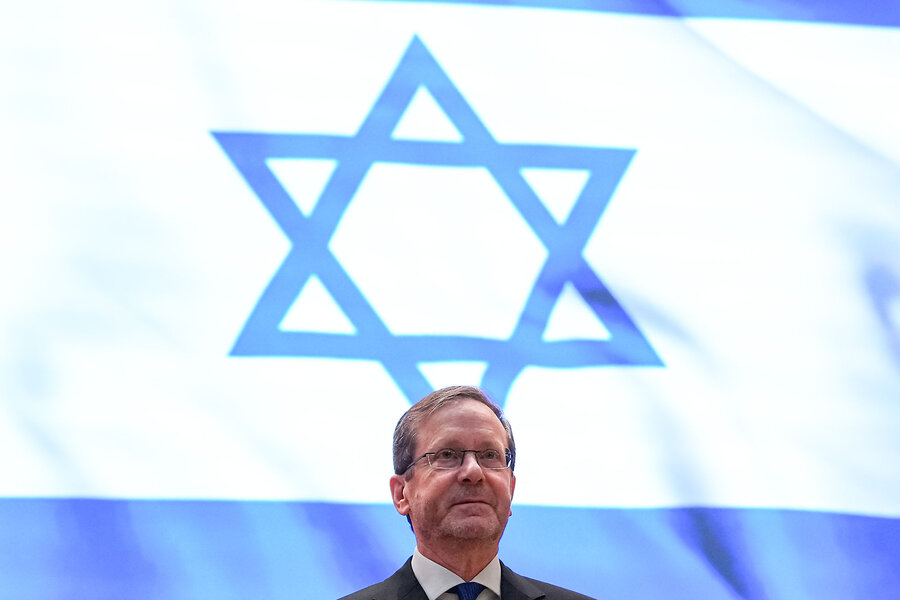
Haifa, Israel | Nov. 03, 2026, 4:41 p.m. ET | 5 min read Isaac Herzog projected defiance. The year was 2015. Israel was on the cusp of national elections. And the Labor Party leader unequivocally rejected the notion of forming a national unity government with Benjamin Netanyahu’s Likud.Today, Mr. Herzog is telegraphing the opposite message. He is now president, planning to begin meetings with representatives of Israel’s political parties on Wednesday. Among them is his old adversary, Mr. Netanyahu.President Herzog has urged lawmakers to “come with an open mind” to “find creative solutions to prevent another round of elections.” His remarks were widely interpreted as a push toward a unity government – the precise outcome he vehemently rejected back in 2015. “As we all know, during an election campaign, candidates naturally and predictably climb to lofty positions,” Mr. Herzog said on Sunday. “This week at the President’s Residence, we will try to put up ladders so that our leaders can come down and face this reality in a measured and careful way.”In Israel, presidents are mostly tasked with ceremonial duties. They receive diplomatic credentials, preside over parliament’s inauguration, and cut ribbons. But they also play the critical role of tapping a parliament member after national elections to form a new government. This is the task President Herzog now faces. Tsafrir Abayov/AP/FileIsrael's outgoing President Reuven Rivlin (left) waves as he walks with the newly sworn-in President Isaac Herzog on July 7, 2021. Mr. Herzog is the scion of a prominent Israeli family and the country's 11th president. Isaac Herzog is a scion of Israel’s political aristocracy. His grandfather was the first chief rabbi of Ireland, and later named chief Ashkenazi rabbi of Israel. His father, Chaim Herzog, served as Israel’s president from 1983 to 1993. His uncle, Abba Eban, served as Israel’s foreign minister, education minister, and ambassador to the United States, among other positions.The younger Mr. Herzog climbed the ranks of Israel’s Labor Party and became the leader of the opposition going into 2015’s showdown against Mr. Netanyahu. “I think it’s a mistake to hold negotiations,” he told Israel’s Channel 12 that March, just days before the vote. “I intend to win,” Mr. Herzog declared.But he lost.“Netanyahu defeated him in a very humiliating fashion,” says Nachman Shai, a former senior Labor Party minister, now dean of Hebrew Union College in Jerusalem. Mr. Herzog “expected to be prime minister,” he says, but was delivered a stinging disappointment.He stayed on as opposition leader for a few more years before resigning from the Knesset, Israel’s 120-seat parliament. In 2021, lawmakers elected Mr. Herzog to the presidency.Israel’s elections last Tuesday resulted with neither Benjamin Netanyahu and his allies, nor his main rival, Gadi Eisenkot, and his “Change Coalition” securing a clear path to victory. Mr. Netanyahu’s bloc won 53 seats in the Knesset and his opponents won the remaining 67. Ronen Zvulun/ReutersIsraeli Prime Minister and Likud party leader Benjamin Netanyahu gestures at his party headquarters in Jerusalem on the night of Israel's national elections, Oct. 28, 2026. But it remains to be seen whether Mr. Eisenkot is willing to build a majority coalition with the support of two Arab parties. Two of his main partners pledged during the campaign they would not. Mr. Netanyahu has waged a monthslong campaign demonizing Israel’s Arab parties and delegitimizing any political cooperation with them. Arabs make up around 22% of Israeli citizens. The Joint List of Arab factions and the smaller Islamist Ra’am party won a combined 19 seats – an unprecedented achievement – after historically high voter turnout among Arab voters.With the election results finalized, party leaders now face the arduous task of forging a parliamentary majority of 61 seats required to swear in a government. That’s where Mr. Herzog’s own judgment comes into play.“The president does not automatically assign the task of forming a government to the leader of the largest party, but rather to the person most capable of forming a government,” says Reuven Hazan, a professor of political science at Hebrew University.That candidate will have 28 days to hammer out coalition agreements with prospective allies, and can then seek a 14-day extension. Should that lawmaker fail, President Herzog will pass the mandate of forming a government to another party leader of his choosing, who has another 28 days to form a majority. If that candidate does not succeed in the allotted time, the mandate passes to parliament, which can pick a lawmaker of its choosing. If that effort fails, parliament is dissolved and Israeli voters go back to the polls.Mr. Herzog is expected to offer the first crack at forming a coalition to Mr. Eisenkot, who is likely to receive the most recommendations. Nonetheless, signs point to President Herzog pushing for a unity government, Professor Hazan says. “The president can make his preferences known, but he cannot twist or change the preferences of the political parties,” he says. Behind closed doors, however, the president will undoubtedly be “cajoling, enticing, convincing” politicians to play by his rules, Professor Hazan says.Mr. Herzog may look to his father’s example. In 1984, the elder President Herzog presided as a divided nation, at war in Lebanon, went to the polls. The ruling Likud party faced stiff opposition. After high turnout among Israel’s Arab minority, the elections ended in a stalemate. Anat Givon/AP/FileIsraeli Labor Party Leader Shimon Peres (at right) speaks with reporters in Jerusalem after President Chaim Herzog (at left) appointed Mr. Peres as prime minister designate March 20, 1990. “I had to bring together the diverse elements instead of allowing a dangerous fragmentation to develop,” Chaim Herzog wrote in his 1997 autobiography, “Living History: A Memoir.” “Accordingly, I approached [Yitzhak] Shamir and [Shimon] Peres, who agreed to go ahead with the idea of setting up a national unity government.”Ksenia Svetlova, a former Knesset member and associate fellow at the British think tank Chatham House, says she is certain President Herzog will push Mr. Netanyahu and Mr. Eisenkot toward a unity government.“He’s already expressed his concern about repeat elections. How can you prevent another election? One of the ways is the creation of a unity government,” she says.Mr. Netanyahu, for his part, welcomes the prospect of forming a unity government – under his leadership. Benny Biton, mayor of the southern Israeli town of Dimona and a political ally of the prime minister, told Kan public radio on Sunday that he spoke with President Herzog. Mr. Biton said that “the president of the state of Israel and the president of the United States will be guarantors” to an agreement on a new unity government.But opposition leaders just campaigned on a promise to oust Mr. Netanyahu as prime minister, not to join him. Just how Mr. Herzog could square that circle remains unclear. The Israeli president’s office declined requests from the Monitor to interview Mr. Herzog. Deepen your worldviewwith Monitor Highlights.Politics with respectGet political stories with respectful analysis.There‘s a world of new ideas in everyBooks newsletter.There‘s more to life, enrich yours withCulture & Learning weekly.Follow humanity‘s discoveries withScience & Nature stories in your inbox.Gain a spiritual perspectivefrom the stories in your inbox.Want to understand the deeper impact of critical events? Learn the Monitor‘s insight.Already a subscriber? Log in to hide ads. “He’ll cook up some arrangement, or stratagem, to build the government he wants there to be: a national unity government,” Mr. Shai, the former diaspora affairs minister, says.“He’ll try. I don’t know if he’ll succeed.” ALREADY A SUBSCRIBER? LoginReal news can be honest, hopeful, credible, constructive.The Christian Science Monitor was founded in 1908 to lift the standard of journalism and uplift humanity. We aim to “speak the truth in love.” Our goal is not to tell you what to think, but to give you the essential knowledge and understanding to come to your own intelligent conclusions. Join us in this mission by subscribing.
After deadlocked elections, it’s up to Israel’s president to find a way forward
Full Article
Original Source
Read the full article at Csmonitor →KhanList aggregates and links to publicly available news content. We do not host full articles from third-party sources. Always verify important information with original sources.