
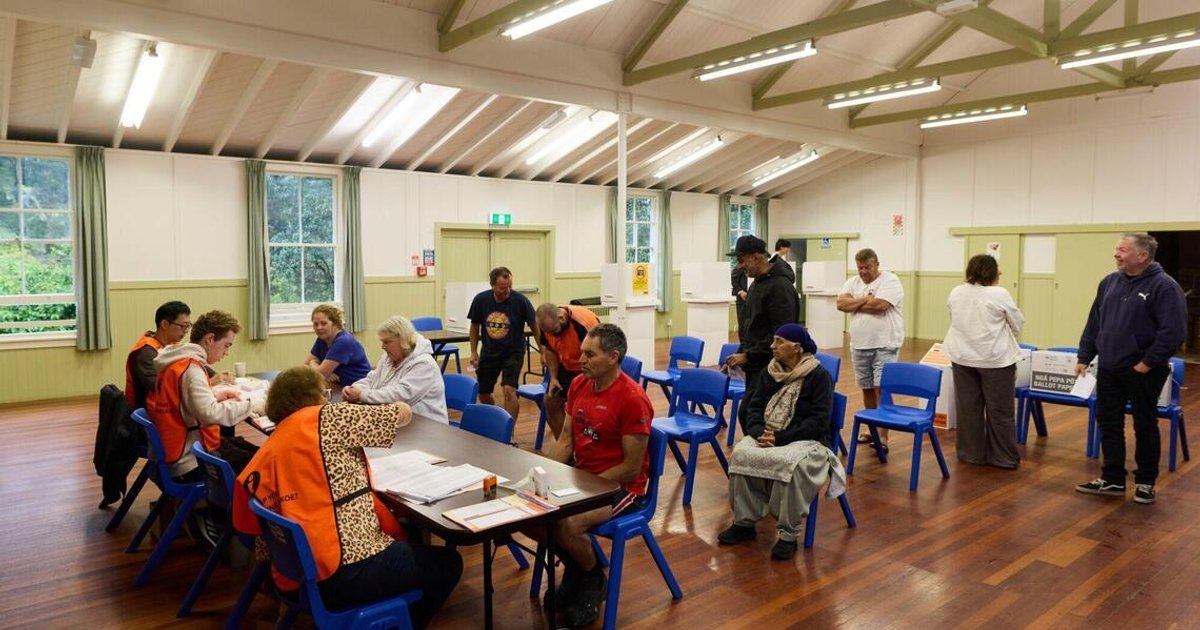
WELLINGTON – New Zealanders faced weeks of uncertainty on Nov 8 over who will govern the country after their general election, with the current coalition holding a slim majority but a potentially decisive slice of votes still to count.Prime Minister Christopher Luxon’s National Party and its partners ACT and New Zealand First were on track for 67 of the currently projected 131-seat Parliament, Electoral Commission preliminary results of Nov 7’s vote showed.Sixty-six seats are needed for a majority.But special votes, around 14% of the total, remain to be counted, it said.These, including ballots from overseas New Zealanders and people voting outside their electorates, have historically favoured the left.They will be announced with the final count on Nov 27.Until a coalition to govern New Zealand for the next three years is formed, Luxon will head a caretaker government.Centrist Opportunity party may play key roleNeither the prime minister nor opposition leader Chris Hipkins of the Labour Party claimed victory in their speeches following the election, which has been dominated by talk of a soft economy and the cost of living.“I’ve been saying it’s going to be a very tight election – it has definitely proven to be that. We unfortunately don’t know what that means for another three weeks,” Luxon told a press conference, but added that on current numbers, it was “quite feasible” that National could build a government with its current partners.If the National-led coalition loses its majority at the official count, either it or a left-leaning coalition would require the support of the centrist Opportunity Party, which looks likely to enter Parliament for the first time.Luxon, who had repeatedly ruled out working with Opportunity, softened his stance on Nov 8, refusing to again rule the party out and instead saying it would be appropriate to build a relationship with Opportunity.Mona Krewel, a senior political science lecturer at Victoria University of Wellington, said she believed it was possible the two parties could work together.“I actually would take them (Opportunity) for very centrist, very pragmatic, and so I do think they could make it work with National,” she said.National, Labour support hits lowNew Zealand adopted a mixed-member proportional system in 1996, in which people vote for both a party and a local constituency candidate.There are 71 constituency, or electorate, seats, and the Electoral Commission now projects there will be 60 party list seats.National and a minor party, Te Pati Maori, each won a disproportionately high share of constituency seats relative to their popular vote support due to tactical voting, reshaping the balance of seats in Parliament and sparking debate about the electoral system, said political commentator Ben Thomas.“It certainly looks as if we’re on track for the least-proportional Parliament that we’ve had, as a result of the vagaries of the rules around how electorate seats interact with Parliament as a whole,” Thomas said.The popular vote shares for National and Labour were each below 30%, their lowest since the new system was introduced, signalling voters’ frustration with the slow pace of economic growth under Luxon and a lack of trust in Hipkins’ promise to turn things around.National’s low popular vote means the party is set to lose several senior lawmakers in the next Parliament, including Finance Minister Nicola Willis.Willis remains in the role for the next four weeks.Simeon Brown, a National lawmaker, said the party had lost some significant people, making the result “bittersweet”. REUTERS
After close vote, New Zealand must wait weeks for new government
Full Article
Original Source
Read the full article at Straitstimes →KhanList aggregates and links to publicly available news content. We do not host full articles from third-party sources. Always verify important information with original sources.