
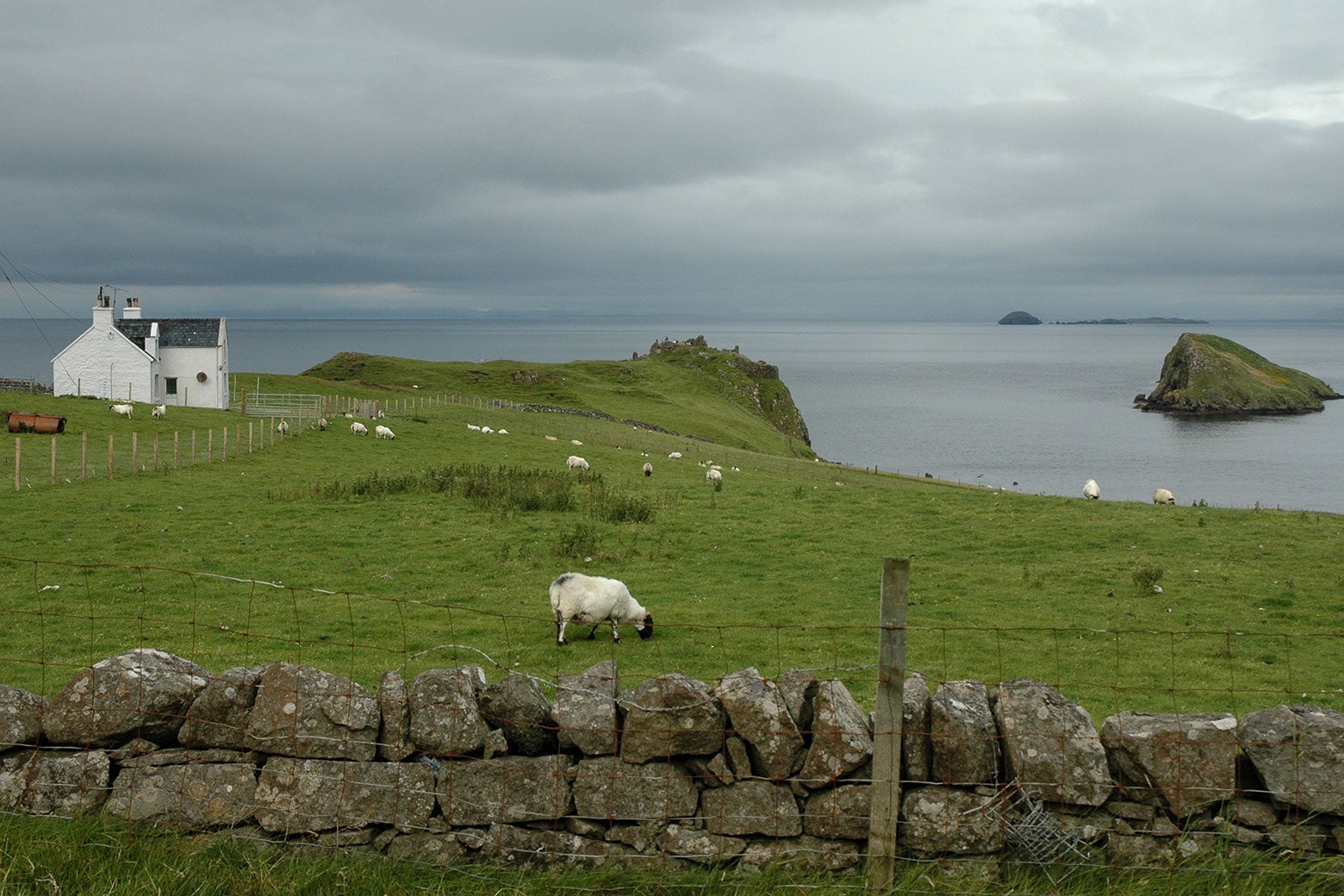
Politics A Decade of Despair. A Month of Reprieve. After a tragedy, I took a month away from the horrors of our modern politics and our online dystopia. I came back with a new understanding of what’s being done to us. Getty Images Plus. Sign up for the Slatest to get the most insightful analysis, criticism, and advice out there, delivered to your inbox daily. “Hegseth is going to livestream an execution by firing squad.” I received this message while gazing out at the Atlantic Ocean parked atop a cliff in the emptiness of Northwest Scotland; the first message from the outside world I’d received in 23 days. I’d chosen a place to stay with no phone reception or internet, which meant that on the rare occasion I needed to do something like alter travel arrangements or learn how to tie a spinnerbait, I needed to drive to somewhere—somewhere like this cliff, where that message awaited me like an emotional roadside IED. I never stood a chance. Here’s the thing about spending a month off-grid and overseas: Your body forgets how it feels to exist in America every day. Here, you are having more conversations with sheep (mostly about getting off the road) than people; you have recently discovered that your allegedly waterproof hiking boots are rotting from the inside; you have learned how to gut a trout and reliably build a fire. You are more relaxed than you have ever been, and you have forgotten the way nearly every news story of the last decade grabs hold of your heart and squeezes, twists, strangles. That constant, low-level dread. If you are reading this, you are someone who reads the news, and if you are someone reading the news, that hand is throttling your heart right now. On some level, you know this, but you are likely so used to it that you do not really know how hard it’s squeezing, and how much it saps your strength. This is not an article about how everyone should spend a month off-grid in the most beautiful place they’ve ever been. Six months ago, my wildest dreams consisted entirely of paying off my credit card debt and eating beef once in a while; I am very familiar with the seething rage such articles provoke. They functionally shift blame onto the individual for failing to thrive in a society that makes thriving almost impossible. Are you stressed all the time? Wallowing, unproductive, depressed? Maybe you should do some self-care. Have you considered taking care of yourself, you slovenly fuck? Step up, take responsibility, spend a month getting lost in the silence and beauty of nowhere. If you really cared about yourself, you’d find a way to make it happen. Less avocado toast, maybe. If I ever write that article, please shoot me on sight. No jury would convict you. I come bearing the opposite message. There are reasons why so many people are struggling right now—reasons that cannot fully be avoided or mitigated. So many of our bad habits are survival mechanisms, ways to make it through one more day. Better to eat candy than starve to death. And while it’s good to replace that metaphorical candy with something healthier, we cannot flog ourselves into not needing something sweet to survive the bitter world we live in.After getting the message about Hegseth’s ghoulish plan, I closed Signal, made my travel arrangements with shaking hands, and pulled back onto the road with my heart jackhammering in my chest. It did not matter whether or not Pete Hegseth would follow through on his sadism—the administration was once again laying groundwork for future cruelty. I suspected the administration would back down—as indeed it did. But six months from now, they’ll float the possibility again. And this time it won’t be new, and it won’t be unthinkable. And we are always, always thinking. Not only do we carry the horrors of the universe in our pockets, we spend most of our waking hours gazing into that abyss in the name of staying informed. We’ve come to see it as an end in itself: like, share, retweet. It works very well for the people who own the platforms. You are always about to make a difference, which means you can never log off—not when a West-Wing-style rhetorical victory over the forces of darkness feels so close. Meanwhile, those forces perpetrate fresh atrocities that require fresh awareness, and so the cycle never stops: action and reaction, forever. “We create our own reality. And while you’re studying that reality — judiciously, as you will — we’ll act again,” an unnamed advisor told journalist Ron Suskind in 2004. “We’re history’s actors … and you, all of you, will be left to just study what we do.” I went to Scotland to try to break that cycle, for no one is more guilty of ouroboros behavior than the Very Online political journalist. I have started to feel like a sports commentator for the apocalypse—not all the time, but way too much. I pretend my chronic social media use is “for work,” and to some extent that’s true. It’s also an excuse to avoid work. Why write an entire article when I can dash off a quick thread and gain hundreds of likes? And then there’s the Skinner-box effect of the Internet generally, in which we keep pressing the button to generate irregular rewards, be it something truly hilarious or that adrenaline shot to the heart that comes with a terrible take or the horror of the day. I needed a detox, and I was lucky enough to be able to take one. So I packed my things and went somewhere I hadn’t been for decades: a place where the internet wasn’t. For the first week I spent in Scotland, I slept ten hours a night. The number slowly dropped, then settled out at eight. I was well-rested for the first time in my adult life, and I felt physically good to be alive in ways I had not thought possible. It is difficult to adequately convey the difference between experiencing 16 wakeful hours per day and white-knuckling your way through a brutal 20. Suddenly, I had energy for things that actually make me happy: reading, hiking, creative writing. Replacing my anesthetizing habits took no discipline at all. The best minds of our generation—or at least, the most sociopathic ones—are spending all their time creating vicious, carefully-crafted cycles to keep you activated and staring at as many screens as possible from the moment you wake up to the instant you fall asleep, and maximizing time between the two. You wake up worried about the world—what fresh horrors have transpired overnight? You reach for your phone and doomscroll, which makes you more anxious, which makes you doomscroll, and shit, you’re late for work: no time to hit the gym, even though you swore you would. You stumble through your work in a daze and finish your day exhausted: too tired to do anything fun but not too tired to doomscroll or watch short-form videos or chase the methamphetamine high of some terrible take online. Helplessness melts into righteous rage as you type some scathing retort, as loneliness gives way to the metallic taste of parasocial satisfaction as the likes and reposts flood in. Oh shit, it’s 2:00 AM. Whatever. You’ll hit the gym tomorrow, you tell yourself, knowing it’s a lie. By you, I mean me. And maybe you. Certainly most of the people I know. Five days after I received the message about Pete Heseth, I returned to civilization to find that very little had changed in my absence. Our trajectory remained unaltered, we’d simply continued to travel in that direction. Trump had reluctantly reversed course on Hegseth’s snuff film, but he continues to threaten election integrity in all the ways one might expect. A failed press secretary provided great amusement for a week or so. The brave people of Ukraine continued to endure murderous barrages of Russian drones while Elon Musk sabotaged their ability to fight back and Trump agreed to buy diesel from his old friend Putin. Unspeakable horrors in Gaza continue. All of these things are horrific. Not a single one is surprising. I am not hopelessly behind after 28 days away; things are either exactly the same or worse. I am returning to a world carefully crafted to drive me insane, but armed with knowledge I lacked when I left. There is a difference between burying your head in the sand and periodically reminding ourselves that the world can be beautiful and good. We have somehow become convinced that turning away even for a second is a betrayal of the most vulnerable amongst us, but constant activation paralyzes us with dread and leaves us too exhausted to take action. Hyperawareness is not a virtue, it’s a symptom of mental illness—ask your Complex Post Traumatic Stress Disorder friends about it sometime. We are not betraying the cause by turning off our phones for a few hours; we are not lazy pieces of shit who deserve to be poor when we opt for sleep over pseudoproductivity. Not everyone can fuck off to Scotland for a month because they’re “very sad” and “spent the last four months watching a loved one die horribly of cancer,” but everyone can take an awareness break once in a while. If a tree falls in a forest and you miss a post about it, it still makes a sound. It will still be on the ground in a few hours, or even a few days. You could not have stopped it falling by watching it on livestream, and you are not betraying your fellow humans by taking care of yourself instead of tree-watching 24/7. All of this is easier said than done. So many things are working against us: the obscene cruelty of our broken political system, a tech ecosystem that profits off making us perpetually aware of that cruelty, an omnipresent self-help industry that tells us that our resulting dysfunction stems from a weakness of will. Less than two weeks back in the country I am already sleep-deprived and stressed to the gills. But I have two rest days planned for next week, and I’m not upset at myself for falling into the old ways once in a while. The day I learned about Hegseth’s live-streamed execution fantasy, I’d planned to go to Durness, a lovely seaside town with charming historical caves and a gorgeous peninsula hike. Instead, I found myself driving down a bumpy single-track dirt road to Shegra, a tiny village that consists of perhaps ten crofter’s huts, a cemetery, and (according to my guidebook) a trailhead that leads to a beach known for shipwrecks and ghosts. Dark clouds roiled above the empty moor. I felt dark and empty too. As so often happens in Scotland, the alleged trail immediately vanished into a vast stretch of bog with no obvious way forward. Two ravens circled overhead, then flew Northwest, and on a whim I followed them. An hour later, I found myself on a sheer cliff face overlooking the roiling Atlantic, which I followed until I came across a promontory fenced off with an ancient stone wall, behind which a herd of sheep peacefully grazed. How long ago was this ancient stone erected? Whose sheep are these? Scotland offers very few answers, but the questions tend to be wonderful. I never did find that beach, but I wandered those ancient cliffs for hours, which were mountains as tall as the Himalayas until time and glaciers carved them down, forests until the Brits took the timber for their navy, farmland until the aristocracy expelled the crofters by force and replaced them with sheep. A few thousand years from now, it will be something else. With its rocky soil and lack of mineral wealth, it is currently the most powerful thing you can be in today’s climate: unexploitable. Scotland is nothing like heaven, but exactly like Valhalla. By the time I made it back to my car, I felt ready to fight again.
After a Tragedy, I Spent a Month Away From Our Online Dystopia. It Changed Me.
Full Article
Original Source
Read the full article at Slate →KhanList aggregates and links to publicly available news content. We do not host full articles from third-party sources. Always verify important information with original sources.