
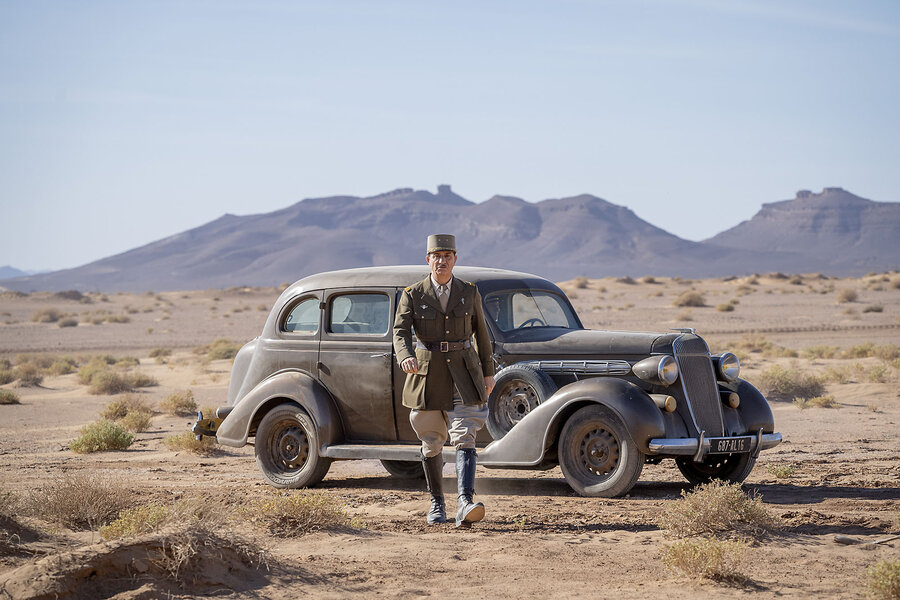
In the opening of “De Gaulle: Résistance,” it’s June 1940 and France is in the throes of World War II.The country’s Vichy government has agreed to end all fighting with Germany, in exchange for its collaboration with Adolf Hitler’s Nazi regime. Anger among a young French resistance is bubbling over.Amid it all, Charles de Gaulle’s lone cry rises above the fray: ”The French need a voice that tells them to fight!” For much of the early part of the film, de Gaulle – then a young French army officer – is alone in his battle for a united, free France. But he never gives up on his vision. And if the success of Antonin Baudry’s two-part wartime biopic is any indication, today’s French are looking for an equally inspiring political hero.Despite the 2-hour, 40-minute run time of each part of the biopic – which landed U.S. distribution last week and are set to be released in November or December – the films have become France’s unexpected summer hits. After getting off to a rocky start, “De Gaulle” has sold more than 5 million tickets here. While critics initially attributed the films’ success to people’s desire for air conditioning during consecutive heat waves, the biopic’s staying power into September suggests it has tapped into something larger.That something might be what French politicians on the right, left, and further afield regularly reprise during election years: that it’s cool to be a Gaullist. “De Gaulle united the people, didn’t discriminate, and believed in the power of the state,” says Frédéric Fogacci, a historian at the Charles de Gaulle Foundation in Paris. “His legacy will most certainly show up during presidential campaigning.”An icon, both moral and politicalIn addition to resisting Nazi Germany, de Gaulle sought to rally the French together at a time when the country was split between the collaborationist Vichy government and the French Resistance movement.In 1940, during the Battle of Dakar, de Gaulle – accepting defeat – told his Free French troops to retreat from escalating attacks by Vichy French fighters, famously saying he would not continue to “shed the blood of Frenchmen for Frenchmen.” While de Gaulle asked a lot of the French people, he was always consistent in what he said, says Dr. Fogacci. AP/FilePresident Charles de Gaulle salutes standing troops at Orly Airport near Paris, Aug. 25, 1966, before leaving for a trip around the world. De Gaulle was president from 1959 to 1969. Those are qualities that observers say are missing from today’s political class. Only 22% of respondents in recent French polls say that they trust their politicians.“Politicians constantly change their ideas based on what they think will be popular with the public,” says Anna Marie, outside a Paris cinema following a “De Gaulle” screening.“De Gaulle showed resilience, he was a great orator, and he never let go of his ideals,” says Mehdi Briand, another Parisian moviegoer. “It’s good to be reminded of what happened in our history, especially since some people are trying to change the story.”That starts with de Gaulle himself. Though Mr. Baudry’s films invite viewers to see de Gaulle in a positive light – a man who was usually right, even when throwing out what appeared to be cockamamie battle plans – he was not always well-liked by the French public. De Gaulle saw his approval ratings ebb and flow throughout his time as wartime general and then later as French president, before his eventual resignation in 1969. That hasn’t stopped presidential candidates such as center-right Edouard Philippe and far-left Jean-Luc Mélenchon from trying to channel de Gaulle’s feisty but unwavering spirit. Even far-right National Rally candidate Marine Le Pen, who is leading in opinion polls in the run-up to next year’s presidential election, has praised de Gaulle’s resilience and grandeur. In 2020, Ms. Le Pen said that National Rally, or RN, was the only party that embodied de Gaulle’s political spirit.However, the party – originally known as the National Front – was founded by Ms. Le Pen’s father, Jean-Marie Le Pen, alongside supporters of the war-era Secret Army Organization, which tried to assassinate de Gaulle numerous times in the early 1960s.“The RN is using a charm offensive to make people forget where their party came from,” says Gilles Ivaldi, an expert on the far right at Sciences Po’s Centre for Political Research.“In need of moral authority”But Dr. Ivaldi contends they’re doing so because opinion polls show that the French are nostalgic for de Gaulle. “The French need to believe in a new type of politics,” he says. Deepen your worldviewwith Monitor Highlights.Politics with respectGet political stories with respectful analysis.There‘s a world of new ideas in everyBooks newsletter.There‘s more to life, enrich yours withCulture & Learning weekly.Follow humanity‘s discoveries withScience & Nature stories in your inbox.Gain a spiritual perspectivefrom the stories in your inbox.Want to understand the deeper impact of critical events? Learn the Monitor‘s insight.Already a subscriber? Log in to hide ads. That new type of politics is, ironically, rooted in the old. And even though de Gaulle was a divisive leader at times, when he says in the film, “The French are in need of a moral authority,” viewers understand immediately that he is talking about himself.While it might currently be cool to be a Gaullist, embodying de Gaulle’s spirit is another matter. Whether France’s presidential candidates have what it takes to do so will be up to voters to decide. ALREADY A SUBSCRIBER? LoginReal news can be honest, hopeful, credible, constructive.The Christian Science Monitor was founded in 1908 to lift the standard of journalism and uplift humanity. We aim to “speak the truth in love.” Our goal is not to tell you what to think, but to give you the essential knowledge and understanding to come to your own intelligent conclusions. Join us in this mission by subscribing.
After a biopic’s success, the French ask: Where’s our modern de Gaulle?
Full Article
Original Source
Read the full article at Csmonitor →KhanList aggregates and links to publicly available news content. We do not host full articles from third-party sources. Always verify important information with original sources.