
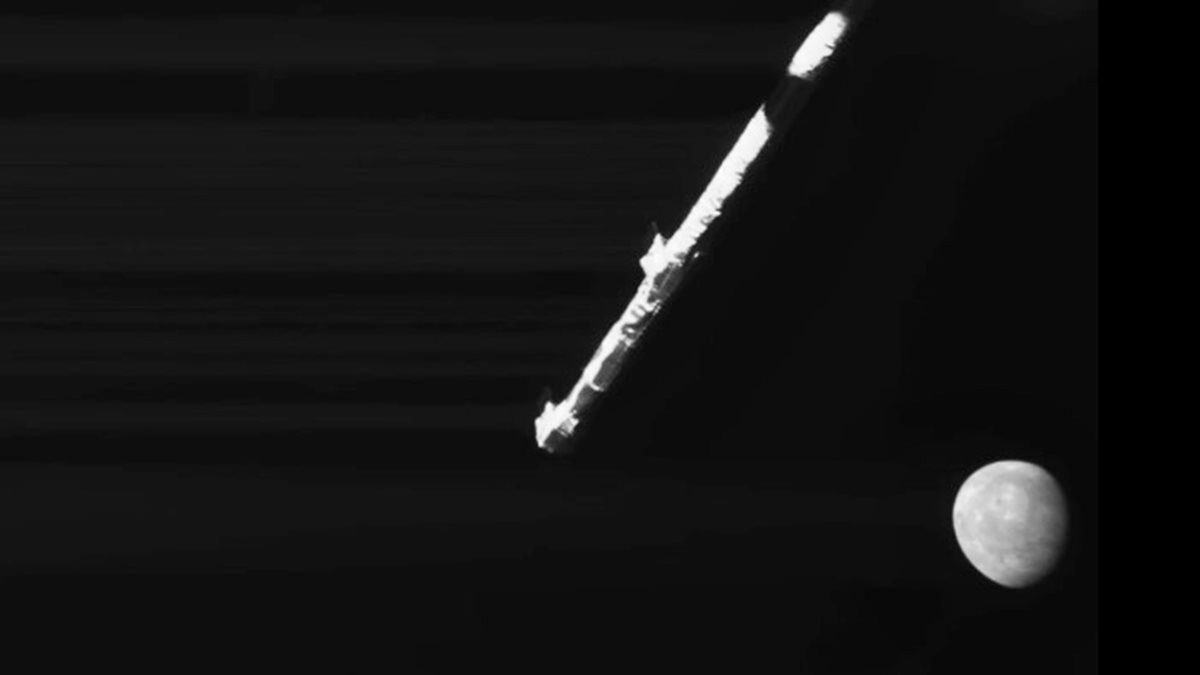
BepiColombo is entering the final phase of its long journey to Mercury. Here's why reaching the planet was so difficult and what the two spacecrafts will study.Mercury captured by the BepiColombo spacecraft. (Photo: Jaxa)After a eight-year journey through the inner Solar System, two spacecraft are finally closing in on Mercury, the smallest and least-explored planet among the Solar System's four rocky worlds.The European Space Agency's (ESA) and Japan Aerospace Exploration Agency's (JAXA) BepiColombo mission, which was launched on October 20, 2018, has travelled billions of kilometres around the Sun, using the gravity of Earth, Venus and Mercury itself to gradually change its path.Now, the mission has entered its final arrival phase.Mercury Transfer Module separation confirmed!After nearly eight years in space and billions of kilometres travelled, #BepiColombo's Mercury Transfer Module has successfully separated.Signal acquired via our Cebreros deep-space antenna confirms the spacecraft is healthy pic.twitter.com/es5v8DqpAT— European Space Agency (@esa) September 3, 2026Earlier this week, on September 3, the Mercury Transfer Module that powered the journey separated from the two science spacecraft. The next major milestone comes on November 21, when the two spacecraft are scheduled to enter orbit around Mercury together.A LONG JOURNEY TO MERCURYMercury may be the closest planet to the Sun, but reaching it is surprisingly difficult. (Source: ESA) A spacecraft travelling from Earth has to lose a huge amount of speed to fall towards the Sun and enter orbit around Mercury.BepiColombo therefore took a carefully planned route, making nine planetary flybys; one of Earth, two of Venus and six of Mercury. It did so while using solar-electric propulsion to gradually shape its journey.The mission consists of two scientific orbiters travelling together; ESA's Mercury Planetary Orbiter (MPO) and JAXA's Mercury Magnetospheric Orbiter (Mio).Mercury in motion... One of the #BepiColombo selfie-cameras captured Mercury today as the spacecraft rushed by the planet at almost 3 km per second.This time-lapse of unprocessed images was captured during 10:26-11:18 UTC today (11:26-12:18 CET), between 53700 and 48000 km pic.twitter.com/NPlnLCBOr3— BepiColombo (@BepiColombo) December 1, 2024TWO SPACECRAFTS, TWO MISSIONSOnce at Mercury, the pair will separate and study different aspects of the planet.MPO will focus on Mercury's surface, interior and composition, while Mio will investigate its magnetic environment and how it interacts with the solar wind.Together, they will examine the planet's surface, thin atmosphere, magnetic field and huge iron-rich interior.Scientists are particularly interested in Mercury's polar craters, where some permanently shadowed areas contain deposits believed to be water ice.BepiColombo will provide a much more detailed look at these regions than earlier missions could. An image of Mercury captured by BepiColombo in 2025. (Photo: ESA) The mission is also expected to investigate mysterious surface features called “hollows”, understand why Mercury has a magnetic field and determine how the planet formed so close to the Sun.The two spacecraft are scheduled to separate in December 2026, with MPO reaching its final orbit by March 2027.Routine science operations are expected to begin in April 2027.In other words, BepiColombo's real scientific journey will finally begin after eight years of commute.- EndsPublished On: Sep 5, 2026 11:43 IST
After 8 years, two spacecraft are about to reach Mercury. What's next?
Full Article
Original Source
Read the full article at Indiatoday →KhanList aggregates and links to publicly available news content. We do not host full articles from third-party sources. Always verify important information with original sources.