
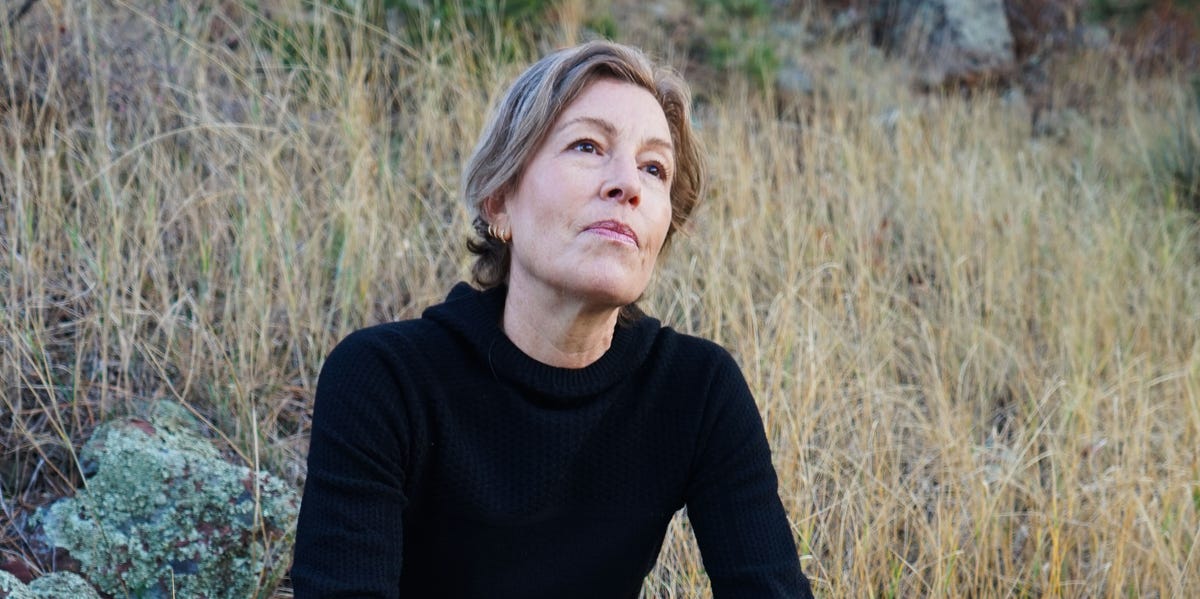
Courtesy Dagny Scott“Some runs are shouts, and some runs are whispers,” I wrote a few decades back in Runner’s World Complete Book of Women’s Running, an attempt to capture the many moods—the many functions—that running served in my life. I scrolled past the phrase recently on social media: Somebody had designed it with colors and typography and posted it, apparently finding resonance in the sentiment.I chuckled a little upon seeing it. If I wrote that today, I’d add something else: “Some runs are walks.”This new reality that came with illness and settled in for the long haul wasn’t easy to accept. I’ve been running on and off for more than 50 years, some 85 percent of my life. I jogged along with my older brother when I was a girl, competed in high school as a teen, trained for a sub-3 marathon as a working professional in my 30s, plodded with a baby jogger in my 40s. Now, past 60, running has shape-shifted again. The transformation is different this time, the lessons deeper and, frankly, a little harder to grasp. But after a period of struggle, I’ve made peace with it. Because as usual, if you dare to listen, running will speak to you.Most of us who run spend years or even decades seeking to improve, from a 5K to 10K, from breaking 4 hours in a marathon to then trying for 3:45. For a long time, wherever you are, improvement is possible, and change generally trends in one direction. Not every run, of course. The body has good days and challenging ones; that variability is a given, and progress is not a straight line. But we can expect a trajectory that provides a satisfactory feedback loop, one of betterment.Inevitably, aging will bend the line of progression into an arc. We can know that and still have trouble seeing it at first, because the heavy legs or knee catching feels like just another hard day. Nothing a little rest or cross-training can’t solve.If seeing it is difficult, accepting it can be even harder. The forward march has been the natural state of things for so long. The battle waged for incremental increases in mileage or decreases in time was never easy. Shouldn’t I be pushing past this? Isn’t it what runners do?Running taught me to be tough. For years, that served me even beyond the sport. In work, the tug of fatigue from long nights at the ad agency felt familiar and manageable as a long run. Giving birth called back the discipline of breathing through pain; the years of motherhood to come called in the lessons of patience, of quietly putting in the hours without immediate affirmation or result. I loved being a badass in the endurance sport of life. The ability to override tiredness felt powerful. I enjoyed telling myself I was fine when evidence pointed to the contrary. I relished pushing against edges and limits.Until the day I woke, swung my feet over the side of the bed to stand, and felt the world spin wildly out of control. The floor rushed up to my face, and I curled in a ball seeking safety and stillness. Confusion mingled with nausea. I could feel the whirling even with eyes closed. The fetal position proved fitting. I’d spend years relearning how to be in this new world, where vertigo could strike at any time.My first reaction was “I’ll fight!” Though for months that thought came while I was sprawled on the couch, unable to focus my eyes or lift my arms. A year of doctor visits, scans, and tests eventually ruled out physical problems and delivered a neurological diagnosis: vestibular migraine. As with other forms of migraine, the condition is underdiagnosed, women suffer more than men, and precious little is understood about what is actually happening in the brain to produce the symptoms. Some connection has been made to hormonal fluctuations, and, for some, a genetic link seems to exist; stress, I learned, is a reliable exacerbator of triggers.My own onset remains a mystery.The impulse to fight landed ineffectually in space against the judo of forced rest. Any struggle against this opponent would only feed it. Somewhere along the way, a new understanding dawned: Vertigo was my body saying, “Stop.”Tough got me here, but it wasn’t going to get me through this next chapter. The fighting stance I’d adopted so long ago was not going to serve me well with the changes happening now. Some things about the body are not in our control, despite our best efforts. With precious few alternatives, I did something I never had before: I paused, I listened to what my body was saying, and I opened to the possibility of unlearning some things that running and life had drilled into me so very long ago. This time the lesson wasn’t about pushing through. It’s also not a sob story about slowing down. It is about acceptance.Now, three years since my first vertigo attack, something akin to gratitude has set in. The softening and adapting are treasured new tools. Essential new tools. Because the fact is: you don’t “overcome” aging.Nowadays, when I’m feeling good enough to put on my shorts and running shoes, I might have an idea of what I’d like to do. But it’s just that, an idea. I start slowly, so as not to tweak a knee or an ankle. Eventually, my body will tell me what this day has in store. If I’m lightheaded and the sun feels too bright, triggering aural distortion, I walk and think, yes, it is a fine day for a walk. If I feel strong, I push to the degree I can and think, how wonderful, to feel good. Neither situation really surprises me anymore. None of it is bad. I feel lucky to be out here.The point is this: It is all like this now. And if I can’t accept that in my running, I’m going to be in for an exhausting battle with every other part of aging. Don’t mistake this for giving up. I am working harder to stay fit than I have in a very long time. Pushing the pace all those years? It came pretty easy. It felt damned good. What I’m doing now takes more effort: Spin classes that give my knees a break... and where 80-year-olds are dusting me. Full-body lifting that leaves every hidden muscle protesting. Yoga classes that make it clear balance has never been a prerequisite for anything before in my life. The objective now isn’t performance—it’s simply to age as well as possible.There is no fairness in this, no way that this “should” go. Aging comes differently for us all, as an entire generation who grew up during the first running boom is now learning. Our running will change in its own way, a reflection of everything we have done before, plus the ineffable element of luck.My son-in-law’s mother is one of those seemingly defying the years. Pushing 60, she’s also pushing into new territory with a string of 50K trail races. Her streak of runs is proudly documented on Strava, which cheerily alerts me every time she becomes the “Local Legend” of some new stretch.She’s excited, posting every day, a wide smile spread across her face. She exudes the joy of progress. I’m a bit envious, sure. I’m also glad for her. Both things can be true.I have other friends who do not run anymore. In one way or another, their bodies—joints that didn’t respond to surgery, chronic illness that has sapped their energy—have let them know those days are done. The ones doing the best move on, find new challenges.I’m approaching this new land.My joy comes from somewhere else now. It’s not so much the running per se; rather, everything around it. The feeling of autumn’s first cool air on my shoulders. The smell of spring’s thawing mud. The sheer pleasure of moving through space outdoors one more day. In fact, these things are more present than before, without the distraction of pace and goals.If my running taught me everything about how to persist, why wouldn’t it be the thing to teach me about how to let go? Our running is always “becoming.” Just as we are ourselves. We have an opportunity to learn from it, because the fact is that running isn’t the only thing that is changing.As with everything else, it might not be the lesson you want, but it’s always the lesson you need.Dagny Scott is the author of Runner’s World Complete Book of Women’s Running. She is currently working on a book that explores the beauty in finding authenticity and acceptance in an aging body. Scott lives, writes, runs, and walks in Boulder, Colorado.
After 50 Years of Running, I’m Facing My Toughest Challenge: Having to Let Go of the Runner I Used to Be
Full Article
Original Source
Read the full article at Runnersworld →KhanList aggregates and links to publicly available news content. We do not host full articles from third-party sources. Always verify important information with original sources.