
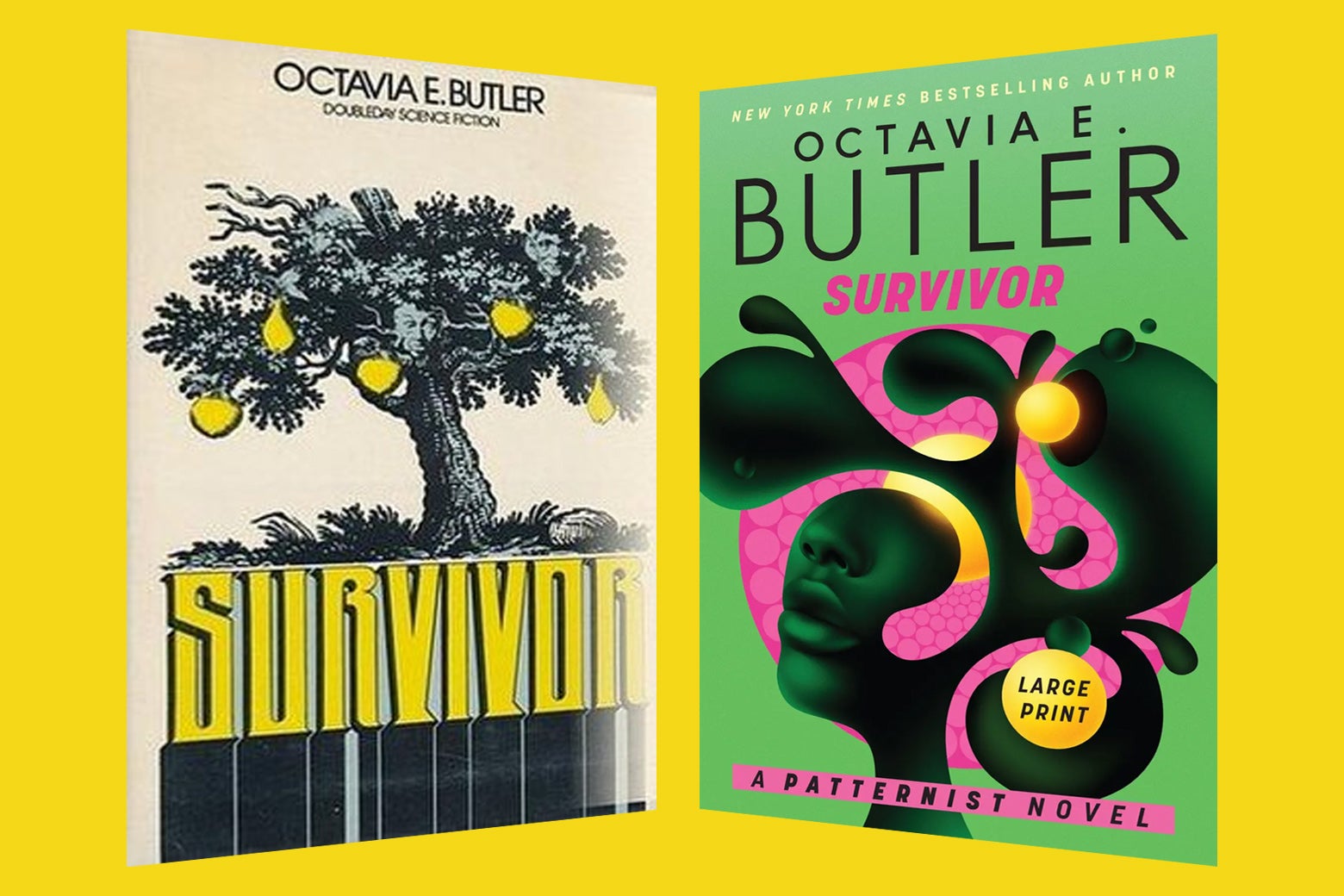
Books Octavia Butler Let Survivor Fall Out of Print More Than 40 Years Ago. Now It’s Finally Back. It was the beloved science-fiction writer’s least favorite of her books. But it remains worth reading. By Enter your email to receive alerts for this author. Sign in or create an account to better manage your email preferences. Unsubscribe from email alerts Are you sure you want to unsubscribe from email alerts for Rebecca Onion? Sept 06, 202610:00 AM Illustration by Slate Sign up for the Slatest to get the most insightful analysis, criticism, and advice out there, delivered to your inbox daily. While she was alive, beloved science-fiction author Octavia Butler let her third novel, Survivor, published in 1978, fall out of print within a few years of its release. The book is part of the five-novel Patternist series, Butler’s first, a wild ride of a story about the rise of a new race of psychics that spans from ancient Egypt far into the future, introducing the reader along the way to an immortal spirit obsessed with breeding humans, an astronaut who brings an alien plague to Earth, and Alanna, the heroine of Survivor. Sent with a group of missionaries who hope to establish humanity on a new planet, Alanna is taken captive by a group of aliens and ultimately becomes the mate of their leader. Unlike the inflexible missionaries, who fail to recognize their own powerlessness in this situation, Alanna adapts in order to survive. These themes will be familiar to anyone who has read and loved Butler’s Parable books, about the leader Lauren Olamina forming a community during a near-future collapse of the United States, or her Xenogenesis trilogy, in which aliens save humans from extinction and demand to merge species in return. But Butler found her own execution lacking and discouraged people from reading Survivor, calling it “a good story badly told.” Nevertheless, two decades after her death, Butler’s estate has decided to revive her long-lost book, and this week, the new edition of Survivor became available. At last, Butler completists can read the Patternist series straight through without needing to acquire a rare first edition for hundreds to thousands of dollars. Alyssa Collins, a scholar at California State University, Northridge who was the inaugural Octavia E. Butler Fellow at the Huntington Library from 2021 to 2022 and is working on a book called Cellular Blackness, about Butler’s scientific contemplation, wrote the introduction to the new edition. I was curious what a person so close to the author’s thinking could tell me about this republication, Butler’s dislike of the book, and why people who like Butler—or science fiction, or just novels!—should read Survivor. This conversation has been edited and condensed for clarity. Slate: I read that Octavia Butler dismissed Survivor as her “Star Trek” novel (despite being a fan of Star Trek!). What was her problem with the book? Did she dislike it while she was writing, or did she just not like the results? Alyssa Collins: Oh, yes, she struggled with Survivor as she was writing it, as well as after. When I was in her archives, it was interesting to see her as a still-young author, writing these really intense editorial notes and letters to herself about how the work was not as good as she wanted it to be … how it felt kind of pat, in a way that she did not want it to be. I found a couple of notes that she wrote to herself feeling really frustrated, even having taken on comments from really trusted teachers and her own editor, and still finding that perhaps maybe this wouldn’t be a novel that would get to where she would want it to be, even if she took their advice and tried to make it better herself. The Star Trek comment refers to the kind of science fiction where people can travel wherever and can interact with different planetary species and peoples, and sometimes those relationships are very easy and they’re sexually compatible. … After the book was published, Butler was frustrated she had sent these humans off onto a planet, and they meet with a species and can make babies immediately, and that seemed perhaps too easy and wrong. I always think about her saying that, because in her next series, the Xenogenesis trilogy, we see that there’s a highly mitigated sexual act that has a lot of moving parts and needs a third entity. She’s like, I’m not going to make that mistake again. … This time, I thought about the evolutionary issues here. Yeah. Whereas in Survivor, it’s just Alanna disliking kissing her alien lover because he doesn’t have any lips! And then they easily have a baby. I was laughing at the part of your introduction where you mentioned that the sex scene was something that Survivor’s editor flagged, saying that it would make the book hard to sell. And you wrote something like, Well, compared to what people read in contemporary romantasy, it might not seem like much. And after I read the novel, I was like, yeah, if you’ve experienced Ice Planet Barbarians, the sex in Survivor is nothing! Yes! Being a Butler scholar, and being a millennial and having been on Tumblr, and reading a lot of what’s in the archives where she talks about the stress of being a writer and being misunderstood, I was like, Man, you would have done numbers on Tumblr. In the Tumblr golden age, she would have had people to talk to who were also thinking about weird alien monster sex and how that works. It would have been so different for her. And I think about that a lot, even if she had lived just a bit longer. What kind of science fiction was she reacting against when she dismissed her own work? It’s complicated, because these were her peers. This was the genre she was writing in. But Butler’s narrative about herself, even as a young writer, was always this way. Early, she saw [the movie] Devil Girl From Mars and was like, I could do something better. So that kind of feeling, that drive of being a young creator, a young artist who’s like, Actually, I see this genre that I like and respect, but I could do it better, my perspective could do it better, I could make a better story out of this, seemed to be her narrative for herself as a writer from the beginning. Her big motivational notes to herself from her diaries and commonplace books have circulated on the internet a lot, and in them we see her saying, I’m going to be the best writer, I’m going to be an award-winning writer, all of this stuff to hype herself up. We could understand it both as her own kind of self-making and an argument for her own self-making as a writer, but we could also think about her relationship to being a writer as … well, no one can recognize her as a young Black woman, or even as an older Black woman, as a writer of science fiction, let alone a writer at all. … I think a lot of what we see in how she narrativizes her own work as an author is kind of like, If I’m going to do this, I’m going to do it really well and be the best. With Survivor, that sort of ran up against a need to make money, to publish and be part of a larger industry apparatus. … Writing the introduction, I was thinking about what it means to be a younger writer, having only two novels to your name, not having the best, most solid, most aggressive representation that you could, and having a back-and-forth with editors at Doubleday about the content of your work being perhaps too weird or raunchy or titillating. And about what happens when you’re also trying to develop a novel after you get notes, or have a really long back-and-forth about your previous work, then you’re writing this other novel at the same time. Butler talks about wanting to make the planet of Fulfillment, in Survivor, feel more real. And I think that also connects to her worrying about this being her Star Trek novel, where you go to a planet and it’s partially real, or it’s imagined only through a human’s eye or an Earthling’s eye and not made real by the people who live there or have a history, and it being kind of interchangeable with other places. Survivor By Octavia E. Butler. Grand Central Publishing. Slate receives a commission when you purchase items using the links on this page. Thank you for your support. With all of this said, why should people read Survivor? I’m glad I did! Lots of people like to think about Butler as a California writer. Her work is really grounded in where she’s from, what she’s experienced, her life in Pasadena, her experiences in Victorville with her grandma. But in Survivor, which is the first totally off-world novel she wrote, you can see the very planetary arguments about who humans are, what our hierarchies are, what we expect and imagine as human. Butler has always placed Black women at the center of that conversation, when we have very strong historical examples of Black women being excluded from those conversations. … Survivor is about what happens if we try to be human somewhere else, and what happens to that kind of patriarchal humanity that is so ingrained in the missionaries, and what they want to have happen as they watch humanity change on the planet, and how they’re trying to save these scraps of what a Christian patriarchal humanity could be, but are thwarted by aliens. And what Alanna, as a protagonist, chooses to do with that, to both save her people and also think through the logistics of being on this planet that aren’t as exclusionary. Yes, and to eventually break with her adopted father, who turns out to be unable to handle it. Exactly. While I definitely agree with Butler that maybe the novel isn’t as good as it could be or as good as the novels that she writes later, I love seeing the seeds of her later thought in this novel. … A lot of her frustration over not getting Survivor to where she wanted it to be is because her brain was already ticking over to something different, and that something different was Wild Seed (1980) and Kindred (1979). … She needed to submit Survivor, and she also was excited to move on to other things. That’s really real as a writer, when the material conditions of what’s happening—you trying to make a living, you trying to get this book done, people asking you for things—come up against what you have time to produce. I think that’s what’s so amazing about Butler, because she’s both writing these stories that are completely diverting and offering us these moments of interrogation of the human, whether those be off planet or on planet. … These are ideas that she had for so long. By reincorporating Survivor into this long line, I think, it offers people a lot to think about, even as we sit with the discomfort of reading a book that Butler didn’t particularly like and let fall out of print. But I think it’s also really useful to have this book right now, as we are living in a time when governments are deciding who to actively dehumanize and remove their rights from all the time. And so a more explicit approach, like hers in Survivor, where we see this conversation about who’s human, how we’re supposed to be protecting humans, and then a woman who is perhaps stuck in the middle and trying to navigate that and chooses something different, can be a very useful tool for understanding these longer Enlightenment arguments about who is human. Books Science Fiction
After 40 Years, a Long-Lost Book by One of Our Most Beloved Authors Is Finally Back in Print—and Worth Reading
Full Article
Original Source
Read the full article at Slate →KhanList aggregates and links to publicly available news content. We do not host full articles from third-party sources. Always verify important information with original sources.