
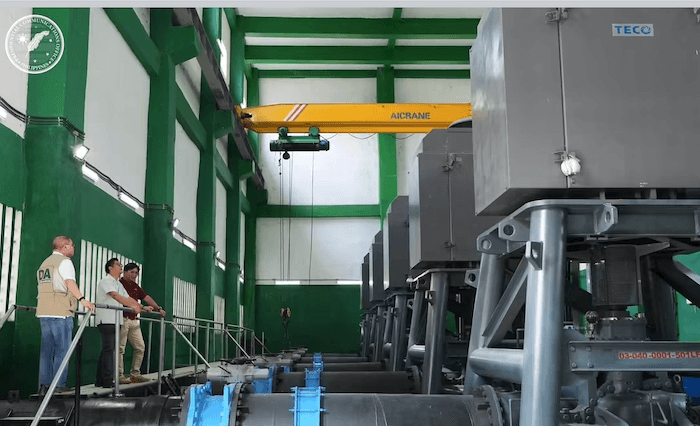
ALPIS. President Ferdinand Marcos Jr. inspects the pump house and control rooms of the Alfonso Lista Pump Irrigation System (ALPIS), which draws water from the Magat Reservoir and irrigates 2,300 hectares of farmland across four barangays in Alfonso Lista, Ifugao, on October 26, 2026. Presidential Communications Office The project was originally scheduled for completion in 2017, but limited annual funding releases, among other factors, pushed construction years beyond that target, a source tells Rappler The ₱1.49-billion Alfonso Lista Pump Irrigation System was inaugurated by President Ferdinand Marcos Jr. after over 14 years of construction, aimed at providing a reliable water supply to 1,315 farmers in Ifugao. The irrigation system will expand coverage from 275 hectares to 2,300 hectares, potentially increasing rice production from 900 metric tons to 26,000 metric tons and farmers' earnings from ₱16 million to ₱159 million. The project is operational and will help farmers mitigate the impacts of prolonged dry spells, especially with the anticipated El Niño conditions, while local officials seek further government support for additional agricultural infrastructure. This is AI-generated. Read the article for full context. Report any errors. BAGUIO CITY, Philippines – A ₱1.49-billion irrigation project that took more than 14 years to complete was inaugurated by President Ferdinand Marcos Jr. in Alfonso Lista, Ifugao, on Monday, October 26, promising a more reliable water supply to 1,315 farmers who have long depended on rainfall for their crops. The Alfonso Lista Pump Irrigation System (ALPIS), which draws water from the Magat Reservoir, is designed to irrigate 2,300 hectares of farmland across four barangays. According to National Irrigation Administration (NIA) records, construction began on May 22, 2012, and was completed on October 7, 2026. The project was originally scheduled for completion in 2017, but limited annual funding releases pushed construction years beyond that target, according to a NIA source familiar with its implementation. The source said the project also encountered damage from several typhoons, right-of-way problems, delays involving the transportation of explosives needed for tunnel construction, and a lengthy process of securing approval for its electrical connection. Construction-material prices increased during the extended implementation period. Pending clearance from the National Commission on Indigenous Peoples (NCIP) also prompted an agreement to suspend construction activities in 2019. The source, however, said the higher material costs and NCIP-related suspension had minimal or no effect on the overall delay. More water, bigger harvests Marcos said the completed facility would expand irrigation coverage from 275 hectares to 2,300 hectares and could increase palay production from 900 metric tons to 26,000 metric tons once fully utilized. He also projected farmers’ earnings to increase from ₱16 million to ₱159 million, although the period covered by these estimates and whether they represent gross or net income were not specified. “Alam po naman natin na ang pinakamahalaga sa pagsasaka ay ang patubig. Malaki ang pagbabago kapag ang non-irrigated areas ay magawan na ng paraan na mapatubigan,” Marcos said. (We all know that the most important element in farming is irrigation. There will be big changes if we find a way to irrigate non-irrigated areas.) The irrigation system will serve Sto. Domingo, Namnama, Namillangan, and Calupaan, farming communities in eastern Ifugao near the boundary with Isabela. Its facilities include five pumping units, an electrical substation, a water intake facility, a transbasin tunnel, nearly 32 kilometers of main and lateral canals, and more than 14 kilometers of access and service roads. NIA said the system is operational and will remain under the agency’s operation and maintenance. Rodolfo Manglallan, president of the Sto. Domingo Irrigators’ Association, said farmers previously relied on rainfall, leaving their rice fields vulnerable to prolonged dry spells. “Of course, magbabago yung ating sistema ng pagsasaka at nawawala yung pangamba namin na yung palayan namin ay matuyuan,” he told the Presidential News Desk. (Of course, our farming system will change and our fear that our rice farms will dry up is disappearing.) Preparing for El Niño The inauguration comes as the government prepares for potentially severe El Niño conditions that could bring prolonged dry spells and threaten agricultural production. NIA Administrator Eduardo Guillen said reliable irrigation would give farmers better opportunities to increase their harvests and improve their livelihoods. He urged beneficiaries to conserve water and help maintain the new facilities, particularly as the government prepares for possible water shortages. Guillen also noted that the inauguration came a day before the 44th anniversary of the inauguration of Magat Dam on October 27, 1982, during the administration of former President Ferdinand Marcos Sr. More than four decades later, the reservoir continues to support agriculture, with the Alfonso Lista project extending its irrigation benefits to additional farming communities. The severity and duration of the anticipated El Niño remain subject to continuing climate monitoring. Ifugao seeks more projects Ifugao Governor Jerry Dalipog welcomed the inauguration but also used the President’s visit to seek additional national government assistance. He requested improvements to farm-to-market roads to help farmers transport their produce and improve access to schools, healthcare facilities, and markets. Dalipog also sought support for completing the Ifugao Sports Complex and proposed a commemorative garden honoring Marcos Sr. in Lamut, Ifugao. No funding commitments for these proposals were specified in the governor’s prepared remarks. Marcos, meanwhile, unveiled the irrigation project’s marker, inspected its control rooms and pump house, and viewed agricultural produce displayed by farmer-beneficiaries. NIA records show that as of September 30, Ifugao had developed 19,997 hectares, or 77.42% of its estimated irrigable land, leaving another 5,833 hectares for irrigation development. The newly completed system is expected to help farmers cultivate previously rain-dependent fields more consistently and potentially increase their cropping cycles. After more than 14 years of construction, its projected benefits will now depend on reliable water delivery, regular maintenance, and the harvests of the 1,315 farmers it was built to serve. – Rappler.com How does this make you feel? Loading
After 14 years, P1.49-billion Ifugao irrigation project finally opens
Full Article
Original Source
Read the full article at Rappler →KhanList aggregates and links to publicly available news content. We do not host full articles from third-party sources. Always verify important information with original sources.