
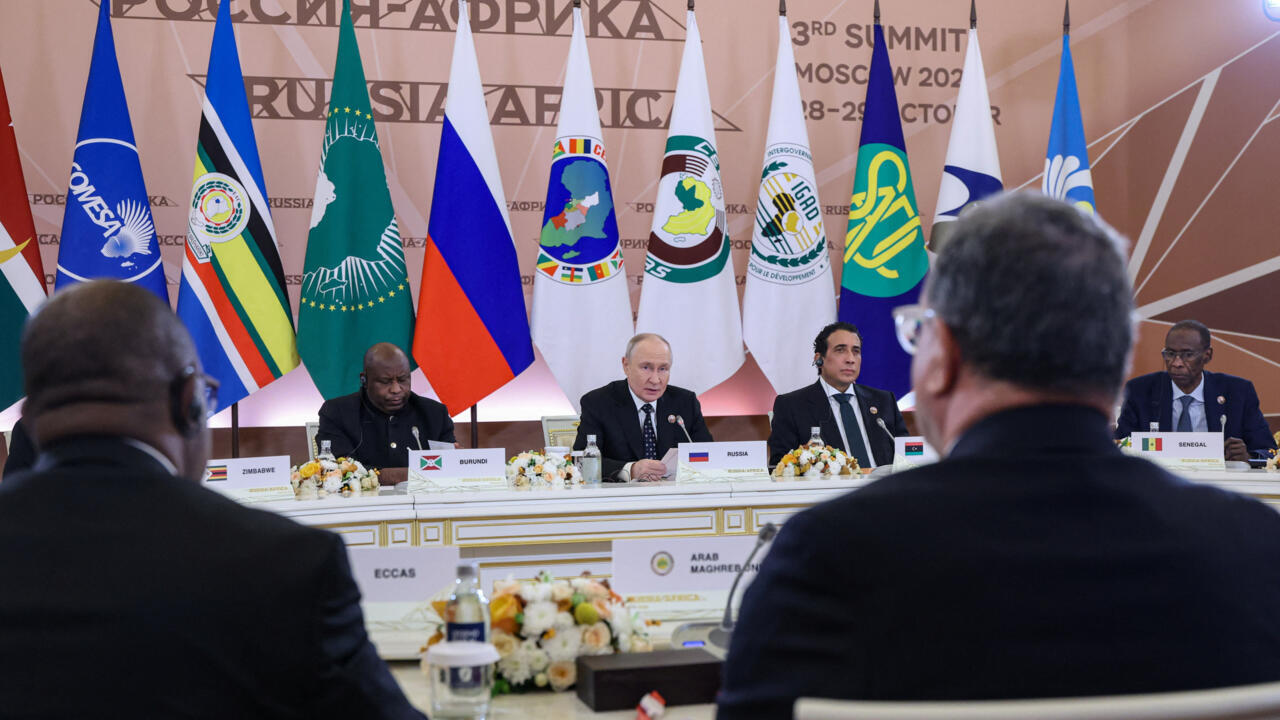
The third Russia-Africa Summit took place in Moscow this week, with 48 African nations sending delegations. It comes as Moscow grapples with sanctions and isolation over its Ukraine offensive, while African governments turn to it for security assistance. However, geopolitical analyst Priyal Singh tells RFI that despite this, Russia still lags behind China in its influence on the continent. Addressing African leaders in Moscow, Russia's President Vladimir Putin described a partnership with Russia as an alternative to traditional allies – who he referred to as a "narrow bloc of states" which determine "the destinies of entire continents". This narrative of breaking away from old allies or former colonial powers is one that has also been deployed by China. However, Chinese trade with African countries dwarfs Russia's – at $348 billion recorded in 2025 compared to $27 billion. Priyal Singh, a geopolitical analyst at risk advisory firm Signal Risk and senior research consultant at the Institute for Security Studies in South Africa, told RFI why the two powers cannot be compared in terms of their relationships with African countries, and how Africa leverages these for its own gain. Russia-Africa summit tests Moscow's ambitions for broader influence RFI: Do China and Russia have rival interests in Africa? Priyal Singh: China and Russia structurally are two very different international actors and represent two very different types of partners for most African countries. China, of course, has incredibly deep pockets. It has an incredibly extensive network of commercial engagements with many African states that go back many years. Whereas the story of Russia is quite different because following the fall of the Soviet Union, Russia largely retreated from the African continent to focus on its more immediate pressing political, security and strategic interests closer to home. And during much of that period, a whole set of other global actors and global powers kind of stepped into that void and made considerable headway. Russia then pivoted back towards the African continent. It began in earnest in the late 2000s amongst a handful of African countries, but we saw a much more acute and targeted engagement with African countries in very recent years, particularly in the wake of its 2022 invasion of Ukraine. I think Moscow looks towards the African continent as a critical theatre for it to reestablish its presence and to deepen its engagements, as a concerted effort to circumvent Western isolation and Western sanctions. But materially, Russia is still very, very much playing catch-up to the likes of China. I mean, let alone the likes of China – other global powers like India, for example, you'd often find have far more substantial and deeper commercial engagements across the African continent. Vladimir Putin pictured with African leaders at the third Russia-Africa Summit in Moscow on 29 October. © Reuters/Anastasia Barashkova And one clear distinction I'd make is that Russia's game plan for strategic influence and engagements across the African continent is quite distinct in different parts of the continent. In the Sahel region, Russia plays a far more overt security role, working with those governments in the Sahel, providing arms, military support, technical training and, of course, the role and influence of its state-backed private security providers are also very pronounced in those regions. In Southern Africa, however, Russia maintains far more longstanding liberation-era ties to many of the ruling parties in this part of the world, and its engagements are far less security-orientated. It's far more commercially orientated. Nevertheless, those engagements lag far behind the likes of China. RFI: So Russia and China are not in competition, trying to carve up Africa between them? PS: Not at all. I don't think there is that kind of overt competition between China and Russia in Africa. I think the competition is much more centred around Russian competition with Western actors, particularly the European Union, individual European member states, and, of course, the United States. But China, I would not see as being a major competitor for Russia, for it to try and displace and win influence across the African continent. RFI: Russia uses language where it seems to be seeking to identify with the Global South. But the African leaders at this summit are not naive. What do they seek to gain from Russia? PS: African leaders are not naive. For most African leaders, it's very clear that Russia is very much a major world power that has a seat at the United Nations Security Council, just like China does, and they are not a developing nation. So, what do African countries want from Russia? Well, African countries want investment. They want partnerships that will spur on their own industrialisation. And most African countries will take that investment and will take that partnership from whoever is making the best offer. So whether it's coming from the United States or it's coming from Europe or China or Russia or India or Brazil, African countries are open to that kind of partnership. And an additional factor is that all of these competing offers to help African countries develop their local industries, to diversify their critical mineral supply chains and so on, all ultimately work in favour of African countries because they can play one offer against the other. Leaked files reveal Russia's blueprint to expand African Sahel alliance RFI: Is Russia succeeding in extending its influence beyond the Sahel region, where it is firmly established? PS: You're correct in saying that the real centre of Russia's security influence across the continent is centred in the Sahel region. I think Russia has found it quite difficult to expand beyond this hard security focus through arms sales, through technical cooperation. But we have seen Russia attempt to branch out, especially in the provision of nuclear energy and infrastructure through Rosatom, a state nuclear energy corporation. And we've seen a lot of commitments around energy development. But a lot of these remain largely framed as broad commitments. We haven't seen these commitments translate into firm agreements that have taken off on the ground. So there's still a large implementation gap in terms of what Russia can do outside of its security focus in the Sahel. Russian President Vladimir Putin during the plenary session of the third Russia-Africa summit, an event first held in 2019. © AP/Ivan Sekretarev RFI: Russia has been weakened by the Ukraine war. On the economic front, does it have the means to invest significantly in Africa? PS: Russia often is able to extract greater dividends from a relatively more meagre investment, be it diplomatic investments or economic investments. And this is because Russia has pursued a very kind of targeted strategy to gain access and influence, particularly in the Sahel, particularly across West Africa and into Central Africa and into East Africa and the Horn of Africa. Those kinds of very targeted engagements in which Russia doesn't necessarily play by the same playbook as most Western actors have allowed it to basically gain access and influence with a much smaller cheque book. And it doesn't necessarily need to make the massive multi-million or multi-billion dollar infrastructural investments that its larger peers are able to do in Africa. RFI: In that context, what appeal does Russia have for African nations? PS: Maybe not looking towards African nations as a whole but political elites within a very select handful of certain African countries, Russia can bring those political elites into the fold. It can put very attractive offers on the table, providing security cooperation in exchange for access to critical minerals, to energy and so on. And this is something that not many Western actors are able to do because Western actors have to abide by their own normative commitments. So Russia is able to provide an alternative avenue for political elites in Africa to engage with. Madagascar marks one year since uprising as Russia’s influence grows RFI: Can Russia's relations with some African states be summarised as military support in exchange for access to natural resources? PS: Absolutely. I think a defining feature of Russia's security engagements – with most Sahel countries, with most West African and Central African countries – is largely transactional in nature. It's tit-for-tat security deals that allow African countries to barter influence and access to their critical minerals, their gold, their energy resources in exchange for regime security and support. RFI: And with little regard for human rights? PS: Absolutely. RFI: This is the third Russia-Africa summit, held this year in Moscow. What is different this time round? PS: During the time of the first summit [in 2019] much of the Western world still believed that its efforts to diplomatically isolate Moscow could work, and that African states would largely lend their support to Western actors in cutting off ties from Russia. I think where we are in 2026, it's a very different story. That hope that many Western actors had has clearly proven [unfounded]. African countries are willing to work with all actors from all corners of the world – be it China, Russia, Gulf actors, Turkey, India and so on – so long as they are able to get the best possible deal, and then leverage all of these competing offers against one another. African states really have no qualms about choosing one partner to displace another, so long as it is more attractive and it leads to perhaps more expeditious outcomes on the ground. So, I think that has been the fundamental change. And the second fundamental change has, of course, been the United States and the second Trump administration, which has taken a very different approach in engaging with Russia. And again, that kind of isolation that Western Europe was perhaps hoping for is no longer seen as a very viable option in light of the fact that you have Washington and you have most of the global South not playing by the same playbook.
'African leaders are not naive, they will partner with whoever makes the best offer’
Full Article
Original Source
Read the full article at Rfi →KhanList aggregates and links to publicly available news content. We do not host full articles from third-party sources. Always verify important information with original sources.